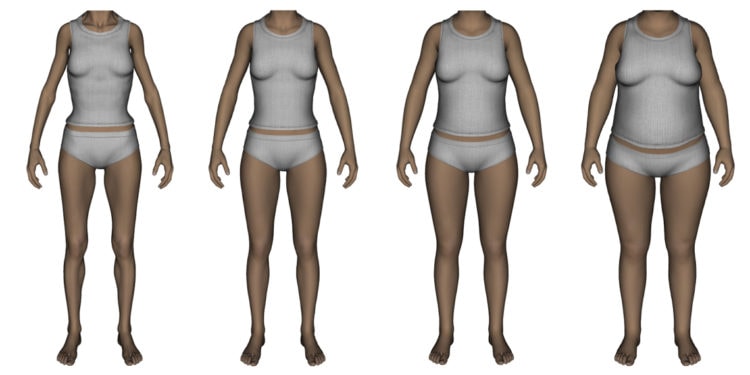
New research provides evidence that an overrepresentation of thin bodies in the social environment can produce dramatic changes in what is considered a normal body weight among women. The findings, published in Psychological Science, indicate that a psychological phenomenon known as “prevalence-induced concept change” occurs in the domain of body judgments.
“I have been interested in the effects of context, and specifically the prevalence of events, on human judgement for some time now,” said Sean Devine, a PhD student at McGill University and the corresponding author of the new study.
“I had been looking into prevalence-induced concept change as a psychological phenomenon and was impressed with the generality of it; for instance, David Levari’s work has shown that the prevalence of a concept can influence our judgements about not only low-level stimuli, like colour, but also higher-order decisions, like those about what is ethically right.”
“The parallels between the experimental work being done and the real-world influence of media on our judgement was not lost on me,” Devine explained. “Media imagery has shaped how women have judged their own and others’ bodies for decades and has promoted an ideal of thinness that has strongly informed modern Western beauty standards.”
“What is interesting, however, is that the media seems to do this without hitting audiences over the head—it’s not like TV shows come out and say ‘thin is good, be thin,’ as though we were living in John Carpenter’s ‘They Live.’ Instead, thin bodies are repeatedly featured and emphasized, and through this process, thinness comes to be defined as the norm, and, in turn, larger bodies as the exception.”
“In this study, my coauthors and I wanted to explore how this process occurs, and whether the mere prevalence of thin bodies in the environment could so drastically influence judgements as basic and important as that of body size,” Devine said.
For their study, Devine and his colleagues used Concordia University’s participant pool and the research platform Prolific to recruit a sample of 419 women who were between 18 and 28 years old.
The participants were shown hundreds of computer-generated female body images, one by one, and were asked to judge whether each body was overweight or not. The participants were randomly assigned to one of two conditions. In the experimental condition, the prevalence of thin bodies shown to the participants steadily increased over time. In the control condition, the prevalence of thin bodies remained consistent.
The researchers found that women in the experimental condition became more likely over time to judge average-sized bodies as overweight compared to women in the control condition. In other words, the overrepresentation of thin bodies appeared to shift women’s perception of what is normal.
“To exemplify the consequences of prevalence-induced concept change in body judgments, consider a body with a BMI of 23.35 (well within the normal range of BMI for an adult woman),” the researchers wrote in their study. “At the beginning of the experiment, few participants in either condition (increasing prevalence or stable prevalence) judged this body to be overweight… By the end of the experiment, however, a quarter (25%) of participants who saw the prevalence of thin bodies in the environment increase (those in the increasing-prevalence condition) judged this same body to be overweight.”
“In an environment in which images of thin women are repeatedly presented, what comes to count as a ‘normal’ body shifts to one that is in reality much thinner than most would judge if the environment were truly representative of average body sizes,” Devine told PsyPost. “In my view, there are two key takeaways from this finding, one theoretical and the other practical.”
“Theoretically-speaking, it is fascinating how such a basic cognitive mechanism as that of prevalence-induced adaptations in judgements can account for high-level social decisions, like body image judgements. The results from this paper therefore support an emerging body of literature highlighting the highly contextual nature of human judgement and decision-making.”
“More practically, these findings speak to the pervasive effect thin-centric media can play on our beliefs and judgements,” Devine said. “To curtail the thin ideal in Western media, it may not be enough to reduce the explicit endorsement of thinness; it also requires an increase in representation.”
Previous research on prevalence-induced concept change has indicated that it can influence a variety of perceptual judgments. For example, one experiment showed similar results using dots. When the prevalence of blue dots was reduced, people began to classify dots as “blue” that they had previously classified as “purple.”
But, “like any study, readers should interpret the generality of the results with caution,” Devine noted. “Though a growing body of literature seems to suggest that prevalence-induced concept change influences our judgements in a wide array of domains, these studies remain laboratory-based experiments, that require rapid, successive, decisions to be made in a short timeframe.”
“In reality, and especially in the case of body image judgements, shifts in the prevalence of a given concept occurs slowly and gradually and decisions are high stakes. Moving forward, we hope continue to test this hypothesis more stringently, employing more realistic timing in our experiment, varying our stimuli sets, and examining the computational mechanisms underpinning these decisions for hints about how it might occur in real-world decision-making.”
But could the effect run in the opposite direction? Could repeated exposure to overweight bodies result in prevalence-induced concept changes? Theoretically yes, Devine said, although the researchers did not specifically test this.
“During the review process for this article, a reviewer raised an interesting question: ‘How can we square these results with the obesity crisis in the West?'” Devine explained. “In the paper, we touched on this a bit.”
“To be sure, the following interpretation is highly speculative at this point, but it is fascinating to note how social movements advocating for greater body positivity and fat acceptance in the West have seemed to coincide with a shift the distribution of people’s weights towards the heavier side. Mirroring the experimental design in our paper, the West has been getting larger and, in turn, previous beliefs about what kinds of bodies should look ‘average’ are being overturned and updated as women are exposed to an increased number of heavier set bodies.”
“Of course, whether prevalence-induced concept change is the mechanism explaining this broad social change is a big inferential leap, and, importantly, body image is a complex multifaceted topic,” Devine said. “Nevertheless, it is interesting to speculate on how, at least anecdotally, these real-world shift in social categories are precisely of the kind we would predict according to our theory.”
The study, “Changes in the Prevalence of Thin Bodies Bias Young Women’s Judgments About Body Size“, was authored by Sean Devine, Nathalie Germain, Stefan Ehrlich, and Ben Eppinger.