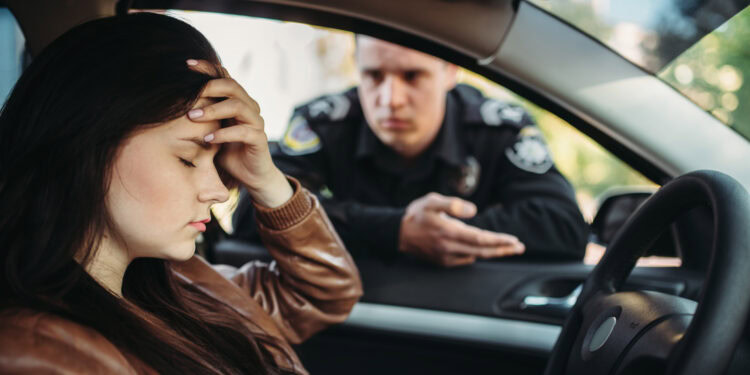
How people judge a traffic stop may reflect not only how the officer behaves, but also the personality traits they bring to the interaction. A new experiment published in the Journal of Experimental Criminology suggests that people higher in vulnerable narcissism tend to view police stops less favorably even when an officer is courteous and fair, whereas those higher in grandiose narcissism respond more positively when shown respect or spared a ticket. The findings indicate that everyday psychological differences are linked to how people evaluate police encounters, although overtly rude policing drew strongly negative reactions across the board.
Nearly 50 million people in the United States aged 16 or older had contact with the police in 2022. Traffic stops are the most common type of encounter that police initiate. Research in criminology consistently indicates that these encounters go more smoothly when officers practice procedural justice, an approach to policing centered on fair decision-making and respectful interpersonal treatment. In practice, procedural justice involves four behaviors: giving citizens a voice to tell their side of the story, explaining decisions neutrally and transparently, treating people politely and with dignity, and showing genuine concern for the public.
Fair policing tends to encourage cooperation, satisfaction, and views of officers as legitimate authorities, and one proposed reason is that respectful treatment signals that a person is a valued member of society. Even so, an officer’s objective conduct does not always match how a citizen perceives a stop. In a 2021 field study of Dutch moped stops, researchers who observed officers on the street and interviewed drivers immediately afterward found no evidence that fairer officer behavior led drivers to rate the encounter as fairer.
One reason people interpret similar stops differently is that citizens do not enter police interactions as blank slates. For example, a 2022 vignette experiment with Muslim participants in Australia found that individuals who felt their community was stigmatized by police gained less trust from polite, fair conduct than those who felt less stigmatized. Broad personality traits may matter as well. An earlier study examining dark personality traits found that higher overall narcissism and more past police contacts were associated with more negative general attitudes toward police, whereas psychopathy and Machiavellianism were not.
Don’t miss the next big psychology finding
Every morning, PsyPost sends a short briefing on the most interesting new peer-reviewed research in psychology and neuroscience.
In psychology, narcissism is not confined to narcissistic personality disorder, a formal clinical diagnosis. It also exists as an everyday personality trait that varies across the general population, reflecting how people maintain a positive self-image and seek validation from others. Psychologists divide this trait into two primary forms, grandiose narcissism and vulnerable narcissism, which can coexist within the same person.
Grandiose narcissism is marked by assertiveness, overconfidence, feelings of superiority, and entitlement, with individuals looking for social feedback that confirms their high status. Vulnerable narcissism involves fragile self-esteem, anxiety, shame, and shyness, making people uncomfortable with direct attention, sensitive to potential criticism, and inclined to withdraw when they cannot present themselves favorably.
Because police stops involve authority, status cues, and public scrutiny, lead study author Tal Jonathan-Zamir, an associate professor at the Institute of Criminology in the Faculty of Law at The Hebrew University of Jerusalem, and her colleagues tested how grandiose and vulnerable narcissism relate to citizen evaluations across different styles of officer behavior. Although respectful policing might appeal to both traits’ sensitivity to status and validation, the authors noted that the unwanted attention and implied criticism of being pulled over could also alienate people higher in vulnerable narcissism even when an officer behaves politely.
“I have been investigating the procedural justice model as it applies to policing for decades, from various perspectives,” Jonathan-Zamir told PsyPost. “In a casual conversation with my husband, who is a therapist, the notion of narcissism came up, and when he explained the motivation behind it and the sensitivity to social feedback, especially to cues related to validation, status, and self-worth associated with narcissism, the similarity to common explanations in the literature for ‘why procedural justice works’ hit me. That’s when the very intuitive hypothesis that procedural justice may be more effective with individuals who score high on narcissism came to my mind.”
In November 2025, the researchers recruited a stratified sample of 2,000 English-speaking U.S. adults through the online platform Prolific, matching the adult population in age, sex, and ethnicity. After removing incomplete or low-quality responses, the final sample included 1,904 participants, who first wrote brief descriptions of a positive and a negative police interaction to encourage personal engagement with the topic.
Participants were then randomly assigned to read one of five written traffic-stop scenarios, with 367 to 404 people per group. Reviewed for realism by a retired senior police officer, every scenario asked participants to imagine being pulled over one evening for a burnt-out taillight while driving to pick up a friend, with bystanders observing the stop and the waiting friend texting because the driver was running late.
The five scenarios varied the officer’s demeanor and whether the driver received a ticket. In the full procedural justice condition, the officer greeted the driver politely, explained the reason for the stop, offered to show what needed fixing, listened attentively to the driver’s view, and issued a ticket, whereas a partial procedural justice condition included only the polite greeting and expressions of concern before issuing a ticket.
A business-like condition served as a neutral baseline in which the officer spoke in a strictly formal, matter-of-fact manner, neither polite nor rude, and issued a ticket. A favorable-outcome condition used that identical matter-of-fact script except the driver was let go without a ticket, and a procedural injustice condition depicted an officer who interrupted the driver, called the stop a waste of time, dismissed the driver’s explanation, muttered a biased remark, and issued a ticket.
After passing a comprehension check, participants rated 12 statements from 1 to 5 covering officer legitimacy, satisfaction with the stop, and willingness to obey and cooperate, which were averaged into a single encounter-outcome score. Participants also completed the 28-item Brief Pathological Narcissism Inventory, which, despite its name, has been validated for measuring narcissism as an everyday trait in the general population. On its 0-to-5 scale, sample averages were a modest 2.15 for grandiose narcissism and 1.58 for vulnerable narcissism.
Officer demeanor was the strongest predictor of how people evaluated the stop, accounting for 58 percent of the variation in outcome ratings on its own. The three relatively positive scenarios produced nearly identical favorable scores ranging from 4.18 to 4.23 on the 5-point scale, and the differences among full procedural justice, partial procedural justice, and escaping a ticket were not statistically significant. The neutral business-like stop averaged a lower 3.74, and the overtly rude stop dropped to 2.02, reflecting widespread disapproval across participants in that group.
Next, the researchers examined whether narcissism predicted stop evaluations after accounting for demographics, prior police contacts, and having close friends or relatives in policing. Together, grandiose and vulnerable narcissism explained an additional 1 percentage point of variation in ratings and worked in opposite directions.
Higher vulnerable narcissism was consistently associated with worse evaluations across four scenarios: full procedural justice, partial procedural justice, receiving no ticket, and neutral business-like conduct. Across those four stops, each one-point increase in vulnerable narcissism was associated with ratings about a fifth of a point lower on the 5-point scale. In the overtly rude stop, that association was not statistically significant.
Grandiose narcissism showed a contrasting pattern across the scenarios. Within each of the three favorable conditions, whether the officer practiced full procedural justice, showed polite manners alone, or waived the ticket, higher grandiose narcissism was associated with modestly more positive evaluations of the encounter. In both the neutral business-like stop and the overtly rude stop, that association was not statistically significant.
Formal tests of whether the grandiose narcissism link was stronger in the favorable scenarios than in the neutral stop were not statistically significant either. As a result, the study did not find firm evidence for the original idea that respectful treatment works better on people higher in narcissism.
To explain these opposing patterns, the authors point to how each trait manages self-worth in social interactions. They suggest that individuals higher in grandiose narcissism respond warmly when an officer provides cues of respect, status, or special leniency that affirm an inflated self-image. For people higher in vulnerable narcissism, the researchers propose, being stopped in front of bystanders and being unable to simply leave the interaction may feel uncomfortable even when an officer is polite. Overtly rude policing, in their view, provoked such widespread disapproval that it left little room for personality differences.
“I was not surprised by the effect of grandiose narcissism, but I was surprised that high scores on vulnerable narcissism are associated with negative encounter outcomes across all but the procedural injustice condition (in which responses show very little variance),” Jonathan-Zamir explained. “Going back to the literature, this made sense — vulnerable narcissism is associated with avoidance, withdrawal from social interactions, low tolerance for attention from others, and readiness for criticism and failure. It thus makes sense that enforcement encounters are particularly uncomfortable for individuals scoring high on vulnerable narcissism, even if the officer uses procedural justice or does not issue a ticket. But this is something we had not initially expected.”
Jonathan-Zamir sees the results as part of a broader pattern. “Our findings reinforce the idea that citizens are not ‘tabula rasa’ when entering an encounter with the police,” she noted. “Citizens bring with them things like prior attitudes toward the police, felt stigmatization, support for the Black Lives Matter movement, and more. Now we know that their personality characteristics also play a role.”
In practical terms, the authors point out that police cannot and should not try to gauge citizens’ personalities during a stop, and officers cannot always let drivers off without a ticket. In addition, the team suggests that because citizen ratings may reflect personal psychology alongside officer conduct, agencies evaluating street encounters should, where possible, combine public surveys with independent observations or camera footage.
“In police-citizen encounters, it is very easy to put all of the responsibility on the officer — they are the ones holding the power,” Jonathan-Zamir said. “Without detracting from the very serious responsibility police officers have in police-citizen encounters, we have to remember that the way individuals perceive and respond to police officers does not only depend on what the officer does. We bring a lot into the situation; among others, our personality characteristics, and specifically grandiose and vulnerable narcissism.”
“For the same reason, police officers should not interpret unfavorable responses from citizens as evidence that procedural justice ‘doesn’t work,'” she added. “Our findings reinforce the importance of procedural justice as a general standard of police conduct.”
There are a few things to keep in mind when interpreting these findings. Because personality was measured rather than assigned, the links between narcissism and ratings are correlational. Vulnerable narcissism also overlaps with anxiety and negative mood, which the study did not separate out, so the pattern may partly reflect broader negative emotionality.
In addition, participants read and imagined a written story about a minor equipment violation rather than experiencing an actual roadside stop with flashing lights, emotional tension, and financial costs. Self-rated intentions on an online survey do not always match how people behave face-to-face with an authority figure, and personality traits accounted for a very small share of reactions compared with how the officer behaved.
Because this experiment tested a single traffic scenario among U.S. online panelists, future research will need to examine whether similar patterns hold in higher-stakes encounters or other countries. The authors suggest incorporating validated personality measures into surveys of citizens after real-world police stops and linking those surveys to body-worn camera recordings. They also suggest testing whether communication techniques that minimize feelings of public exposure help ease encounters for people sensitive to criticism.
“I find the police-citizen encounter a particularly fascinating setting,” Jonathan-Zamir reflected. “The big question in my mind is ‘what makes for a “successful” police-citizen encounter?’ Addressing this question involves taking multiple perspectives and asking, for example, what police officers and citizens define as a ‘successful encounter’ and what impacts variation in definitions; after deciding what ‘success’ would mean in a particular encounter, what impacts officers’ choices about how to achieve it; and following the officer’s action — what impacts the extent to which it would be effective for the citizen. Here the present study comes in — now we know that the citizen’s scores on grandiose and vulnerable narcissism have an effect.”
The study, “Personality traits, police demeanor, and encounter outcomes: the roles of grandiose and vulnerable narcissism,” was authored by Tal Jonathan-Zamir, Gali Perry, Naomi Kaplan-Damary, and James J. Willis.
