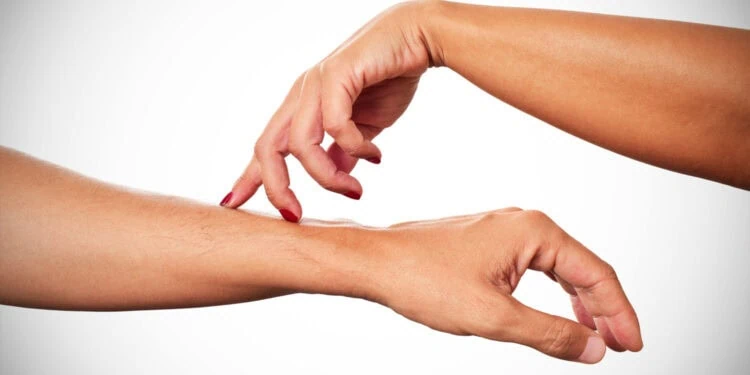

A new study published in the journal Autism Research has provided intriguing insights into how individuals with Autism Spectrum Disorder (ASD) experience touch. Researchers found that people with ASD have lower physiological responses to touch compared to typically developing individuals, but they report higher ratings for both pleasant and unpleasant touch sensations. This discrepancy highlights a complex relationship between subjective experience and physiological response in people with ASD.
Touch plays a crucial role in human communication and social interactions, helping to establish and maintain relationships even before verbal skills are developed. This form of communication is particularly important because it can convey emotional and social meanings, promoting attachment, social affiliation, and bonding. The pleasant effects of certain types of touch, known as affective touch, are typically associated with gentle, caress-like strokes that activate a specialized sensory system in the skin.
However, for individuals with ASD, sensory experiences can be markedly different. People with ASD often exhibit atypical sensory processing, which can significantly impact their social interactions and quality of life. Previous research has shown that these individuals might find certain types of touch unpleasant or overwhelming, contributing to their social challenges. The new study aimed to deepen our understanding of how affective touch is perceived and processed in adults with ASD, given the limited research available on this topic.
“Our lab’s interest lies in the neurobiology of complex social behaviors. The ultimate goal of our research is to provide novel basic neuroscientific insights to better inform the mechanisms underlying social dysfunctions,” said study author Olga Dal Monte, an associate professor of psychology at University of Turin.
“Affective touch plays a vital role in nurturing interpersonal relationships, conveying emotional and social meanings that can shape neurodevelopmental trajectories. Consequently, difficulties in processing tactile input or experiencing abnormal tactile sensitivity may impede social behaviors, significantly impacting individuals’ relational lives.”
“This challenge is particularly pronounced in ASD, characterized by both sensory disruptions and social impairments. Despite the central role of this phenomenon among ASD symptoms, there is a paucity of studies exploring the effects of this specific form of social exchange on behavior and the autonomic nervous system.”
The study involved 48 participants: 24 individuals with ASD and 24 typically developing controls. Participants with ASD were recruited from the Piedmont Adult Autism Center in Turin, Italy, and were diagnosed according to established criteria. The control group consisted of typically developing individuals matched in age and gender distribution.
Participants were seated comfortably with their left arm positioned on a table, hidden from view by a wooden panel. Each participant received a series of touch stimuli on the dorsal side of their left forearm. These stimuli included affective touch, which involved slow, gentle strokes, and a control touch, characterized by tapping. The experimenter delivered the touch stimuli and recorded the participants’ physiological responses using a device that measured skin conductance, a common indicator of autonomic nervous system activity.
After each touch, participants rated the touch on its affective (pleasant) and unpleasant components using a numerical scale. The experiment was designed to be flexible, allowing participants to pause if they felt fatigued or overwhelmed.
The researchers found that individuals with ASD exhibited lower overall skin conductance levels compared to typically developing participants, indicating a lower autonomic response.
While typically developing participants showed a higher physiological response to affective touch compared to control touch, this differentiation was not observed in the ASD group. In other words, people with ASD did not show a distinct autonomic response to affective touch versus control touch.
Despite the lack of physiological differentiation, individuals with ASD rated both the affective and unpleasant aspects of touch higher than typically developing participants. This suggests that they subjectively perceive touch more intensely on both positive and negative scales.
“Analyzing the complexity of ASD affective touch experience using both subjective and physiological measures allowed us to bring out possible divergences from the neurotypical population but also, and much more interestingly, to observe and highlight the discrepancies between the conscious experience of the subjects and the more implicit one that resides in bodily responses,” Dal Monte told PsyPost.
“A deeper understanding of the aspects that characterize individuals with autism in emotional situations is crucial for a greater comprehension of the distinctive challenges associated with this syndrome and may have implications for diagnosis and therapeutic approaches.”
The study’s limitations include a focus exclusively on adults with ASD who meet specific support criteria, limiting the generalizability to those with different levels of functioning; an unbalanced gender distribution skewed towards males; and a concentration on young adults, which may not represent the experiences of older individuals.
Future research could include a more diverse range of individuals on the autism spectrum, encompassing various levels of functioning and a balanced gender representation. Studies should also explore sensory processing in older adults with ASD to understand age-related changes. Incorporating additional physiological measures such as heart rate and pupil dilation could provide a more comprehensive understanding of autonomic responses.
The study, “Autonomic and hedonic response to affective touch in autism spectrum disorder,” was authored by Francesca Capiotto, Giulia Romano Cappi, Ilaria Mirlisenna, Alessandro Mazza, Giovanni Cicinelli, Chiara Lauritano, Roberto Keller, and Olga Dal Monte.