Subscribe
The latest psychology and neuroscience discoveries.
My Account
  • Mental Health
  • Social Psychology
  • Cognitive Science
  • Neuroscience
  • About
No Result
View All Result
PsyPost
PsyPost
No Result
View All Result
Home Exclusive Neuroimaging

Newborn neurons in adults may protect against cognitive decline

by Aswathy Ammothumkandy, Charles Liu, and Michael A. Bonaguidi
January 29, 2025
in Neuroimaging
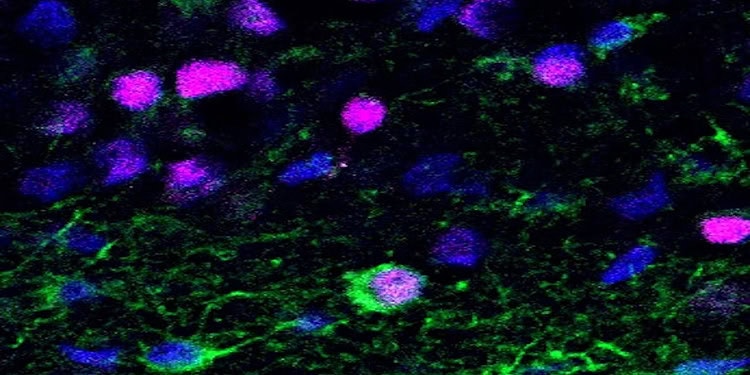
Newborn neuron (green and purple) in brain tissue from human epilepsy patients. (Aswathy Ammothumkandy/Bonaguidi Lab/USC Stem Cell)

Newborn neuron (green and purple) in brain tissue from human epilepsy patients. (Aswathy Ammothumkandy/Bonaguidi Lab/USC Stem Cell)

Share on TwitterShare on Facebook

Your brain can still make new neurons when you’re an adult. But how does the rare birth of these new neurons contribute to cognitive function?

Neurons are the cells that govern brain function, and you are born with most of the neurons you will ever have during your lifetime. While the brain undergoes most of its development during early life, specific regions of the brain continue to generate new neurons throughout adulthood, although at a much lower rate. Whether this process of neurogenesis actually happens in adults and what function it serves in the brain is still a subject of debate among scientists.

Past research has shown that people with epilepsy or Alzheimer’s disease and other dementias develop fewer neurons as adults than people without these conditions. However, whether the absence of new neurons contributes to the cognitive challenges patients with these neurological disorders face is unknown.

We are part of a team of stem cell researchers, neuroscientists, neurologists, neurosurgeons and neuropsychologists. Our newly published research reveals that the new neurons that form in adults’ brains are linked to how you learn from listening to other people.

New neurons and learning

Researchers know that new neurons contribute to memory and learning in mice. But in humans, the technical challenges of identifying and analyzing new neurons in adult brains, combined with their rarity, had led scientists to doubt their significance to brain function.

To uncover the relationship between neurogenesis in adults and cognitive function, we studied patients with drug-resistant epilepsy. These patients underwent cognitive assessments prior to and donated brain tissue during surgical procedures to treat their seizures. To see whether how many new neurons a patient had was associated with specific cognitive functions, we looked under the microscope for markers of neurogenesis.

We found that new neurons in the adult brain are linked to reduced cognitive decline – particularly in verbal learning, or learning by listening to others.

This was very surprising to us. In mice, new neurons are known for their role in helping them learn and navigate new spaces through visual exploration. However, we did not observe a similar connection between new neurons and spatial learning in people.

Google News Preferences Add PsyPost to your preferred sources

Improving cognition

Talking with others and remembering those conversations is an integral part of day-to-day life for many people. However, this crucial cognitive function declines with age, and the effects are more severe with neurological disorders. As aging populations grow, the burden of cognitive decline on health care systems worldwide will increase.

Our research suggests that the link between newborn neurons and verbal learning may be foundational to developing treatments to restore cognition in people. Enhancing new neuron generation could be a potential strategy to improve brain health and restore cognition in aging and in people with epilepsy or dementia. But for now, these ideas are just goals and any future treatments are a long way off.

Importantly, our finding that new neurons function differently in mice and in humans emphasizes the critical need to study biological functions like neurogenesis in people whenever possible. This will ensure that research conducted in animal models, such as mice, is relevant to people and can translate to the clinic.

Current drugs for epilepsy primarily aim to reduce seizures, with limited focus on addressing the cognitive decline patients experience. To enhance cognitive outcomes for patients, we started a clinical trial focusing on boosting new neuron production and cognition in epilepsy patients through aerobic exercise. We are currently in the early Phase 1 of the clinical trial, which seeks to establish the safety of the study. Thus far, two patients have successfully and safely finished the study. We plan to recruit eight more patients to exercise and complete this phase.

By bringing together basic science in the lab and clinical research in people, a better understanding of brain regeneration could help support brain health throughout the lifespan.The Conversation


This article is republished from The Conversation under a Creative Commons license. Read the original article.

Previous Post

Romantic breakups linked to lower hippocampal brain volume in adults with childhood trauma

Next Post

Do women really talk more than men? Scientists have a surprising answer in huge new replication study

RELATED

Live music causes brain waves to synchronize more strongly with rhythm than recorded music
Cognitive Science

Soft brain implants outperform rigid silicon in long-term safety study

April 18, 2026
Live music causes brain waves to synchronize more strongly with rhythm than recorded music
Neuroimaging

Can choking during sex cause brain damage? Emerging evidence points to hidden neurological risks

April 18, 2026
Live music causes brain waves to synchronize more strongly with rhythm than recorded music
Cognitive Science

Live music causes brain waves to synchronize more strongly with rhythm than recorded music

April 18, 2026
Deep sleep emerges as potential shield against Alzheimer’s memory decline
Alzheimer's Disease

Scientists find evidence some Alzheimer’s symptoms may begin outside the brain

April 17, 2026
Sorting Hat research: What does your Hogwarts house say about your psychological makeup?
Cognitive Science

Maturing brain pathways explain the sudden leap in children’s language skills

April 17, 2026
What we know about a person changes how our brain processes their face
Neuroimaging

More time spent on social media is linked to a thinner cerebral cortex in young adolescents

April 15, 2026
Breathwork shows promise in reducing stress, anxiety and depression, according to a new meta-analysis
Meditation

Advanced meditation techniques linked to younger brain age during sleep

April 13, 2026
Psychology researchers identify a “burnout to extremism” pipeline
Narcissism

Narcissistic traits are linked to a brain area governing emotional control

April 12, 2026

STAY CONNECTED

RSS Psychology of Selling

  • Why personalized ads sometimes backfire: A research review explains when tailoring messages works and when it doesn’t
  • The common advice to avoid high customer expectations may not be backed by evidence
  • Personality-matched persuasion works better, but mismatched messages can backfire
  • When happy customers and happy employees don’t add up: How investor signals have shifted in the social media age
  • Correcting fake news about brands does not backfire, five-study experiment finds

LATEST

Can a common parasite medication calm the brain’s stress circuitry during alcohol withdrawal?

Childhood trauma and attachment styles show nuanced links to alternative sexual preferences

New study reveals how political bias conditions the impact of conspiracy thinking

Cognition might emerge from embodied “grip” with the world rather than abstract mental processes

Men and women show different relative cognitive strengths across their lifespans

Early exposure to forever chemicals linked to altered brain genes and impulsive behavior in rats

Soft brain implants outperform rigid silicon in long-term safety study

Disclosing autism to AI chatbots prompts overly cautious, stereotypical advice

PsyPost is a psychology and neuroscience news website dedicated to reporting the latest research on human behavior, cognition, and society. (READ MORE...)

  • Mental Health
  • Neuroimaging
  • Personality Psychology
  • Social Psychology
  • Artificial Intelligence
  • Cognitive Science
  • Psychopharmacology
  • Contact us
  • Disclaimer
  • Privacy policy
  • Terms and conditions
  • Do not sell my personal information

(c) PsyPost Media Inc

Welcome Back!

Login to your account below

Forgotten Password?

Retrieve your password

Please enter your username or email address to reset your password.

Log In

Add New Playlist

Subscribe
  • My Account
  • Cognitive Science Research
  • Mental Health Research
  • Social Psychology Research
  • Drug Research
  • Relationship Research
  • About PsyPost
  • Contact
  • Privacy Policy

(c) PsyPost Media Inc