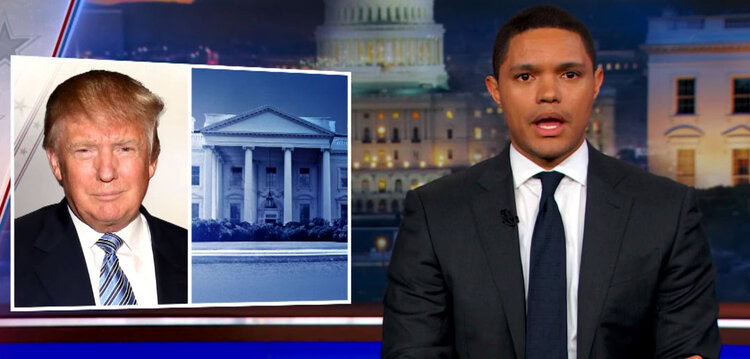

Satirical news programs, often dismissed as mere entertainment, have real political effects on the people who watch them, new research suggests.
A study found that people chose satirical news that matched their pre-existing attitudes — liberal or conservative – and that watching satirical news reinforced those attitudes as much as watching serious news.
The study found that people with little interest in politics were more likely to select satirical over serious news. In addition, watching satirical news affected feelings of political efficacy — people’s belief that they can influence political processes.
“Satirical news matters,” said Silvia Knobloch-Westerwick, author of the study and professor of communication at The Ohio State University.
“It is not just entertaining — it has a real-life impact on viewers.”
This research aimed to measure the impact of programs like The Daily Show, which use comedy and satire to examine political news of the day.
Knobloch-Westerwick conducted the study with Simon Lavis, a graduate student at Ohio State. The findings are published online in the Journal of Communication.
The study involved 146 college students who selected news clips to watch concerning climate change, gun control and immigration.
The participants were first presented with an overview page that had eight selections of news videos on just one of the three politically polarizing topics. Four of the clips were serious news clips that were said to be from MSNBC (liberal news) or Fox News (conservative news). Four were said to be from satirical news sources “The Spoof” (liberal) or “Mock the Week” (conservative).
But in fact, all the clips were from C-SPAN. For the serious news, there were two pairs of videos that were identical, with the only difference being the descriptions of the clips on the overview page, which gave a conservative or liberal slant to the available videos, and whether they were reportedly from Fox News or MSNBC.
The satirical sites also had two pairs of identical videos, but with different text crawls across the bottom of the screen with satirical commentary with a liberal or conservative slant.
After watching two videos on the first topic, participants had the opportunity to select videos on the other two topics.
Before and after watching the videos, the participants completed measures about their attitudes on the three target topics (climate change, gun control and immigration) and their feelings about their own ability to bring about political change. At the end of the session, they were also asked about their media consumption, attitudes toward news and political satire, general interest in politics and their partisan leanings.
Results showed that, in general, participants selected the serious news clips more often than the satirical ones. However, those who said they had lower interest in politics were more likely than others to choose the satirical clips.
“These results suggest that satirical news can engage people who otherwise would avoid political news,” said Knobloch-Westerwick, who is author of the book Choice and Preference in Media Use, (Routledge, 2015).
“This suggests that satirical news could be a gateway into more serious news use for people who aren’t currently engaged in politics.”
In general, participants selected clips that lined up with their political leanings: Republicans chose conservative clips, while Democrats chose liberal clips.
But there was a difference when it came specifically to the satirical news clips. Republicans tended to choose the conservative satirical clips, but Democratic-leaning participants didn’t have a preference for liberal videos from the satirical sites.
Knobloch-Westerwick said it may have to do with the novelty of conservative satire of the news.
“Democrats may have been curious just because they had rarely or never seen conservative satire before,” she said.
The results showed that regardless of whether they viewed the serious or the satirical news clips, participants’ political views were strengthened if they viewed videos that agreed with their original beliefs.
“Satirical news has the same impact as serious news — it reinforces your political attitudes,” she said. “It may be funny, but it has serious effects.”
Finally, the results showed that viewing satirical news had an effect on how much participants felt they could personally impact the political process – their political efficacy.
But, surprisingly, the results were different for Democrats and Republicans in the study. Liberal satire news increased the feelings of efficacy among Democratic viewers, while conservative satire undermined efficacy for Republicans.
More research is needed to understand this, Knobloch-Westerwick said. One possibility is that conservative viewers may be troubled by satire that critiques leading figures in politics because conservativism emphasizes respect for authority.
“The important point is that satirical news did have an effect on political efficacy, as well as on political attitudes,” she said.
“Satirical news shouldn’t be disregarded just because its goal is to make people laugh. It still has an impact, just like serious news does.”