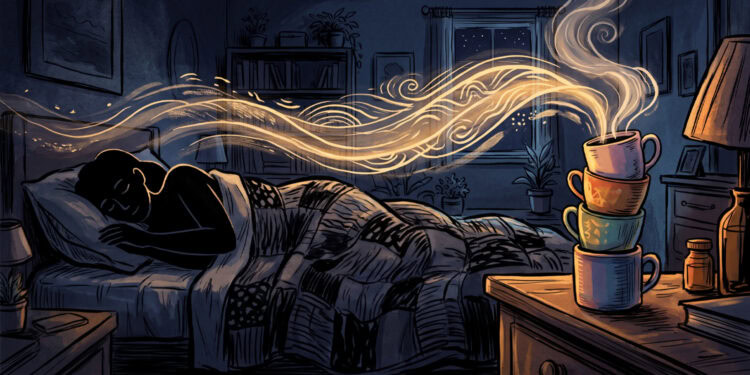
If you’re the kind of person who pours a fourth cup of coffee or tea without giving it a second thought, you’ve probably heard the warning. Caffeine is the world’s most widely used psychoactive substance—woven into daily life for focus, energy, stress relief, and social rituals—yet it carries a stubborn reputation as sleep’s worst enemy.
Plenty of people know the feeling of a tough time falling asleep after caffeine, and research has long shown that it can trim sleep duration and reduce sleep efficiency. So why do so many heavy daily drinkers feel like they sleep just fine?
Part of the answer may come down to how caffeine is usually studied. Much of the earlier evidence comes from controlled lab experiments where regular users temporarily stop consuming caffeine before receiving an experimental dose—a very different experience from the steady habit most people keep at home.
What happens when your body gets used to it
When researchers looked at real-world consumption instead of lab setups, a more surprising pattern showed up. In a study published in the Journal of Psychopharmacology, Benjamin Stucky and his colleagues set out to test how habitual caffeine intake shapes everyday sleep in people’s own beds.
Don’t miss the next big psychology finding
Every morning, PsyPost sends a short briefing on the most interesting new peer-reviewed research in psychology and neuroscience.
To do that, the team paired genetic data from over 485,000 UK Biobank participants with at-home sleep recordings from Switzerland’s HypnoLaus cohort, which tracked brain waves and other sleep signals overnight. Using naturally occurring genetic differences linked to caffeine habits, they estimated how drinking four or more caffeinated beverages a day compares with drinking fewer.
The first finding matched expectations, just on a much smaller scale. Habitual heavy drinkers did sleep less, yet the researchers’ more reliable causal estimates pointed to a reduction of only about 11 to 13 minutes per night.
Just as notable, people who drank more caffeinated beverages didn’t rate their own sleep quality any worse. Nor did heavy caffeine use make someone more likely to be a night owl or an early riser.
Shorter nights, deeper rest
The biggest twist appeared in the brain waves. Even though heavy habitual drinkers slept slightly less, their brains shifted into deeper sleep—shown by stronger electrical brain activity known as delta power.
Rather than leaving rest shallow and broken, chronic caffeine intake seemed to trigger a quiet trade-off. As Stucky and his colleagues wrote, “The data show that high habitual caffeine intake alters the characteristics of sleep in the general population, while sparing the major physiological principles of sleep-wake regulation possibly due to adaptation.”
In other words, the body appears to adjust to a steady daily habit, compensating for slightly shorter nights by sleeping more deeply to preserve sleep’s natural balance. For a closer look at how the team reached that conclusion, PsyPost’s full coverage of the study breaks down how Mendelian randomization works, the much wider range of statistical estimates the researchers had to evaluate, and the specific polysomnography measurements recorded at home.
The fine print behind the mug
The study contributes to the scientific understanding of how habitual caffeine intake affects everyday sleep. However, participants self-reported how many caffeinated cups they drank each day, leaving room for recall errors, and the analysis didn’t account for differing caffeine levels across beverage types or non-beverage sources like chocolate. The full report walks through those caveats alongside the complete set of sleep questionnaires participants completed.
Still, these findings add a useful dose of nuance to a habit millions of people share. For regular heavy caffeine drinkers, the body’s sleep system doesn’t simply unravel—it appears surprisingly capable of adapting, trading slightly shorter nights for deeper rest to keep its natural balance intact.
