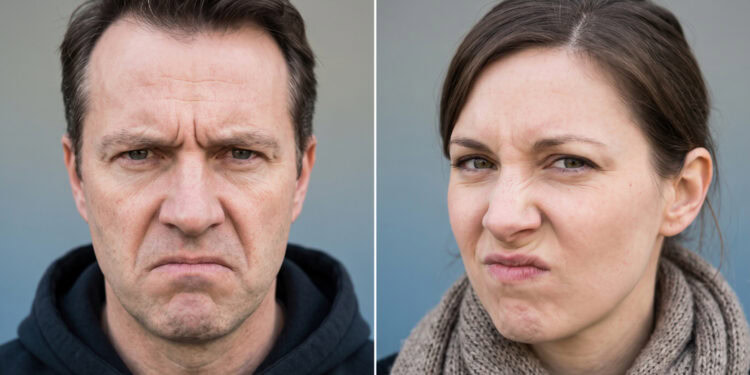

People who harbor unconscious doubts about their self-worth, or who have a large gap between their conscious and unconscious self-esteem, tend to detect subtle facial expressions of disgust and anger earlier than others. This heightened sensitivity to potential social rejection is also linked to poorer interpersonal wellbeing, according to new research published in Personality and Individual Differences.
Self-esteem is generally understood as how much a person values themselves. But psychologists separate this concept into two distinct layers. Explicit self-esteem refers to conscious feelings of self-worth that a person can easily describe, such as agreeing with the statement that they have a number of good qualities. Implicit self-esteem refers to automatic, unconscious evaluations of the self that operate beneath the surface of awareness.
Sometimes, these two layers do not match. A person might report high self-esteem on a questionnaire but harbor deep unconscious doubts about their worth, or they might report low self-worth despite having positive automatic associations with themselves. This mismatch is known as self-esteem discrepancy.
The research was led by Patrycja Korzeniowska, a lecturer in psychology at the School of Psychology, Sport Science & Wellbeing at the University of Lincoln in the UK. She and her colleagues aimed to understand how these different layers of self-evaluation shape the way people perceive the social world around them.
“We were interested in why people differ in their sensitivity to subtle social signals of acceptance and rejection, because detecting and interpreting these cues is an important part of navigating social interactions,” Korzeniowska told PsyPost.
Previous research has explored how self-evaluation alters social perception. For instance, a 2021 study demonstrated that people with lower conscious self-esteem can detect emerging expressions of anger and disgust at earlier, more subtle stages than people with high self-esteem. Building on related concepts, a 2025 study indicated that having low unconscious self-worth, or a mismatch between conscious and unconscious self-esteem, predicts a tendency to interpret ambiguous facial expressions as rejecting.
“Our aim was therefore to examine these components together, rather than treating self-esteem as a single, purely self-reported construct,” Korzeniowska explained. This led the team to test whether unconscious self-worth and self-esteem clashes directly heighten perceptual sensitivity to emerging rejection cues, and how that heightened sensitivity might affect psychological wellbeing.
To investigate this, the scientists recruited 225 adults to complete an emotion detection task. In this task, participants watched short videos of faces that slowly morphed from a completely neutral expression into a full-intensity emotional expression. The possible emotions were anger, disgust, fear, and happiness. The faces increased in emotional intensity in two percent increments, starting from a neutral state and ending at a complete display of emotion.
Participants were instructed to press a key the exact moment they recognized an emotion taking shape on the face, and then they selected which emotion they had seen. This setup allowed the researchers to measure perceptual sensitivity, or the minimum intensity level of the facial expression required for the participant to accurately detect it.
Before the computer task, participants completed several psychological assessments. They filled out a standard questionnaire to measure their explicit self-esteem and a psychological wellbeing scale to assess aspects of their life like personal growth, positive relations with others, and autonomy. To measure implicit self-esteem, the participants completed an Implicit Association Test.
This computer-based task requires people to quickly categorize words related to the self or others alongside positive and negative words. Faster reaction times when pairing self-related words with positive concepts indicate higher implicit self-esteem. By comparing the explicit and implicit scores, the researchers calculated each participant’s self-esteem discrepancy.
The results indicate that unconscious self-evaluation plays a prominent role in reading social cues. Participants with lower implicit self-esteem were able to detect expressions of disgust and anger at much lower intensities than those with higher implicit self-esteem. They were also faster to detect expressions of fear.
The gap between conscious and unconscious self-esteem also played a role. Participants with a larger self-esteem discrepancy required less emotional intensity to spot anger and disgust. This held true regardless of the direction of the gap, meaning it applied both to people who consciously felt great but unconsciously felt poorly, and to people who consciously felt poorly but had high unconscious self-worth.
Interestingly, while conscious self-esteem initially appeared to predict how quickly people spotted anger, this relationship faded when the researchers accounted for unconscious self-esteem. This suggests that previous research attributing heightened rejection sensitivity to low conscious self-esteem might have actually been picking up on the effects of unconscious self-evaluation or the clash between the two layers.
“Wang and colleagues had previously found that lower explicit self-esteem was associated with greater sensitivity to anger and disgust using closely related stimuli, whereas in our models explicit self-esteem was not a significant predictor; instead, implicit self-esteem and self-esteem discrepancy emerged more consistently,” Korzeniowska noted.
“This does not mean that explicit self-esteem is unimportant, as it was strongly associated with psychological wellbeing in our data, but it suggests that different components of self-esteem may relate differently to rapid social-perceptual processes,” she added. “The main takeaway is that how we respond to subtle social cues may be associated with aspects of self-evaluation that are not fully captured by simply asking people how they feel about themselves.”
The researchers also explored how this sensitivity to facial expressions relates to mental health and social functioning. Being highly attuned to early signs of disgust and anger was not directly related to overall psychological wellbeing, but it was linked to specific social outcomes. Heightened sensitivity to disgust, driven by low implicit self-esteem and high discrepancy, predicted poorer positive relations with others.
On the other hand, heightened sensitivity to anger predicted higher self-reported autonomy. While autonomy is generally considered a positive trait, the authors note that in the context of low implicit self-esteem and a high self-esteem discrepancy, this might indicate a defensive posture. People who are hypersensitive to anger might distance themselves from others to avoid negative evaluation and social rejection.
As with all research, there are some caveats to consider. The primary measure used for unconscious self-esteem is widely used, but its exact psychological interpretation remains a topic of debate. Some researchers argue that the sorting task measures automatic associations that a person has learned from their environment rather than a true, unified sense of self-worth.
“One important point is that ‘implicit self-esteem’ should not be understood as a hidden or unconscious ‘true’ self-esteem that the test somehow reveals,” Korzeniowska said. Because the test measures relatively automatic associations between the self and positive or negative evaluations, she noted that the findings “are best understood as evidence concerning automatic self-evaluative associations, and they should ideally be replicated using multiple methods.”
Additionally, while the study measured how quickly people can visually detect facial cues of rejection, this is not exactly the same as feeling rejected in daily life. Spotting a faint flicker of disgust on a computer screen is an automatic perceptual process, whereas real-world rejection sensitivity involves complex emotional and behavioral reactions to social events.
“We measured perceptual sensitivity to facial cues associated with social rejection, not rejection sensitivity as a personality or dispositional construct,” Korzeniowska clarified.
She also emphasized that the effects observed were relatively small, accounting for roughly 4 to 7 percent of the variance in sensitivity to anger and disgust. “These are modest, correlational effects, so the findings should not be interpreted as showing that a particular self-esteem profile causes someone to perceive rejection differently,” Korzeniowska explained. “I see the findings primarily as evidence for an association worth investigating further, rather than something that currently supports individual-level prediction or clinical application.” A larger sample size, she added, would help confirm some of the more subtle interactive effects observed in the data.
“An important next step is to test whether these associations replicate across different measures of automatic self-evaluation and different ways of assessing responses to social rejection,” Korzeniowska said. She hopes to explore whether the same pattern generalizes to more naturalistic social situations and to other behavioral or physiological measures of responses to rejection-related cues.
“I see this study as part of an emerging rather than settled picture,” she told PsyPost. “Together with our previous work showing that lower implicit self-esteem and greater self-esteem discrepancy were associated with interpreting ambiguous facial expressions more negatively, these findings suggest that automatic self-evaluations may be relevant both to how social expressions are interpreted and to how quickly subtle cues are detected.”
The study, “Implicit self-esteem and self-esteem discrepancy: Implications for dynamic facial expression sensitivity and psychological wellbeing,” was authored by Patrycja Korzeniowska, Kun Guo, and Petra M.J. Pollux.