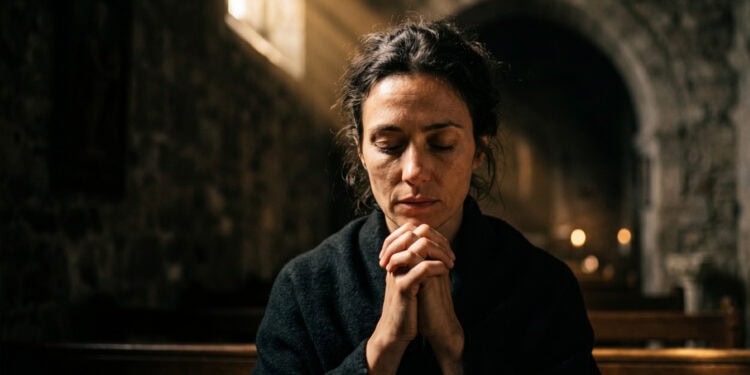

New research suggests that engaging in private religious activities, like praying or reading sacred texts, tends to lower sudden spikes in blood pressure during stressful situations. The findings indicate that personal religious habits might provide a protective buffer against the physical toll of acute stress, while general spiritual feelings do not appear to offer the same physical benefit. This study was recently published in the journal Religion, Brain & Behavior.
Cardiovascular disease remains a leading cause of death worldwide. Psychological stress is a recognized risk factor for developing heart problems, rivaling physical factors like smoking, obesity, or a lack of exercise. When people experience sudden stress, their bodies react by increasing their heart rate and blood pressure. This biological change is known as cardiovascular reactivity.
Exaggerated or prolonged physical reactions to temporary stress can eventually damage the heart and blood vessels. Scientists suggest that finding ways to manage these bodily responses might help protect long-term heart health. Past studies have noted that religious and spiritual individuals often experience better physical health and lower rates of heart disease.
Despite this observed connection, past scientific work has frequently mixed up the concepts of religion and spirituality. Religion typically involves foundational principles, rituals, and practices centered around a higher power or specific tradition. Spirituality tends to be a broader concept, describing a personal search for meaning, inner peace, or a feeling of connection to the world at large.
Because modern society is seeing an increase in people who identify as spiritual but not religious, the authors wanted to separate these two ideas. They aimed to examine whether it is specific religious behaviors or general spiritual feelings that actually help the body cope with sudden stress.
“I have always been interested in psychosocial factors and how they influence health, particularly stress responses and the development of cardiovascular disease,” said Ailbhe Dempsey, a researcher in the Department of Psychology at the University of Limerick in Ireland. “Through my reading, I realized that religiosity and spirituality are often conflated and used interchangeably in the literature.”
“With the societal decline in traditional religion alongside the rise of more individualized forms of spirituality, I became interested in how these constructs may differently relate to health outcomes,” Dempsey explained. “I soon discovered that the literature in this area was both limited and mixed, particularly due to the poor distinction between religiosity and spirituality.”
“This sparked my interest in the topic and ultimately led me to explore it further in my PhD research,” Dempsey noted. Dempsey is affiliated with both the Study of Anxiety, Stress and Health Laboratory and the Health Research Institute at the university.
To explore these relationships, the researchers utilized data from a large national project known as the Midlife Development in the United States study. The final sample included exactly 628 middle-aged adults, ranging in age from 35 to 85 years old. The group was predominantly white and primarily identified with Christian traditions.
Participants visited a clinical research center for a standardized stress testing procedure. The researchers monitored three specific bodily functions throughout the experiment. They tracked systolic blood pressure, which measures the pressure in blood vessels when the heart beats. They also tracked diastolic blood pressure, which measures the pressure in vessels when the heart rests between beats, along with overall heart rate.
The testing protocol lasted about an hour and a half and involved three distinct phases. First, participants sat quietly for eleven minutes so researchers could record their resting baseline measurements. After this resting period, participants completed two difficult mental tasks designed to induce acute psychological stress.
The first stressor was a mental arithmetic task requiring participants to solve complex math problems under time pressure. The second stressor was a cognitive test where participants had to quickly identify font colors that did not match the written word, like the word “red” printed in blue ink. After completing these two six-minute stressful tasks, participants sat through a six-minute recovery period.
To measure private religious practices, the researchers used a survey that asked participants how often they prayed in private, meditated or chanted, and read religious literature. Higher scores on this three-item questionnaire indicated more frequent private religious activity. A separate five-item survey measured daily spiritual experiences, asking participants how often they felt a deep sense of inner peace, a connection to all life, or a profound appreciation for the world.
This spiritual scale did not mention God or specific religions to keep it separate from formal theology. The stress tasks successfully provoked a physical reaction across the sample. On average, the participants reported feeling significantly more stressed during the mental challenges compared to their resting state.
When the researchers analyzed the data, they discovered a specific association between private religious practices and the body’s reaction to stress. Participants who reported higher levels of private religious practices experienced significantly lower spikes in their systolic blood pressure during the stressful tasks.
“The findings suggest that private religious practices, such as private prayer, may help some individuals respond to stress in a healthier way by reducing physiological stress responses, particularly blood pressure reactivity (results remained after controlling for baseline cardiovascular measures, age, sex, race, BMI, smoking, or prescription medication use),” Dempsey said. Body mass index, or BMI, is a standard measure of body fat based on height and weight.
Interestingly, the researchers did not find any associations between daily spiritual experiences and any of the cardiovascular measurements. General feelings of inner peace or a connection to nature did not appear to dampen the physical stress response.
“In contrast, spirituality alone did not appear to influence these physiological measures,” Dempsey added. “The study highlights the importance of distinguishing between religiosity and spirituality, as they may affect health and stress responses in different ways.”
The authors suggest that deeply internalized religious beliefs, practiced regularly in private, might provide a structured framework for coping with life’s challenges. Engaging in personal religious habits may help people reframe stressful events, making them feel less threatening. This mental shift could be the reason why the body does not react as severely, experiencing less strain on the cardiovascular system over time.
By fostering positive meaning in life, religious practices may lead to frequent experiences of emotions such as gratitude and joy. Psychological theories suggest that these positive emotional experiences can expand a person’s cognitive flexibility. This helps individuals develop enduring resources like resilience, which tends to buffer against the negative physical effects of daily stressors.
While the study provides nuanced insights, the researchers acknowledge a few limitations in their work. Because the data was collected at a single point in time, the scientists cannot prove a direct cause-and-effect relationship. It is possible that people with naturally calmer physical stress responses are simply more drawn to private religious practices, rather than the practices themselves causing the physiological calmness.
“An important caveat is that the findings were specific to systolic blood pressure (SBP) reactivity, as private religious practices were not associated with diastolic blood pressure or heart rate responses to stress,” Dempsey explained. The SBP abbreviation specifically refers to the top number in a blood pressure reading, which showed the only significant physiological change in the models.
The sample was also somewhat limited in its diversity. Most participants were white and from Christian backgrounds, where practices like personal prayer and reading scripture are highly common.
“In addition, the sample was predominantly Christian, which may have influenced the observed associations,” Dempsey cautioned. “As religiosity can vary across cultural and social contexts, these findings may not generalize to more religiously diverse or less religious populations. Future research should therefore explore these relationships across different cultural and religious groups.”
There is also a possibility for misinterpretation regarding the content of the surveys. The private religious practices scale included meditation, which is a practice utilized in secular and spiritual contexts as well as religious ones. Future studies should separate meditation from explicitly religious actions to better understand what specifically drives the dampening of the stress response.
Additionally, while lower cardiovascular reactivity is generally seen as healthy, an unusually blunted physical response to stress can sometimes indicate negative health outcomes, such as depression or behavioral disengagement. The scientists suggest that more research is needed to fully understand when a muted stress response is adaptive and when it might be harmful.
Looking ahead, the researchers hope to build on these findings to better understand the distinct physical impacts of faith. “With regard to this research area, I hope to conduct longitudinal studies exploring different facets of religiosity and spirituality, including both positive and negative dimensions, across diverse cultural groups and age ranges,” Dempsey said.
The study, “Examining the associations between private religious practices, daily spiritual experiences, and cardiovascular stress reactivity,” was authored by Ailbhe Dempsey, Siobhán Howard, and Stephen Gallagher. The research was supported by Taighde Éireann and the National Institute on Aging.