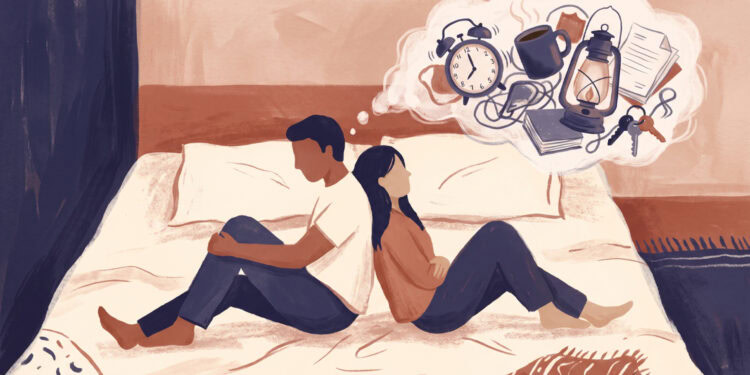
If you’ve ever lain awake wondering why your sex drive seems to have vanished for weeks, you know how quickly that silence can turn into self-doubt. You start running a quiet audit in your head. Is something off? Shouldn’t you want this more often?
What tends to sting most in those moments isn’t only missing the spark you used to feel. Often, the heaviest part is a quieter fear aimed at someone else: the nagging worry that you aren’t satisfying your partner.
It feels like a solitary problem, partly because few people bring it up over coffee. Yet that private unease turns out to be remarkably common — and it rarely stays neatly inside the bedroom. Everyday mental health, deep exhaustion, and the quiet pressures of partnership sit right behind how people judge their own desire.
Why the worry lands on your relationship
That picture comes into focus in research published in the Journal of Sex & Marital Therapy by Caroline F. Pukall, a psychology professor at Queen’s University in Kingston, Ontario, and her colleagues. To move past purely clinical cases and see how ordinary people experience desire day to day, the team ran an online survey combining multiple-choice questions with open-ended prompts where respondents could explain their thoughts in their own words.
Don’t miss the next big psychology finding
Every morning, PsyPost sends a short briefing on the most interesting new peer-reviewed research in psychology and neuroscience.
Across the adult respondents, 57.1 percent said they had worried about their sex drive. Most feared their desire was too low, and among the worried group, 42.4 percent pointed to a mismatch between their own appetite and their partner’s.
When people dealing with low desire were asked what troubled them most, the top answer wasn’t personal frustration — it was feeling they were letting a partner down, alongside missing how sexual they once felt. “We were also struck by how often people’s worries centered not only on themselves, but on how their desire affected their relationships, particularly concerns about satisfying a partner or managing differences in desire,” Pukall told PsyPost.
In their written replies, some respondents described how a dip in desire chipped away at their confidence, leaving them feeling unworthy of a partner. A few even admitted worrying they might feel pressured into unwanted sex just to keep their partner happy.
What really sits behind a fading mood
It is easy to treat desire like a standalone switch that either works or doesn’t. Yet when respondents explained why their sex drive felt low, 44.3 percent pointed to mental health struggles, alongside body dissatisfaction, medication side effects, and the sheer weight of stress, chronic exhaustion, and parenting.
“Another notable finding was the extent to which participants linked low libido to mental health, stress, exhaustion, and parenting responsibilities, highlighting how connected sexual well-being is to overall well-being,” Pukall said.
If you’re curious how those patterns shift across different groups, PsyPost’s full coverage of the study breaks down the complete set of findings — including how worries differed across genders, sexual orientations, and relationship lengths, along with Pukall’s broader reflections from the original interview.
Putting the quiet doubt in context
The study contributes to the scientific understanding of how everyday adults perceive and worry about their sexual desire. However, participants were recruited through the social media accounts of the science podcast Science Vs, and the group leaned toward younger adults and people already in committed relationships, so the patterns may not look identical across every population. You can explore the sample’s full demographic makeup and survey design in PsyPost’s in-depth report.
Even with those caveats, the findings offer a calmer lens for a very familiar anxiety. Desire naturally rises and falls alongside the rest of life — whether that means a rough stretch for your mental health, the exhaustion of parenting, or simply navigating a long-term partnership.
When your mood disappears for a stretch, the worry that follows isn’t proof that you’re an outlier. For most adults in the survey, wondering whether your desire is “normal” is simply part of the experience.
