PsyPost
  • Mental Health
  • Social Psychology
  • Cognitive Science
  • Neuroscience
  • About
No Result
View All Result
Join
My Account
PsyPost
No Result
View All Result
Home Uncategorized

Researchers decipher interaction of fragrances and olfactory receptors

by Ruhr-University Bochum
December 13, 2011
Reading Time: 2 mins read
Share on TwitterShare on Facebook

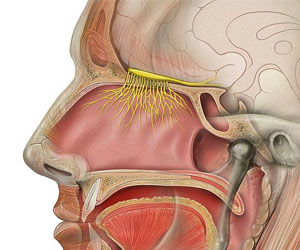
Human nose illustration by Patrick LynchBanana, mango or apricot – telling these smells apart is no problem for the human nose. How the olfactory organ distinguishes such similar smells has been uncovered by an interdisciplinary team of researchers at the RUB.

The scientists were the first to shed light on the dynamics of the three-dimensional structure of the binding site of an olfactory receptor. In so doing, they also found a characteristic pattern of hydrogen bonds between odorant and receptor, which accounts for the specificity of the olfactory sensors. Using computer simulations, the RUB team was able to predict whether odorant molecules activate a certain receptor or not. “A dream of science and industry is coming true” says smell expert Prof. Dr. Dr. Dr. Hanns Hatt (Department of Cell Physiology).

The study was chosen as cover story of the journal Angewandte Chemie International Edition.

The human nose has about 350 different types of olfactory receptors, each specialising in one or a few smells. “The receptor is like a door lock which can only be opened by the right key” says Dr. Lian Gelis from the Department of Cell Physiology. How the lock is exactly constructed was previously unknown.

To solve the puzzle, Dr. Steffen Wolf and Prof. Dr. Klaus Gerwert (Department of Biophysics) set out by creating a computer model of the human olfactory receptor for the smell of apricots. In the model, they mutated several components (amino acids) in the binding site of the protein and predicted whether these receptor variants bind apricot fragrance or not. Gelis und Hatt then verified these predictions using “Ca2+-imaging” on the receptors in the physiological system.

In this way, the researchers showed how the binding site has to be structurally constituted so that the apricot fragrance activates the receptor. Using molecular dynamics simulations, they then analysed the two binding partners in greater depth. They found that, in the dynamic interplay of the interaction between receptor and odorant molecule, specific chemical bonds, called hydrogen bridges, form and separate.

“It’s like a tango, where the female dancer constantly separates from her partner and joins him again at another point” explains Gerwert. “The receptor uses the dynamic hydrogen bonding pattern to distinguish between activating and non-activating odours.”

The researchers established how many molecular junctions the interaction partners have to form in order for a smell to activate an olfactory receptor. They also managed to specifically manipulate a receptor protein in the model and in the experiment so that it detected papaya fragrance instead of apricot fragrance.

Google News Preferences Add PsyPost to your preferred sources

“The findings can help to generate specific ‘super-olfactory sensors’ for a defined fragrance” says Hatt. “Since olfactory receptors not only occur in the nose, but also in many other tissues in the human body, for example in the prostate, in sperm, and in the intestines, the results may help to develop novel therapeutic approaches”. The work was carried out as part of the Collaborative Research Centre SFB 642. The Mercator Foundation supported Prof. Gerwert with a grant.

TweetSendScanShareSendPinShareShareShareShareShare

Follow PsyPost

The latest research, however you prefer to read it.

Daily newsletter

One email a day. The newest research, nothing else.

Google News

Get PsyPost stories in your Google News feed.

Add PsyPost to Google News
RSS feed

Use your favorite reader.

Copy RSS URL
Social media
Support independent science journalism

Ad-free reading, full archives, and weekly deep dives for members.

Become a member

Trending

  • Specific cognitive skills rival general intelligence in predicting socioeconomic success
  • Mapping the dark triad: Which countries have the most narcissistic and manipulative populations?
  • Fascinating findings emerge from recent LSD research
  • Study finds unpredictable childhood environments are linked to borderline personality traits in adulthood
  • Is intelligence related to happiness?

Science of Money

  • New study blames authoritarian bosses for the quiet quitting trend
  • Three types of older jobseekers, three very different odds of getting hired
  • Can AI read the market’s mood? Researchers test DeepSeek sentiment scores against Shanghai stock returns
  • Do glowing words really sell? An economist finds a small but real puffery effect on Airbnb
  • Error tolerance: entrepreneurship booster or societal risk?

Recent

  • Tiny vesicles in breast milk carry stress signals to the infant brain
  • Scientists discover how boosting a protective protein stops toxic tau spread in the brain
  • Internal expectations, not actual posts, drive how narcissists view their social media success
  • Female biology professors are now more likely to have a Wikipedia page than their male peers
  • Artificial intelligence reveals subtle movement differences in autistic toddlers
  • Adults with depression show a negative attentional bias, but new research suggests it is highly task-specific
  • Physically compressing peoples’ torsos reduces the riskiness of their decisions, study finds
  • The surprising disconnect between intense romance and a couple’s sex life
  • Does going to religious services actually improve your mental health?
  • Specific cognitive skills rival general intelligence in predicting socioeconomic success

PsyPost is a psychology and neuroscience news website dedicated to reporting the latest research on human behavior, cognition, and society. (READ MORE...)

  • Mental Health
  • Neuroimaging
  • Personality Psychology
  • Social Psychology
  • Artificial Intelligence
  • Cognitive Science
  • Psychopharmacology
  • Contact us
  • Disclaimer
  • Privacy policy
  • Terms and conditions
  • Do not sell my personal information

(c) PsyPost Media Inc

Welcome Back!

Login to your account below

Forgotten Password?

Retrieve your password

Please enter your username or email address to reset your password.

Log In

Add New Playlist

Subscribe
  • My Account
  • Cognitive Science Research
  • Mental Health Research
  • Social Psychology Research
  • Drug Research
  • Relationship Research
  • About PsyPost
  • Contact
  • Privacy Policy

(c) PsyPost Media Inc