As disabling as its delusions and hallucinations, psychosis’ devastating toll on memory arises from dysfunction of frontal and temporal lobe regions in the brain that rob sufferers of the ability to make associative connections, a UC Davis study has found, pinpointing potential target areas for treatments to help the more than 3.2 million Americans for whom medication quells the voices and visions, but not the struggle to remember.
The study found that memory is most impaired when people with schizophrenia try to form relationships between items — remembering to also buy eggs, milk and butter when buying flour to make pancakes — and that this relational encoding problem is accompanied by regionally specific dysfunction in the dorsolateral prefrontal cortex.
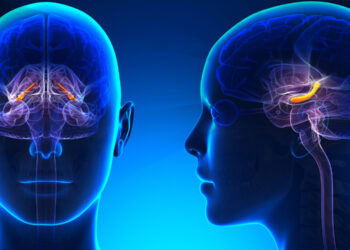
People with schizophrenia also have greater difficulty retrieving this relational information even when they can remember the individual items, and this relational retrieval deficit is accompanied by functionally specific dysfunction in a brain area called the hippocampus. The research is published online today in JAMA Psychiatry.
Schizophrenia is well-known for its more florid manifestations, said J. Daniel Ragland, professor of psychiatry in the UC Davis School of Medicine and lead author of the study.
“Everyone has had the experience of hearing their name called or phone ring, or that someone is standing beside them. When these events take place initially we experience them as real,” Ragland said. “What happens in psychosis is that you continue to have the experience, and the feeling becomes more developed, more real and more intrusive.”
Decades-old medications treat these symptoms effectively. But what remains is often more intractable: memory loss and other cognitive difficulties that make it difficult to perform the activities of daily living.
“People with schizophrenia have difficulty retrieving associations within a context, and this creates a pervasive loss of memory that makes everyday life a challenge,” Ragland said. “You can’t work if you can’t remember the next step in what your boss told you to do.”
“If you’re going to develop a drug or other therapy to improve memory, we found that this frontal and temporal lobe relational memory network may be a target or ‘biomarker’ for treatment development,” he said.
The multi-site functional magnetic resonance (fMRI) study was conducted in approximately 60 male and female patients with schizophrenia who were age matched with unaffected control subjects. Participants with psychosis were clinically stable, had remained on medication for one month, and were experiencing mild symptoms. Participants were located at UC Davis, Washington University in St. Louis, University of Maryland and Rutgers University.
For the study, participants viewed a series of pictures of everyday objects, and made either an item-specific encoding decision about whether the object was living or non-living, or made a relational encoding decision about whether one of the objects could fit inside of the other during fMRI scanning.
This was followed by an item-recognition task consisting of previously studied objects presented together with never-studied objects. Participants had to assess whether or not the object was previously studied.
Participants also were tested on their associative recognition of which objects were paired together during the relational encoding task. The more severe pattern of relational memory deficits and dorsolateral prefrontal and hippocampal dysfunction was revealed by contrasting the item-specific and relational memory conditions during encoding and retrieval.
In the participants diagnosed with psychosis, the dorsolateral prefrontal cortex appeared substantially less activated than in healthy control participants — 28 percent to 30 percent less activated.
Although participants with schizophrenia activated the ventrolateral prefrontal cortex during relational versus item encoding, they failed to activate the dorsolateral prefrontal cortex — a finding that is consistent with earlier fMRI studies of attention and problem-solving in individuals with schizophrenia.
In addition, the study revealed that healthy controls exhibited increased activation in the hippocampus, while activation was significantly reduced in the participants with psychosis for retrieval following relational-memory encoding, but not for retrieval following item memory encoding.
Thus, the hippocampus – which plays a unique role in creating relational memories, joins the dorsolateral prefrontal cortex in helping to explain the disproportionate relational memory deficits experienced by people with schizophrenia.
Cameron Carter, senior author and professor of psychiatry, said that the finding is exciting because it points the way to potential pathways to improve the lives of people with psychosis.
“This shows that the memory problems in people with schizophrenia are not the same as those of people with Alzheimer’s disease,” where the brain region is damaged and deteriorating. “It’s more like those of people with other cognitive deficits, such as ADHD,” said Carter, who is director of the Imaging Research, Behavioral Health and Neuroscience centers at UC Davis.
“We now know that, if we’re going to improve memory in people with psychosis we have to improve the functioning of the dorsolateral prefrontal cortex. And there are many different ways that we can do that, such as through cognitive brain training,” he said.
Carter said that another experimental treatment, called transcranial direct current stimulation, is designed to activate and enhance the function of the brain region.
“This research is directly informing the next steps in our research. And the area that we’ll stimulate will be this one.
“Twenty or 30 years ago we couldn’t do any of this,” Carter said. “So this is real progress.”