New research published in Comprehensive Psychoneuroendocrinology provides insight into moral decision-making processes in psychopathic individuals. Researchers found that clinical psychopaths with high impulsivity tend to make deontological choices in high-emotion scenarios, avoiding direct harm even at the expense of optimal outcomes.
Psychopathy is a complex personality disorder characterized by a range of emotional, interpersonal, and behavioral deficits. Individuals with this condition often display a profound lack of empathy, disregard for the rights and feelings of others, and a tendency toward manipulative and antisocial behaviors.
These traits make psychopathic individuals more prone to engaging in criminal activities and other forms of antisocial conduct. The prevalence of psychopathy in the general population is relatively low, but its impact is disproportionately high in forensic and clinical settings, particularly among violent offenders and those with repeated criminal behaviors.
The motivation behind the study stemmed from the need to better understand the moral decision-making processes of psychopathic individuals. Given their high rates of criminal recidivism and the significant societal costs associated with their behaviors, researchers aimed to explore how these individuals make moral choices in situations that require weighing the greater good against causing harm to others.
“Since I work in a Dutch forensic observation clinic for mental assessment of alleged criminal offenders, one of my main interests is psychopathy. This personality disorder is said to be related to disturbed processing of moral issues,” said study author Ronald J.P. Rijnders, a forensic psychiatrist at the Netherlands Institute for Forensic Psychiatry and Psychology.
The study involved two groups of male participants: 24 psychopathic patients recruited from maximum-security forensic psychiatric hospitals in the Netherlands and 28 non-psychopathic controls, consisting of security guards and nursing staff from the same hospitals. Psychopathy in the patients was confirmed using the Psychopathy Checklist-Revised (PCL-R), with a cutoff score of 26 or higher, while the controls were screened using the Psychopathic Personality Inventory-Revised (PPI-R).
“A unique point of this study is that we investigated a clinically identified and PCL-R confirmed group of forensic psychopathic patients who were not treated with medication like selective serotonin reuptake inhibitors, selective noradrenaline reuptake inhibitors, antipsychotics, or hormonal libido inhibitors,” Rijnders noted.
Participants were presented with a series of moral dilemmas designed to elicit either utilitarian (outcome-based) or deontological (harm-averse) responses. Each dilemma was displayed on a computer screen and read aloud through headphones, with participants required to indicate the moral permissibility of the proposed action via a forced-choice question (“Would you…?”) that could be answered with “yes” or “no.”
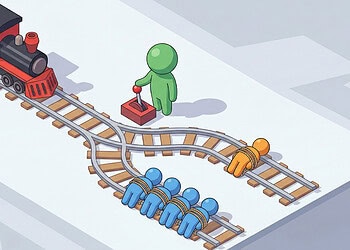
“We used moral choices that were either utilitarian or deontological in nature,” Rijnders told PsyPost. “Utilitarians have rational responses to maximize total welfare, that is, to promote the greater good of all, even if it means breaking common social rules. Deontologists, on the other hand, have an automatic emotional aversion to inflicting harm on other people because the nature of the ultimate action itself determines whether that action is considered right or wrong.”
“Moral dilemmas are classified as either personal or impersonal. In personal acts, harm is caused by direct physical contact while in impersonal acts, harm is inflicted in an indirect, non-physical way. Utilitarian actions in personal dilemmas are associated with a stronger emotional value. Personal dilemmas are further divided into either inevitable or evitable dilemmas. Inevitable harm assumes that regardless of whether and what action is taken, the person involved will eventually suffer harm, whereas the latter is not the case with evitable harm if the action is waived.”
Among psychopathic patients, the researchers found that those with higher levels of impulsivity were more likely to make deontological choices in high-emotion scenarios. Specifically, these patients were more inclined to avoid causing harm when it involved direct physical action, even if this meant achieving less optimal outcomes overall. This finding was particularly evident in personal-evitable dilemmas, where the harm could be avoided by choosing not to act.
In the control group, psychopathic traits such as lack of empathy and failure to consider consequences were associated with a higher likelihood of making utilitarian decisions, but only in scenarios with low emotional stakes. This suggests that while psychopathic traits can predict utilitarian choices in the general population, this tendency is influenced by the emotional context of the decision.
Contrary to some previous studies, the researchers found no evidence that psychopathic patients, in general, made more utilitarian choices compared to non-psychopathic controls. Instead, the severity of psychopathy in patients was associated with more deontological choices, particularly in scenarios involving high emotional investment and where harm could be evitable.
“We hypothesized that psychopathic patients admitted to a forensic psychiatric hospital would have a propensity for utilitarian choices compared to a control group,” Rijnders said. “Our study showed that this was not the case, as there were no significant differences between the two groups.”
“However, there was an interesting finding regarding the psychopathy severity as measured by the Psychopathy Checklist Revised (for the patients) and the Psychopathic Personality Inventory – Revised (for the normal controls). Our hypothesis was that in both groups the percentage of utilitarian choices was positively related to the severity of psychopathy. This was indeed the case for the normal controls, but not for the psychopathic patients.”
“Highly impulsive psychopathic patients were more likely to make a harm-averse choices in the personal evitable dilemma. We think that the combination of absent self-interest, high impulsivity, an emotionally charged decision that is harmful to the other person and must be carried out by direct physical force may tilt the response toward a deontological choice. Choosing the emotionally charged use of avoidable harm may be immediately considered ‘too hot’ and then impulsively rejected.”
The psychopathic patients underwent two test sessions, one in which they self-administered a nasal spray containing 24 IU of synthetic oxytocin and another in which they received a placebo nasal spray. (The normal controls did not receive any nasal spray and were tested in one session only.) The time interval between the two test sessions for the psychopathic patients was approximately 12 days, and the start times were kept consistent to control for circadian effects.
“In the group of psychopathic patients, we examined the effect of a single nasal application of the neuropeptide oxytocin,” Rijnders told PsyPost. “Contrary to our expectations we found no effects of oxytocin on moral decision-making.”
The study highlights the nuanced ways in which psychopathic traits and impulsivity interact with the emotional context of moral decisions. But as with any study, there are some caveats. The study’s sample size was relatively small, and the findings may not generalize to all psychopathic individuals or to different cultural contexts.
Another limitation is the reliance on a single administration of oxytocin, which may not be sufficient to induce significant behavioral changes. Future research could explore the effects of repeated oxytocin administration over longer periods to assess more substantial and lasting impacts on moral decision-making.
“We will continue our research on moral choice in other forensic populations,” Rijnders said. “Perhaps a design with multiple applications of nasal oxytocin over weeks is possible.”
The study, “Would you? Effects of oxytocin on moral choices in forensic psychopathic patients“, was authored by Ronald J.P. Rijnders, Sophie van den Hoogen, Jack van Honk, David Terburg, and Maaike M. Kempes.