In a new study conducted in the Netherlands, participants suffering from depression or anxiety were offered to choose between running therapy and taking antidepressant medication. Results showed that these two treatments had comparable effects on psychiatric symptoms, but that participants preferred running therapy, which also provided additional physical health benefits. The study was published in the Journal of Affective Disorders.
Depression and anxiety disorders are two distinct mental health disorders that often occur together in the same person. Depression, also known as the major depressive disorder, is a mood disorder characterized by persistent feelings of sadness, hopelessness, and a loss of interest in activities. Anxiety disorders encompass a range of conditions characterized by excessive and persistent feelings of fear, worry, or unease. While it is normal to experience anxiety in stressful situations, anxiety disorders involve more intense or prolonged symptoms that interfere with daily life.
Standard first-line treatments for depression and anxiety disorders involve antidepressant medications and psychotherapy. However, antidepressants are not effective for some people. They also can have adverse side effects. Novel studies have indicated that exercise interventions, where patients engage in physical activity, have effects comparable to antidepressants and psychotherapy.
Aerobic exercises of at least moderate intensity, supervised by exercise professionals, were found to be the most effective. Aerobic exercises, also known as cardiovascular exercises or cardio, are physical activities that increase one’s heart rate and respiration for an extended period. These include brisk walking, running/jogging, cycling, swimming, dancing, aerobic classes, and other similar activities.
Study author Josine E. Verhoeven and her colleagues wanted to complement these findings by also comparing the effects exercises and antidepressants have on physical health. They organized a 16-week intervention study in which they compared effects of antidepressant medication and running therapy on mental health symptom severity and a range of physical health parameters that included metabolic and immune indicators, heart rate, weight, lung function, hand grip strength, and overall fitness in a group of people suffering from depression and/or anxiety disorder.
Participants were 141 patients of outpatient clinics of GGZ inGEEST, a specialized mental health care organization in the Netherlands. Their age ranged between 18 and 70 years. Participants were included in the study if they did not use any psychotropic medication at the time of the study or antidepressants in the prior 2 weeks, had no severe psychiatric disorder other than depression or anxiety, were in sufficiently good health to run or receive antidepressants, had no suicidal risk, and were not pregnant.
Participants were asked to choose between taking antidepressants and running therapy. Participants who reported not having strong preferences for one of the treatments were randomly allocated to a treatment. They were allowed to participate in psychotherapy as usual during the study period.
Participants in the antidepressant treatment received an initial dosage of 10 mg of escitalopram. Escitalopram is a selective serotonin reuptake inhibitor, a class of medication that increases the level of the neurotransmitter serotonin in the brain, thereby increasing its effects. It is commonly used for treating depression and anxiety disorders. The effects of this treatment were evaluated by a psychiatrist at weeks 2, 6, 10 and 16 of the study. Based on this, the dosage could be increased up to a maximum of 20 mg per day.
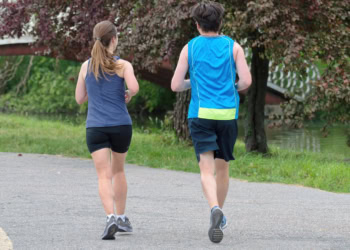
Running therapy consisted of supervised 45-minute outdoor running sessions during the 16-week study period, 2 or 3 times per week. Running sessions started with a 10-minute warming-up exercise period, followed by 30 minutes of jogging at an intensity that maintained the heart rate within the assigned training range. This range was 50–70 % of heart rate reserve for the first 4 weeks and at 70–85 % of heart rate reserve for the subsequent 12 weeks. Exercise periods finished with 5 minutes of cooling-down exercises. These sessions were carried out and supervised by qualified staff.
Results showed that study participants largely preferred running exercises to antidepressants. 96 participants engaged in running therapy, while 45 received antidepressant medication. The two groups were similar in age, share of participants of different gender, relationship status and a number of mental health and physical characteristics.
In the antidepressant group, 82% of participants adhered to the medication treatment protocol. This was the case with only 52% of participants in the running therapy group. This percentage of participants participated in more than 22 running sessions. On the other hand, 14 participants did not start their running therapy intervention at all and 16 participated in less than 9 sessions.
Percentages of participants who achieved a complete or near-complete reduction of symptoms were similar in the two groups – 43% in the running therapy group and 45% in the antidepressant group. Similar results were obtained when severity of symptoms of depression and anxiety were compared in the two groups – mean scores on assessments of these symptoms did not differ between the two groups.
However, the comparison of physical health indicators showed that the running therapy group exhibited a decrease in heart rate, waist circumference and an increased lung function. The antidepressant group, on the other hand, showed an increase in weight, a slight increase in diastolic blood pressure and in concentrations of triglycerides in blood.
“While the interventions had comparable effects on mental health, running therapy outperformed antidepressants on physical health, due to both larger improvements in the running therapy group as well as larger deterioration in the antidepressant group,” the study authors concluded.
The study provides a valuable contribution to the scientific understanding of effects of exercise treatments for depression and anxiety disorders. However, it also has limitations that need to be taken into account. Namely, participants were largely self-selected into treatment groups. Preference for the running therapy was greater, but adherence rate for this treatment also turned out to be much lower.
The study, “Antidepressants or running therapy: Comparing effects on mental and physical health in patients with depression and anxiety disorders”, was authored by Josine E. Verhoeven, Laura K.M. Han, Bianca A. Lever-van Milligen, Mandy X. Hu, Dora ´ Revesz, Adriaan W. Hoogendoorn, Neeltje M. Batelaan, Digna J.F. van Schaik, Anton J.L.M. van Balkom, Patricia van Oppen, and Brenda W.J.H. Penninx.