Subscribe
The latest psychology and neuroscience discoveries.
My Account
  • Mental Health
  • Social Psychology
  • Cognitive Science
  • Neuroscience
  • About
No Result
View All Result
PsyPost
PsyPost
No Result
View All Result
Home Exclusive Mental Health Addiction

Scientists biochemically ‘hard-wire’ synapses to create a mouse that resists cocaine’s lure

by University of British Columbia
February 13, 2017
in Addiction
Share on TwitterShare on Facebook

Scientists at the University of British Columbia have genetically engineered a mouse that does not become addicted to cocaine, adding to the evidence that habitual drug use is more a matter of genetics and biochemistry than just poor judgment.

The mice they created had higher levels of a protein called cadherin, which helps bind cells together. In the brain, cadherin helps strengthen synapses between neurons – the gaps that electrical impulses must traverse to bring about any action or function controlled by the brain, whether it’s breathing, walking, learning a new task or recalling a memory.

Learning – including learning about the pleasure induced by a stimulant drug – requires a strengthening of certain synapses. So Shernaz Bamji, a Professor in the Department of Cellular and Physiological Sciences, thought that extra cadherin in the reward circuit would make their mice more prone to cocaine addiction.

But she and her collaborators found the opposite to be true, as they explain in an article published today in Nature Neuroscience.

Dr. Bamji and her collaborators injected cocaine into mice over a number of days and immediately placed in a distinctly decorated compartment in a three-room cage, so that they would associate the drug with that compartment. After several days of receiving cocaine this way, the mice were put into the cage and allowed to spend time in any compartments they preferred. The normal mice almost always gravitated to the cocaine-associated compartment, while the mice with extra cadherin spent half as much time there – indicating that these mice hadn’t formed strong memories of the drug.
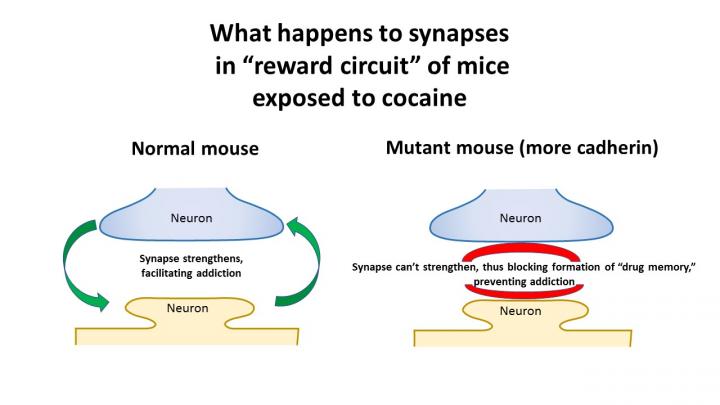
This is a diagram showing synapses in the reward circuit of mice when exposed to cocaine: on left, a normal mouse, and on right, a mouse with increased levels of cadherin. (Credit: University of British Columbia)

To understand that unexpected result, Dr. Bamji and her associates in UBC’s Life Sciences Institute analyzed the brain tissue of the genetically engineered mice.

They found that extra cadherin prevents a type of neurochemical receptor from migrating from the cell’s interior to the synaptic membrane. Without that receptor in place, it’s difficult for a neuron to receive a signal from adjoining neurons. So the synapses don’t strengthen and the pleasurable memory does not “stick.”

“Through genetic engineering, we hard-wired in place the synapses in the reward circuits of these mice,” says graduate student Andrea Globa, a co-lead author with former graduate student Fergil Mills. “By preventing the synapses from strengthening, we prevented the mutant mice from ‘learning’ the memory of cocaine, and thus prevented them from becoming addicted.”

Google News Preferences Add PsyPost to your preferred sources

Their finding provides an explanation for previous studies showing that people with substance use problems tend to have more genetic mutations associated with cadherin and cell adhesion. As studies such as this one illuminate the biochemical underpinnings of addiction, it could lead to greater confidence in predicting who is more vulnerable to drug abuse – and enable people to act on that knowledge.

Unfortunately, finding a way of augmenting cadherin as a way of resisting addiction in humans is fraught with pitfalls. In many cases, it’s important to strengthen synapses – even in the reward circuit of the brain.

“For normal learning, we need to be able to both weaken and strengthen synapses,” Dr. Bamji says. “That plasticity allows for the pruning of some neural pathways and the formation of others, enabling the brain to adapt and to learn. Ideally, we would need to find a molecule that blocks formation of a memory of a drug-induced high, while not interfering with the ability to remember important things.”

Previous Post

New discovery could be a major advance for neurological diseases

Next Post

Couples and friends show similarity in personality traits after all

RELATED

New study links early maltreatment to higher risk of teen dating violence
Addiction

Multiple childhood traumas linked to highly interconnected addictive behaviors in adulthood

March 2, 2026
Why most people fail to spot AI-generated faces, while super-recognizers have a subtle advantage
Dark Triad

Dark personality traits are linked to the consumption of violent pornography

February 28, 2026
A popular weight loss drug shows promise for treating alcohol addiction
Addiction

A popular weight loss drug shows promise for treating alcohol addiction

February 21, 2026
Brain imaging study finds large sex-differences in regions tied to mental health
Addiction

Neural signatures of impulsivity and neuroticism are largely distinct in youth

February 19, 2026
Genes and childhood trauma both play a role in adult ADHD symptoms, study finds
Addiction

Childhood trauma and genetics drive alcoholism at different life stages

February 12, 2026
Adolescents with ADHD tend to eat more snacks than their peers
Addiction

Scientists: Ultra-processed foods are engineered to hijack your brain and should be treated like Big Tobacco

February 9, 2026
Social media may be trapping us in a cycle of loneliness, new study suggests
Addiction

The hidden role of vulnerable dark personality traits in digital addiction

February 3, 2026
The tendency to feel like a perpetual victim is strongly tied to vulnerable narcissism
Addiction

Having a close friend with a gambling addiction increases personal risk, study finds

January 28, 2026

STAY CONNECTED

LATEST

Therapists test an AI dating simulator to help chronically single men practice romantic skills

Women with tattoos feel more attractive but experience the same body anxieties in the bedroom

Misophonia is strongly linked to a higher risk of mental health and auditory disorders

Brain scans reveal the unique brain structures linked to frequent lucid dreaming

Black Lives Matter protests sparked a short-term conservative backlash but ultimately shifted the 2020 election towards Democrats

Massive global study links the habit of forgiving others to better overall well-being

Neuroscientists have pinpointed a potential biological signature for psychopathy

Supportive relationships are linked to positive personality changes

PsyPost is a psychology and neuroscience news website dedicated to reporting the latest research on human behavior, cognition, and society. (READ MORE...)

  • Mental Health
  • Neuroimaging
  • Personality Psychology
  • Social Psychology
  • Artificial Intelligence
  • Cognitive Science
  • Psychopharmacology
  • Contact us
  • Disclaimer
  • Privacy policy
  • Terms and conditions
  • Do not sell my personal information

(c) PsyPost Media Inc

Welcome Back!

Login to your account below

Forgotten Password?

Retrieve your password

Please enter your username or email address to reset your password.

Log In

Add New Playlist

Subscribe
  • My Account
  • Cognitive Science Research
  • Mental Health Research
  • Social Psychology Research
  • Drug Research
  • Relationship Research
  • About PsyPost
  • Contact
  • Privacy Policy

(c) PsyPost Media Inc