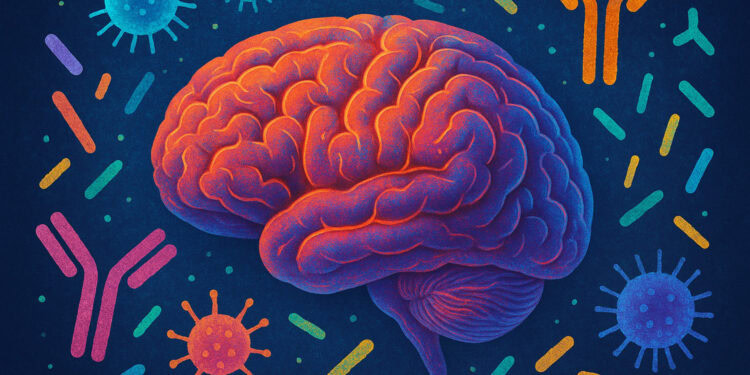

New research suggests that immune system activity may play a role in the development of several major mental health conditions. The study, published in Molecular Psychiatry, identified 29 immune-related proteins that appear to contribute to the risk of disorders such as schizophrenia, depression, bipolar disorder, and Alzheimer’s disease. Many of these proteins are already being targeted by drugs used for other conditions, raising the possibility that treatments focused on the immune system could one day help people with psychiatric disorders.
The researchers undertook this study to clarify whether immune system dysfunction actually causes mental health conditions or merely correlates with them. In recent years, many studies have found that people with depression, schizophrenia, and other disorders often have signs of increased inflammation. However, it has remained unclear whether this inflammation is a consequence of the illness, a contributing factor, or unrelated entirely. Resolving this uncertainty is essential for guiding the development of new therapies.
To investigate this, the research team, led by Christina Dardani and Golam Khandaker at the University of Bristol, used a method called Mendelian randomization. This approach uses naturally occurring genetic differences between people as a kind of natural experiment to estimate whether changes in a particular biological process—such as levels of an immune protein—have a causal effect on health outcomes. It helps minimize confounding factors that can distort associations in traditional observational studies.
The researchers focused on 736 immune-related proteins that can be measured in the blood. They used large genetic datasets to examine whether genetically determined differences in the levels of these proteins were linked to risk for seven neuropsychiatric conditions: schizophrenia, depression, bipolar disorder, anxiety, autism, attention deficit hyperactivity disorder (ADHD), and Alzheimer’s disease. They also used additional genetic data from the brain to assess whether effects might be brain-specific or more systemic.
Their analysis showed that 29 immune-related biomarkers had strong evidence for a causal role in at least one of the conditions studied. Of these, 20 are linked to biological pathways that are already being targeted by drugs for other health problems, such as cardiovascular or autoimmune diseases. These include molecules like ACE, AGER, CD40, and TNFRSF17, all of which have drugs in current use or clinical trials.
Schizophrenia showed the strongest evidence of immune involvement, with 57 immune proteins initially identified and several passing the most rigorous statistical criteria. These included PDIA3, NAGA, and AGER—genes that are involved in protein folding and glycosylation, a process that attaches sugar molecules to proteins and has recently been implicated in schizophrenia. Depression, bipolar disorder, and Alzheimer’s disease also had multiple immune proteins with apparent causal roles.
The study also found some overlap between conditions. For example, lower expression of the ACE gene was linked to a higher risk of both schizophrenia and Alzheimer’s disease. CD40, another immune protein, was linked to both schizophrenia and bipolar disorder. These findings may help explain why some symptoms, such as cognitive decline, are shared across different mental health conditions.
Some of the immune proteins highlighted in the study are already considered “druggable,” meaning they are accessible to small molecules or antibody-based therapies. ACE inhibitors, commonly used to treat high blood pressure, are one example. The idea of repurposing existing drugs to target mental health conditions is appealing because it could accelerate treatment development.
Khandaker, a professor of psychiatry and immunology, said: “Our study demonstrates that inflammation in the brain and the body might influence the risk of mental health conditions. The findings challenge the centuries-old Cartesian dichotomy between the body and the mind, and suggests that we should consider depression and schizophrenia as conditions affecting the whole person.”
While the study’s findings are promising, the researchers caution that more work is needed to understand the exact biological pathways involved. They emphasize that showing a potential causal link between an immune protein and a mental health condition does not mean that altering the protein will necessarily change symptoms. The next steps include testing these targets in clinical trials and exploring how they interact with other biological systems involved in mental illness.
The researchers also note several limitations of their work. The study relied on genetic data from people of European ancestry, so it’s unclear whether the findings apply to other populations. Some of the immune markers were only measured in blood, which may not fully capture their effects in the brain. In addition, the genetic datasets used vary in sample size and methodology, which could influence the results.
Another challenge is that mental health conditions often begin long before they are diagnosed, particularly in the case of developmental disorders like schizophrenia. This makes it difficult to pinpoint exactly when an immune protein might be exerting its influence. The researchers emphasize that future studies should explore how these markers relate to disease progression and not just onset.
Despite these limitations, the study represents one of the most comprehensive efforts to date to assess the potential causal role of the immune system in mental health. By integrating genetic data from both blood and brain, and applying robust statistical methods, the researchers provide a clearer picture of how immune proteins might influence psychiatric disorders.
The study, “Immunological drivers and potential novel drug targets for major psychiatric, neurodevelopmental, and neurodegenerative conditions,” was authored by Christina Dardani, Jamie W. Robinson, Hannah J. Jones, Dheeraj Rai, Evie Stergiakouli, Jakob Grove, Renee Gardner, Andrew M. McIntosh, Alexandra Havdahl, Gibran Hemani, George Davey Smith, Tom G. Richardson, Tom R. Gaunt, and Golam M. Khandaker.