A recent study has revealed how the psychedelic brew ayahuasca alters brain waves to induce profound mystical experiences and vivid, spontaneous thoughts. By recording electrical brain activity before and during the substance’s active phase, researchers discovered that a person’s resting brain state can predict how intensely they will feel certain bodily and emotional changes. The research was published in the Journal of Psychopharmacology.
Ayahuasca is a plant-based beverage containing psychoactive compounds, primarily dimethyltryptamine, or DMT. It has been used for centuries in South American traditional practices to induce altered states of consciousness. Recently, medical professionals have investigated the brew as a potential treatment for severe depression, a condition that affects hundreds of millions of people worldwide.
Because the substance produces powerful alterations in human perception, mental health practitioners want to understand exactly how it works on a biological level. They also want to know whether they can anticipate a patient’s psychological reaction before a clinical session begins. Predicting a patient’s response could help doctors tailor treatments and ensure a safe therapeutic environment.
Researchers Natan Silva-Costa and Jéssica Andrade Pessoa from the Federal University of Rio Grande do Norte in Brazil led a team to investigate the neural mechanics behind these altered states. They specifically wanted to explore how the drug affects mind-wandering. Mind-wandering is the natural flow of spontaneous, unstructured thoughts that occur when a person is resting and not focused on a specific external task.
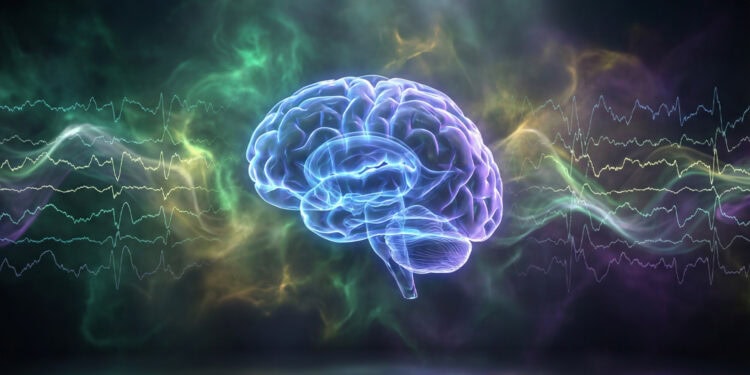
To track these mental shifts, the team used an electroencephalogram, or EEG. This medical device uses small sensors attached to the scalp to measure the electrical signals that brain cells use to communicate. These collective signals form wave patterns of varying speeds, including slow delta waves, medium-speed alpha waves, and faster beta waves.
Different wave speeds correspond to different mental states, such as deep sleep, relaxed wakefulness, or active concentration. The study involved fifty healthy adult volunteers who had never consumed ayahuasca. The researchers used a randomized, double-blind, placebo-controlled design.
This experimental setup means neither the participants nor the observing scientists knew who received the actual drug and who received a harmless substitute. Creating a convincing fake version of the brew was a challenge. The placebo was specially formulated with a caramel colorant to match the brownish hue of the real beverage.
It also contained yeast and citric acid for a bitter, sour taste, along with zinc sulfate to produce mild gastrointestinal discomfort. These ingredients mimicked the physical side effects of the actual brew. Participants rested comfortably in a quiet, dimly lit hospital room while listening to a predefined playlist of instrumental and vocal music.
The researchers recorded their brain waves for five minutes before administering the drink. They took additional five-minute brain wave recordings two hours and four hours after the participants consumed the liquid. Following the session, the volunteers filled out extensive questionnaires detailing their experiences.
These surveys asked about visual perceptions, emotional states, mystical sensations, and spontaneous thought patterns. The team then analyzed the survey data alongside the electrical brain recordings. The subjective reports confirmed that the drug caused massive shifts in human perception.
Compared to the placebo group, those who drank the active beverage experienced intense visual changes, vivid emotional shifts, and a profound sense of transcending time and space. They frequently reported a deep feeling of internal unity and encounters with a sacred presence. The surveys also captured highly nuanced emotional and bodily alterations.
Participants under the influence of the drug reported feeling more childlike, experiencing dreamlike states while awake, and feeling distinct wavelike bodily sensations. They also reported instances of synesthesia, a neurological condition where sensory inputs mix. This blending of the senses allows people to see sounds or taste colors.
The substance also completely changed the way participants experienced spontaneous thoughts. Instead of engaging in ordinary planning or mundane worries about daily life, the volunteers reported what the authors described as “chaotic and meaningful mind-wandering.” Their spontaneous thoughts became highly visual and heavily laden with personal meaning.
This mental state closely resembled the conscious experience typical of vivid dreaming or lucid dreams. These mental shifts corresponded with distinct changes in electrical brain activity. The researchers observed a widespread decrease in alpha waves across the entire brain.
Alpha waves generally act as an inhibitory mechanism that blocks visual imagery when a person relaxes with their eyes closed. A drop in alpha activity likely allowed the brain to freely generate the intense visual experiences reported by the volunteers. The researchers also recorded localized increases in slow delta waves near the front of the brain.
They also noted increases in theta and beta waves in the back and sides of the brain. The team noticed that lower levels of theta activity directly correlated with stronger feelings of mystical unity and profound thought. This specific electrical pattern closely resembles the brain activity often seen in individuals practicing deep meditation or experiencing trance states.
The researchers also discovered that initial resting brain waves could forecast how a person would react to the substance. Before any drug was consumed, individuals with naturally lower theta wave activity ended up reporting higher levels of interoception during their trip. Interoception is the brain’s ability to perceive internal physical sensations.
This internal perception includes an awareness of the heartbeat, the rhythm of breathing, or a sudden rush of physical energy. Participants who started the day with lower theta activity were much more attuned to these inner bodily signals once the drug took effect. Additionally, baseline brain recordings predicted emotional responses.
Participants with lower initial beta wave activity reported experiencing more positive emotions and happiness while under the drug’s influence. This suggests that a simple brain scan could give doctors clues about whether a patient is likely to have a positive or challenging emotional experience during a treatment session. Despite these results, the research team noted several limitations to their experimental design.
The clinical hospital setting provided excellent safety and monitoring, but it lacked the social and cultural elements of a traditional group ritual. The environment in which a psychedelic is consumed can strongly influence the psychological effects of the brew. Some participants also experienced sleepiness, particularly in the placebo group.
This sleepiness caused some volunteers to be excluded from certain brain wave analyses. Maintaining complete ignorance of the drug assignment was also difficult, as the psychological effects of the active substance are incredibly distinctive. The team also noted that the questionnaire assessing spontaneous thoughts was administered two days after the session.
This delay might have reduced the accuracy of the participants’ memories regarding their fleeting mental states. The researchers suggested that future studies should measure mind-wandering immediately after resting periods. Future investigations will need to explore how different environments and social settings alter the connection between brain activity and the psychedelic experience.
Expanding the number of participants will also help confirm whether simple brain wave recordings can reliably forecast an individual’s emotional and physical reactions. This predictive ability could eventually help medical professionals ensure safety and maximize therapeutic benefits. If the substance becomes an approved psychiatric treatment, understanding these neural mechanisms will be an essential step toward personalizing care for patients with depression.
The study, “Predicting and exploring ayahuasca effects: Perception, mind-wandering, and EEG oscillations,” was authored by Natan Silva-Costa, Jéssica Andrade Pessoa, Kátia Cristina Andrade, Sérgio Mota-Rolim, Fernanda Palhano-Fontes, Draulio B. Araujo, and Isabel Wießner.