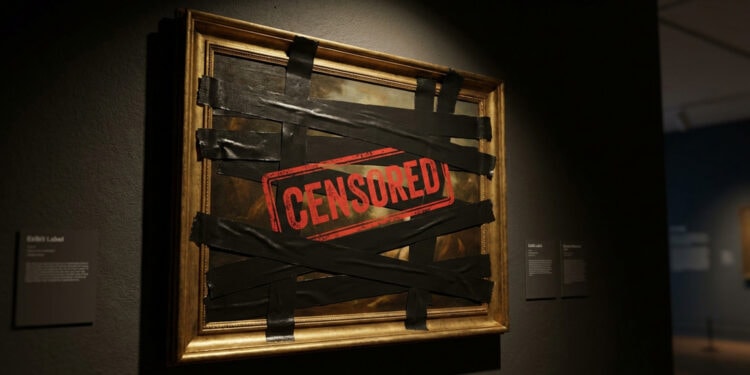

People were more willing to censor or financially devalue artwork when an artist was accused of sexual assault than when the artist was accused of several other crimes, even though they did not like the artwork any less. This research was published in Psychology of Aesthetics, Creativity, & the Arts.
Artists have a history of being associated with immoral or criminal behavior, but modern audiences can now respond collectively through boycotts, public criticism, refusal to financially support work, or pressure to remove artists from cultural spaces. These responses matter because ordinary consumers, beyond critics or institutions, influence what art is watched, streamed, displayed, purchased, or publicly supported.
Rebecka K. Hahnel-Peeters (@RandomMutations) and colleagues examined this issue by asking how Americans reappraise artwork after learning that the artist has been accused of a crime. Biographical information about artists can shape people’s aesthetic judgments; for example, positive artist narratives can increase appreciation, while negative moral information about an artist can reduce liking or alter perceptions of the work.
The present research extends prior work by asking whether the type of accusation matters, with particular attention to sexual assault, as it has been central to recent cultural debates.
“We were interested in this topic because it sits at the intersection of moral decision-making and cultural consumption,” explained Rebecka Hahnel-Peeters, an assistant professor of psychology at Indiana State University.
“The past decade has seen several movements drawing attention to sexual violence (e.g., #MeToo in 2017). These movements often reignite the questions ‘Should I enjoy this cultural product? Can we separate art from the artist?’ Despite how common these debates may be, there’s been surprisingly little empirical work examining how people respond when they learn new, negative information about artists.”
Across a pilot study and three experiments, the authors used a repeated appraisal-reappraisal structure to test how people respond to artwork after learning that the artist had been accused of a crime. In the pilot, 270 U.S. adults viewed the same abstract artwork by a fictional male artist, read a short artist biography, and rated the work. They were then asked to imagine that the artist had been accused of one of seven crimes: sexual assault, murder, physical assault, sexual harassment, vandalism, manslaughter, or self-harm (included to differentiate general harm from harming others).
Participants then rated the artwork again. The key outcome was censure, captured through 7-point agreement items regarding whether the artwork should be prevented from public display or whether people should avoid supporting or paying to see it. The study also included items about whether others should be allowed to enjoy the work, whether the participant would share the work, whether they liked the work, political orientation, and basic demographics.
Study 1 asked 217 U.S. adults to name their favorite male artist and describe a beloved work by that artist. After providing their initial ratings, participants were asked to imagine that this artist had been accused of one crime, such as sexual assault, murder, vandalism, or physical assault. They then reappraised the same artwork using similar censure, enjoyment, sharing, and liking items.
Study 2 returned to the fictional abstract artwork but used a within-person design. In this study, 159 U.S. online participants evaluated the same work after reading several different hypothetical accusations, allowing the researchers to see whether the same participant responded differently depending on the accusation type. This study also asked participants to rate how morally wrong and harmful various crimes were, and it included measures of political orientation and art knowledge.
Study 3 included 845 U.S. adults who viewed and rated a novel abstract artwork by a fictional male artist, then were randomly assigned to imagine one of four accusations: sexual assault, murder, physical assault of a woman, or sexual harassment. They re-rated the artwork on censure items, liking, whether the work moved them, and whether it should be destroyed.
This study also added a financial judgment: Participants estimated the artwork’s value on a $0 to $80,000 slider after being told that most of the artist’s work sold for $40,000. As in earlier studies, participants also completed demographic questions, political orientation items, and art knowledge measures.
Accusations of sexual assault led people to support stronger censure of the artwork than many other accusations did. In the pilot, participants were more willing to censure the artwork after a sexual assault accusation than after the other accusations combined, and this pattern held when compared individually with murder, vandalism, manslaughter, and physical assault of a man.
Study 1 showed a similar pattern even when people were thinking about a favorite artist and a beloved work. Sexual assault accusations produced more censure than murder, vandalism, or physical assault of a man, though not significantly more than physical assault of a woman. Study 2 again found that sexual assault led to stronger censure than self-harm and physical assault, though it did not significantly differ from murder in that within-person comparison.
Study 3 strengthened the overall conclusion in a larger sample. Sexual assault accusations produced higher censure than murder, physical assault of a woman, and sexual harassment. Importantly, this did not simply mean that people liked the artwork less. Sexual assault did not lead to significantly lower liking compared to the other accusations, even though it did lead to stronger support for limiting public or financial support for the artwork.
The economic measure showed the same pattern: After a sexual assault accusation, participants’ average valuation of the artwork dropped from about $19,928 to about $9,680, a larger decrease than after murder, physical assault of a woman, or sexual harassment. The authors also reported that the pattern was not explained away by political orientation, art knowledge, or participants’ judgments of how morally wrong or harmful the crimes were.
“People don’t uniformly respond to all types of criminal accusations,” Hahnel-Peeters told PsyPost.
“When participants learned that an artist was accused of sexual assault, they were more likely to support censorship of said artists’ work—such as preventing the artwork from being displayed or financially supported—compared to other crimes. This comparison held true for crimes rated as more harmful to the victim, such as murder.
“Participants’ reported liking of the artwork, however, did not consistently change. People might still privately enjoy the art but feel uncomfortable supporting it publicly. Participants were making more nuanced judgments than a simple ‘like it vs. don’t like it.’ They’re considering social signaling, support, and social consequences.”
When asked if there are any caveats to the research, Hahnel-Peeters said, “Yes, as with any scientific study.”
“Our studies relied on people’s self-reported judgments in hypothetical scenarios. This doesn’t always map perfectly onto real-world behavior. What people say they would do and what they actually do can differ,” she continued.
“We also focused on U.S. samples. Cultural norms around morality, punishment, and art consumption may vary widely, so the patterns we found in the U.S. may not generalize globally.
“We also used relatively simplified descriptions of accusations. Real-world cases are often more complex and include ambiguity, media framing, biased social support, and legal outcomes influencing how people respond.”
Hahnel-Peeters said, “Although our findings are robust across multiple studies, they should be interpreted as a first step—rather than a complete picture.”
As for future directions, “There are several questions that still need answers,” the researcher told PsyPost.
“Here are a few we think are especially exciting: Why sexual assault? Participants rated murder as more morally wrong, but sexual assault triggered greater support for censorship. Our study didn’t look at the why behind this pattern, so that’d be the next major step.”
“Cross-cultural differences: Do these patterns hold in other countries with different moral norms or media environments?”
“Different domains: Would we see the same reactions to artifacts from scientific fields, medicine, or technology? These products have more functional value than pieces of artwork, and the censorship of things like vaccines and scientific findings based on judgments of the author(s) may have serious implications.”
“People aren’t simply ‘canceling’ art across the board,” explained the researcher. “They seem to make domain-specific and morally nuanced decisions. Our findings suggest that people possibly distinguish between enjoying something privately and supporting it publicly. That distinction may help explain why controversies around artists persist: People are often conflicted rather than fully rejecting the work.”
The research, “Canceling Creativity? Exploring Artist Censure As a Function of Crime Type,” was authored by Rebecka K. Hahnel-Peeters, Jaimie Arona Krems, Keelah E. G. Williams, and Eric J. Pedersen.