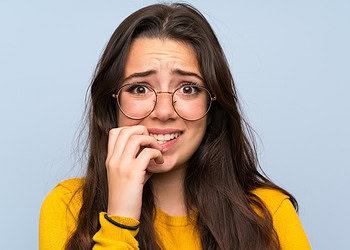
A recent study published in the journal Cognition and Emotion has uncovered new insights into how individuals with high social anxiety process emotional information. The research reveals that people who experience high levels of social anxiety adapt less to angry faces compared to happy faces, a mechanism that may contribute to maintaining negative biases in their perception of social cues. In contrast, individuals with low social anxiety show no significant difference in how they adapt to angry and happy faces.
Social anxiety is a common form of anxiety that involves a persistent fear of being negatively judged or evaluated by others. This condition can have a significant impact on an individual’s social interactions and quality of life. Although much is known about the symptoms of social anxiety, less is understood about the cognitive processes that help maintain it. One such process, according to some researchers, could be how people adapt to emotional stimuli—particularly emotional faces, which are key in social interactions.
“I have a long-standing interest in how we process information conveyed by our different senses and how our perception of the world develops. Our ability to perceive and interpret the emotion conveyed by a face is particularly important for social interaction,” said study author Vivian Ciaramitaro, an associate professor at the University of Massachusetts Boston and a principal investigator at the Early Minds Lab.
“I was intrigued by how a clinical condition, such as social anxiety, could bias how emotional information is processed and was fortunate to have a colleague in my department working on social anxiety, Dr. Sarah Hayes-Skelton, who was interested in collaborating on translational work, bridging the gap between basic science and clinical applications.”
“Individuals who are socially anxious have been shown to perceive faces more negatively,” Ciaramitaro explained. “Yet, what mechanism can explain such a negative bias? The mechanism we considered was altered adaptation to emotional information. Adaptation is a basic process that allows our sensory system to recalibrate and stop responding to repeated old information and focus on processing new information.”
“Adaptation has been shown to be altered in another clinical condition which affects interpreting social cues, autism spectrum disorder, resulting in weakened adaptation to face identity, for example. Here we considered if adaptation to emotional faces was altered as a function of social anxiety.”
The researchers conducted two experiments to investigated whether individuals with high social anxiety have a selective bias in how they adapt to emotional faces, particularly those that signal social threat.
In their first experiment, they recruited 85 participants from the University of Massachusetts Boston, ages ranging from 18 to 61, and divided them into two groups based on their level of social anxiety: high social anxiety and low social anxiety. To determine group placement, they used a self-report measure called the Brief Fear of Negative Evaluation (BFNE), which assesses participants’ fear of negative judgment in social situations. Of the original 85 participants, 76 remained after excluding those with comorbidities, insufficient valid trials, or response bias.
During the experiment, participants were shown emotional faces with varying degrees of happiness or anger. The researchers used an “adaptation” technique, which involves showing participants a series of emotional faces (either happy or angry) for a short period. Following this exposure, the participants were presented with neutral faces to see if their perception of these neutral faces had shifted based on the prior emotional exposure.
The participants were then asked to judge whether the neutral faces they saw were happy or angry. This method allowed the researchers to measure the strength of the adaptation effect—the degree to which repeated exposure to emotional faces altered the participants’ perceptions of subsequent neutral faces.
The results from Experiment 1 revealed that individuals with high social anxiety showed weaker adaptation to angry faces compared to happy faces. In other words, socially anxious participants were less likely to shift their perception of neutral faces after seeing a series of angry faces. This suggests that individuals with social anxiety remain more sensitive to negative, threatening social cues, such as anger, even after being repeatedly exposed to them.
On the other hand, the participants with low social anxiety showed no significant difference in adaptation to happy versus angry faces. This indicates that the altered adaptation seen in socially anxious individuals is specific to social anxiety and is not a general feature of emotional processing.
In Experiment 2, the researchers extended their investigation by examining how individuals with high social anxiety adapted to sad faces, a non-threatening negative emotion, compared to happy faces, with a new sample of 40 participants. The procedure was similar to that used in Experiment 1, except that the emotional stimuli included sad faces instead of angry ones. As in the first experiment, the participants were exposed to either happy or sad faces, followed by neutral faces, and were then asked to judge whether these neutral faces appeared happy or sad.
The findings from Experiment 2 showed no significant difference in how individuals with high social anxiety adapted to sad versus happy faces. This suggests that the weakened adaptation observed in Experiment 1 is specific to anger, a socially threatening emotion, rather than to negative emotions in general. This supports the idea that individuals with social anxiety are particularly sensitive to emotions that convey social threat, such as anger, but not to other negative emotions like sadness, which do not carry the same level of perceived hostility or rejection.
“We found that socially anxious individuals adapted less to negative i.e., angry faces, relative to adapting more to positive social information, i.e., happy faces,” Ciaramitaro told PsyPost. “Initially we were only thinking of the one side of this effect – if you don’t adapt and don’t weaken responsiveness to negative stimuli, you’d be over-sensitive and over-responsive to negative information.”
“But, the flip side can also create a negative bias. If you adapt more and weaken responsiveness to positive stimuli too much, you’d be less sensitive and under-respond to positive information. This is similar to flip sides of attentional effects where attention can enhance responsiveness to the target of interest or decrease responsiveness to distracting information, with either effect yielding enhanced performance.”
Together, the results of the two experiments demonstrate that “social anxiety can result in a bias to view social stimuli, such as faces, more negatively,” Ciaramitaro explained. “One mechanism that can create and perpetuate a negative bias in how faces are perceived is adapting too little to negative faces or adapting too much to positive faces, either will enhance responsiveness to negative relative to positive information.”
“Importantly, you’d expect such negative biases to matter for some negative faces and not others. We expected changes in adaptation to faces perceived as threatening, angry faces, but not for other negative emotions, such as sad faces, since socially anxious individuals are more sensitive to threatening, but not non-threatening, emotions. This is exactly what we found: individuals high in social anxiety showed altered adaptation for angry compared to happy faces but not to sad compared to happy faces.”
As with any research, this study has some limitations. One key limitation is that the sample was drawn from a college student population, which may not fully represent the broader range of individuals who experience social anxiety. While the findings are valuable in understanding how adaptation might work in socially anxious individuals, future studies should include clinical populations—those diagnosed with social anxiety disorder—rather than just students with varying levels of social anxiety.
“Ideally, you’d want to consider clinical populations rather than the sample of college age students considered here,” Ciaramitaro noted. “Furthermore, it would be important to quantify effects before and after treatment to determine a more causal role for this mechanism, i.e., if changes in adaptation occur as social anxiety improves. It would also be important to consider adaptation to other types of emotional information, such as voices.”
Additionally, the study did not examine whether the observed effects are specific to social anxiety or whether they are also present in other conditions, such as depression, which often co-occurs with social anxiety.
“I would say that one major caveat that needs to be teased apart better is the influence of social anxiety versus depression in creating negative biases, since depression, in and of itself, can result in a negative bias and depression is often co-morbid with social anxiety,” Ciaramitaro said. “We might have found even stronger effects in our study if we had included individuals with higher scores on measures of depression in our sample of individuals high in social anxiety.”
Nevertheless, the results of the study provide important new insights into the cognitive mechanisms that may help maintain social anxiety.
“I think it was an important element of our experimental design that we used faces that varied along an emotional continuum, with varying degrees of positive as well as negative emotion,” Ciaramitaro added. “Perceptual biases are most prevalent when stimuli are most ambiguous. Presenting fully affective faces would minimize any bias and only presenting ambiguous faces would increase the likelihood that participants would only make one type of response. Presenting a range of faces ensures that participants are engaged and paying attention as they must judge happy as well as angry faces, requiring different responses.”
The study, “Altered mechanisms of adaptation in social anxiety: differences in adapting to positive versus negative emotional faces,” was authored by Erinda Morina, Daniel A. Harris, Sarah A. Hayes-Skelton, and Vivian M. Ciaramitaro.