![[Adobe Stock]](https://sp-ao.shortpixel.ai/client/to_webp,q_glossy,ret_img,w_750,h_375/https://www.psypost.org/wp-content/uploads/2025/12/books-750x375.jpg)

A comprehensive analysis of English-language literature published over the last century reveals distinct patterns in how race and gender intersect within written text. The findings suggest that Black women and Asian men have historically appeared less frequently in books compared to Black men and Asian women, a phenomenon that aligns with psychological theories regarding social invisibility.
The research also provides evidence that these representational trends are not static and appear to shift in response to major historical events. These findings were published in the journal Current Research in Ecological and Social Psychology.
Joanna Schug, an associate professor at William & Mary, led the research team. She collaborated with Monika Gosin from the University of California San Diego and Nicholas P. Alt from Occidental College to investigate these long-term cultural trends. The study aimed to apply a historical lens to psychological theories that have typically been tested in laboratory settings.
Scholars have previously developed the concept of gendered race theory to explain how society perceives different groups. This framework suggests that the racial category “Black” is often cognitively associated with masculinity. Conversely, the racial category “Asian” is frequently associated with femininity.
These mental associations can lead to a phenomenon known as intersectional invisibility. This theory posits that individuals who do not fit the prototypical stereotypes—specifically Black women and Asian men—are often overlooked or marginalized. Because they do not align with the dominant gendered stereotypes of their racial groups, they may become less visible in cultural representations.
Prior experiments have supported these theories by showing that people are more likely to forget statements made by Black women or Asian men compared to other groups. Schug and her colleagues sought to determine if this psychological bias extended to cultural artifacts. They investigated whether these patterns of invisibility could be quantified in millions of books published over a 120-year period.
To conduct this analysis, the researchers utilized the Google Books Ngram dataset. This massive digital archive contains word frequency data from over 15 million books published between 1900 and 2019. The team examined two specific collections within this dataset: a general corpus of English-language books and a specific corpus containing only fiction texts.
The investigators tracked the frequency of specific phrases, known as “ngrams,” that combine racial and gender identifiers. They searched for terms such as “Black woman,” “Black man,” “Asian woman,” and “Asian man.” To ensure the search was comprehensive, they included various synonyms and historical terms relevant to different time periods.
For the category of Black individuals, the search included terms like “African American” and older designations that were common in the early 20th century. For Asian individuals, the researchers included specific ethnic groups such as Chinese, Japanese, Korean, and Vietnamese. They calculated the raw frequency of these terms to compare their prevalence in fiction versus nonfiction works.
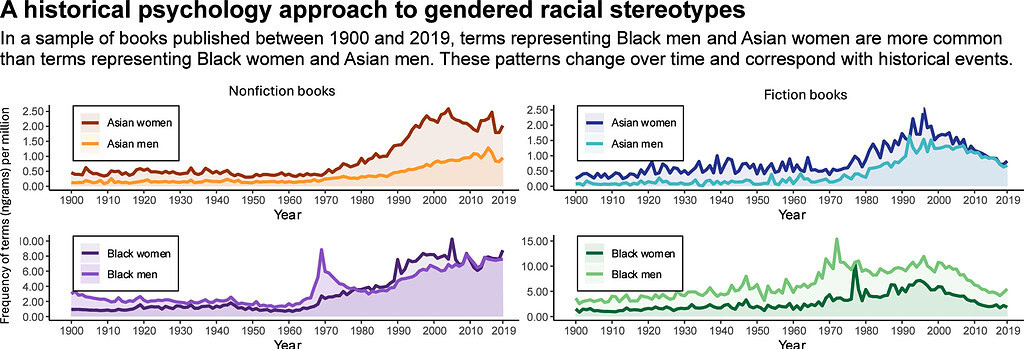
The results from the first part of the study provided evidence supporting the existence of representational invisibility in literature. Throughout the majority of the 20th century, terms referring to Black men appeared more often than terms referring to Black women. This gap was present in both fiction and nonfiction texts.
Similarly, the analysis showed a consistent disparity in representations of Asian identities. References to Asian women generally outnumbered references to Asian men. This pattern persisted across the studied time period, although the gap was particularly pronounced in nonfiction books starting in the 1990s.
The researchers argue that these patterns reflect deep-seated historical stereotypes. For example, historical labor laws and immigration policies often restricted Asian men to domestic roles, which may have contributed to feminized stereotypes. In contrast, historical narratives surrounding Black identity have often focused on men, particularly in the context of labor and political struggle.
The study also included a comparison with White gender categories. The data showed that references to White men far exceeded references to White women. This finding aligns with the concept of androcentrism, where men are treated as the default representation of a group.
While the general patterns supported the theory of intersectional invisibility, the researchers observed a notable shift beginning in the late 20th century. In nonfiction books, references to Black women began to increase substantially around 1980. Eventually, the frequency of terms for Black women surpassed those for Black men in nonfiction texts.
To understand the drivers behind these shifts, the authors conducted a second study. They hypothesized that specific social movements might be influencing how often these groups were mentioned in print. They focused on the Civil Rights Movement and the Black Feminist movement.
The team identified key terms associated with these movements. For the Civil Rights Movement, they tracked phrases like “Civil Rights Movement” and “Black Power.” For the Black Feminist movement, they tracked terms such as “Black feminist” and “womanist.”
They then used statistical models to analyze the relationship between these movement-related terms and the frequency of race-gender categories over time. The analysis examined whether a rise in social movement terminology corresponded with a rise in the visibility of specific groups.
The findings indicated a strong link between the Civil Rights Movement and the representation of Black men. Increases in terms related to Civil Rights were positively associated with increases in references to Black men in both fiction and nonfiction. This suggests that the discourse of this era primarily elevated the visibility of Black men.
In contrast, the Civil Rights terminology did not show a significant positive association with references to Black women. This aligns with critiques from scholars like Kimberlé Crenshaw. Crenshaw has argued that antiracist efforts during that era often focused on the experiences of Black men, while feminist efforts often focused on White women.
However, the data revealed a different pattern regarding the Black Feminist movement. The rise in terms associated with Black Feminism was a significant predictor of increased references to Black women. This effect was particularly strong in nonfiction texts.
This suggests that the Black Feminist movement played a role in correcting the historical invisibility of Black women in literature. As scholars and activists began to produce more work centered on the experiences of Black women, the language in published books shifted to reflect this focus.
The study did observe some differences between fiction and nonfiction. For instance, while Black Feminism terms predicted more mentions of Black women in nonfiction, they were negatively associated with mentions of Black men in fiction. This indicates that different genres may respond to cultural shifts in distinct ways.
The researchers note that the patterns for Asian men and women remained relatively stable compared to the shifts seen for Black men and women. The representation of Asian men remained lower than that of Asian women throughout most of the period. The authors suggest that future research could investigate if specific Asian American social movements have had similar effects on representation.
But there are some limitations to to consider. The Google Books dataset, while vast, is not a perfect representation of all culture. It tends to overrepresent academic and scientific publications, which might skew the results toward scholarly discourse rather than everyday language.
Additionally, the study is correlational. This means that while the rise in social movement terms coincides with changes in representation, it does not definitively prove that the movements caused the changes. Other unmeasured societal factors could have contributed to these trends.
The researchers also point out the complexity of the term “Asian” in their analysis. The study primarily utilized terms related to East Asian identities. This focus means the findings may not fully capture the experiences of South Asian or Southeast Asian groups.
Despite these limitations, the study offers new insights into how cultural stereotypes are preserved and challenged over time. It provides empirical evidence that the “invisibility” of certain groups is not just a theoretical concept but a measurable phenomenon in the written record.
The findings also highlight the potential of social movements to alter widespread cultural narratives. The increase in references to Black women following the rise of Black Feminism suggests that concerted intellectual and political efforts can successfully challenge representational biases.
Future research could build on this work by using more advanced text analysis methods. Newer techniques could examine the context in which these words appear, rather than just their frequency. This would allow for a deeper understanding of the quality of representation, beyond just the quantity.
The study, “A historical psychology approach to gendered racial stereotypes: An examination of a multi-million book sample of 20th century texts,” was authored by Joanna Schug, Monika Gosin, and Nicholas P. Alt.