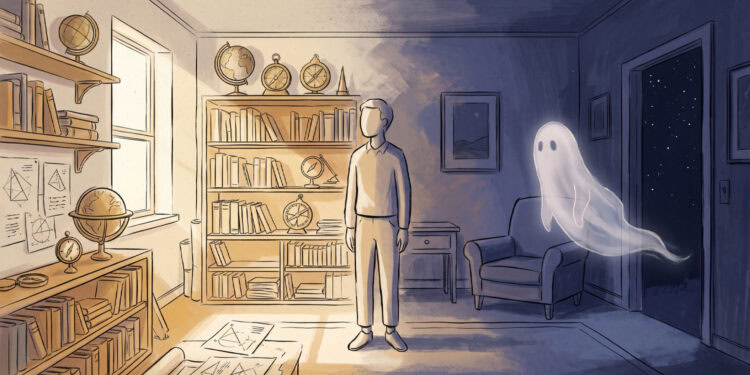
If you’ve ever felt a twinge of unease touring a house with a grim past—or caught yourself quietly dodging a jinx even though you consider yourself a rational, science-minded person—you’re in familiar territory. Most of us assume that trusting science and brushing off official church rules gradually dries up superstition.
Actually, the pattern runs the other way, and it doesn’t belong to the group you might expect. Strict atheists aren’t the ones pairing a scientific worldview with ghosts, curses, and minor rituals. Instead, that combination turns up most strongly in people straddling two worlds—relying on science over religious doctrine while still keeping one foot in faith, whether that means believing in God, claiming a religious affiliation, or attending church services.
When science replaces church rules, not wonder
We tend to picture reason and the supernatural as a simple seesaw: when science goes up, everything eerie or mystical drops out. In everyday life, though, stepping away from institutional authority rarely flips an off switch on curiosity about unseen forces.
What fades first is the official, church-approved version of the supernatural. People who lean on science to understand the world and prefer making moral choices from human experience rather than religious teachings are much less likely to believe in traditional, God-created miracles.
Don’t miss the next big psychology finding
Every morning, PsyPost sends a short briefing on the most interesting new peer-reviewed research in psychology and neuroscience.
Yet that same independent outlook tracks with stronger belief in everyday superstitions—like performing small rituals to ward off bad outcomes, avoiding jinxes, or feeling uncomfortable buying a home where a murder happened—alongside magical ideas like ghosts, curses, predicting the future, and spirits inhabiting objects.
The sweet spot between strict faith and total disbelief
That split emerged in research published in Social Forces by Baylor University sociologist Paul Froese, alongside Isaiah King of Carson-Newman University and Ruiqian Li of American University. Drawing on the 2025 Baylor Religion Survey of 1,812 American adults, the team compared respondents’ commitment to science and independent spiritual judgment against three categories of belief: traditional miracles, magic, and everyday superstitions.
When they separated committed nonbelievers from people with lingering religious habits, the picture sharpened. Among strict nonbelievers and people who never attended church, valuing science didn’t give magical thinking or superstition a boost. The link largely vanished.
Where magic and superstition really flourished was in the middle. Sociologists refer to this dynamic as bounded affinity: keeping some tie to faith leaves the door open to unseen forces, while adopting a secular, scientific mindset loosens a church’s grip on which supernatural ideas stay off-limits.
PsyPost’s full coverage of the study breaks down how the researchers built their belief scales, how demographic factors like income and education played out—including the finding that education didn’t significantly predict any of the three supernatural categories—and how magical thinking historically overlapped with early science.
Why magic feels surprisingly compatible with logic
Why would a science-minded person warm up to magic in the first place? Part of the answer comes down to how magic works. Unlike organized religion, which centers on formal theology and a shared moral community devoted to a higher power, magic operates more like a toolkit—transactional efforts aimed at nudging unseen forces for practical, worldly results.
In a strange way, that mindset mirrors a mechanical, problem-solving outlook. Even when people want nothing to do with official dogma, the notion that hidden forces can be decoded or worked with can offer a sense of personal agency and optimism in a chaotic world.
The study contributes to the scientific understanding of how supernatural beliefs evolve as organized religion loses institutional authority. However, because the survey captured a single moment in time, it cannot prove that adopting a science-first outlook directly causes someone to embrace ghosts or superstitions, and its broad umbrella of magic bundles very different concepts—from casual jinxes to psychic phenomena—together. Readers interested in the full caveats and how online wellness gurus might fuel these blended beliefs can explore them in PsyPost’s in-depth report.
So if a fiercely practical friend rolls their eyes at church rules yet still refuses to tempt fate or keeps an open mind about ghosts, there’s nothing contradictory about it. Stepping back from organized doctrine doesn’t automatically erase the appetite for mystery—for many people, it simply moves that mystery out of the church and into everyday life.
