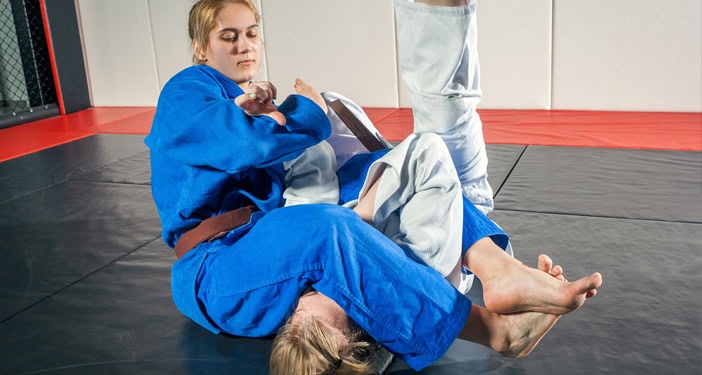

New research sheds light on how some of the rituals associated with Brazilian Jiu Jitsu affect practitioners’ sense of oneness with their martial arts training group.
Social theorists have argued that painful rituals, which have been common all throughout human history, are a means of forging social bonds. But the proposition has been subjected to relatively little empirical research.
The new study, published in European Journal of Social Psychology, examined how BJJ rituals impacted “identity fusion,” where personal and group identities blur, producing a sense of oneness.
“I had trained in Brazilian Jiu Jitsu for a number of years before starting my PhD, so when I started focusing in my research on painful ritual experiences the belt whipping gauntlets that are a (controversial) part of many BJJ promotions came straight to mind,” said study author Christopher Kavanagh of the University of Oxford.
“Moreover, martial arts communities are often overlooked in research despite the fact that they are common across many societies and usually involve highly dedicated people and tightly bonded communities.”
The so-called “gauntlet” is a ritual that occurs after a person has been promoted to a higher belt. The promoted person walks past a line of their training partners, who use their belt to whip or slap the promoted person.
The researchers surveyed 605 BJJ practitioners regarding their training, belt promotion experiences, and other factors. About half of the participants (52.9%) reported enduring belt whipping gauntlets as part of their belt promotion ritual.
But Kavanagh and his colleagues found no evidence that the painful ritual was associated with greater identity fusion overall.
“Despite widespread claims that hazing/shared experiences of pain are uniquely able to bind people together, we found that there was no difference on group bonding measures between BJJ practitioners who had experienced belt whipping events during their promotions and those who had not,” Kavanagh told PsyPost.
The gauntlet was linked to stronger social bonds in some cases.
“What did predict group bonding and pro-group action across the sample, however, was how positively people judged their promotional experiences. So if people had a positive perspective of the painful belt whippings they endured during their promotions, they did feel more bonded to their team, but the opposite was true for those who did not,” Kavanagh explained.
“This result suggests that people who run martial arts/sports groups need to be wary about making any hazing-type promotional activities mandatory. Instead, if they care about group bonding and still want to perform painful rituals, they should let people opt out; without shaming them. A number of BJJ schools already do this, or have banned gauntlets altogether, but there are also many where grueling gauntlets are the norm.”
The study — like all research — has some limitations.
“The study was cross-sectional meaning that we collected all responses at the same time, therefore it is hard to precisely establish causal relationships. A good follow up study would be to follow a selection of BJJ practitioners over time and measure how their bonds with their groups change, especially following promotional rituals,” Kavanagh said.
“Our study also found no correlation between pain at promotion events and group bonding, which contrasts with recently reported experimental studies. Currently there are too few studies on this topic so more work needs to be done to better establish the relationship between shared pain and bonding.”
“While studying the promotion rituals of BJJ practitioners might seem esoteric, our daily lives are saturated with rituals of all different varieties — from hand shaking to World Cup opening ceremonies — so it is important to understand the psychology involved,” Kavanagh added.
The study, “Positive experiences of high arousal martial arts rituals are linked to identity fusion and costly progroup actions“, was authored by Christopher Michael Kavanagh, Jonathan Jong, Ryan McKay, and Harvey Whitehouse.