

New research shows having a greater number of older brothers increases the probability of a person entering a same-sex union at some point in their lives.
This finding, detailed in our paper published this month in the Journal of Sex Research, offers a rare insight into the origins of sexual orientation.
The origins of sexual orientation
In recent decades, many countries have achieved remarkable progress towards equal treatment of LGBTIQ+ people, including greater public support and more protective legislation. But despite these encouraging developments, sexual minorities still experience high levels of stigma – and the origins of sexual orientation remain a matter of debate.
A growing body of research is attempting to shed light on why some people experience same-sex sexual attraction and others don’t. These studies have substantial implications for public opinion and debate, and subsequently the treatment of LGBTIQ+ people.
For example, we know people who view sexual orientation as a product of biological factors (such as hormones or genetics) are more likely to support sexual minorities and their civil rights, compared to those who view it as a product of social factors or individual choice.
The fraternal birth order effect
The “fraternal birth order effect” is one of the most well-documented patterns supporting a biological origin of human sexual orientation. This longstanding hypothesis proposes men’s propensity for homosexuality increases with the number of older biological brothers they have.
This effect has been attributed to a mother’s immune reaction to proteins produced by a male foetus. The proteins enter the mother’s bloodstream and trigger the production of antibodies that influence the sexual development of subsequent children.
These maternal antibodies accumulate over successive pregnancies with male foetuses, which means men with more older brothers are more likely to experience same-sex sexual attraction.
However, previous research documenting the fraternal birth order effect has relied on small and selective participant samples, which has led some scholars to question the authenticity of the phenomenon. Indeed, no study of a representative population sample has supported its existence – until now.
Our research
Our research used unique data from Dutch population registers. These data allowed us to follow the life trajectories of more than nine million people born between 1940 and 1990.
In previous studies we used this dataset to examine whether the gender of a married couple’s children affected the stability of their union, and to compare the academic performance of children raised by same- and different-sex couples. This time, we used it to provide a robust test of the fraternal birth order effect.
While the data did not contain direct measures of individuals’ sexual orientation, they did indicate whether they ever entered a same-sex marriage or registered partnership. We used this information as a proxy for homosexuality.
In the Netherlands, registered same-sex partnerships have been recognised since 1998, and same-sex marriage since 2001.
What we found
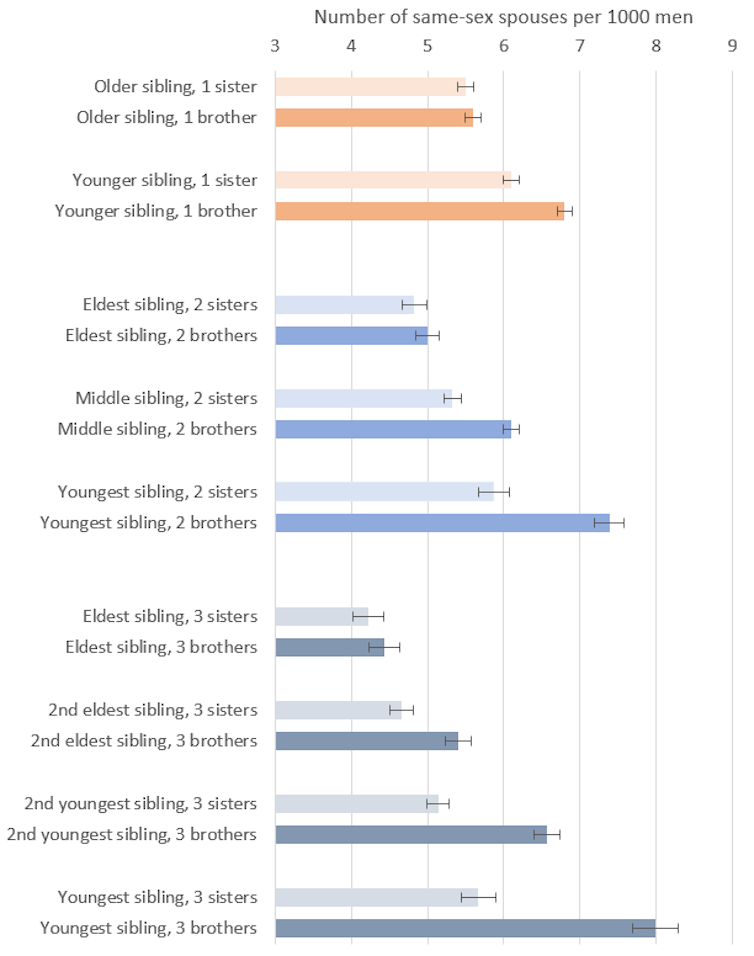
Our results show clear evidence of a fraternal birth order effect on homosexuality. Specifically, men with one older brother are 12% more likely to enter a same-sex union than men with one older sister, and 21% more likely than men with just one younger brother or sister.
The birth order and total number of siblings matter too. Men who are the youngest sibling are more likely to enter a same-sex union than men who are the oldest sibling, and the differences grow larger as the total number of siblings increases.
For example, the probability of a man entering a same-sex union is 41% greater if he has three older brothers, as opposed to three older sisters, and 80% greater than if he has three younger brothers.
The chart below illustrates some of our findings, showing the number of men who entered same-sex unions among those with up to three siblings. The sex of older siblings wields a considerable influence over same-sex union formation. On the other hand, the sex of younger siblings plays little to no role.
Author provided
Unlike earlier studies which focused almost exclusively on men, we documented the same pattern of results among women. We found women are also more likely to enter a same-sex union if they have older brothers.
This finding yields tentative support to arguments that maternal antibodies and foetal proteins also interact to influence womens’ sexual development.
What does it all mean?
Our results tell a clear and consistent story: the number and sex of one’s siblings play an important role in the development of their sexuality.
This evidence aligns squarely with perspectives that emphasise sexual orientation as an innate trait and a reflection of a person’s true self, rather than a product of “lifestyle choices” or a “fashion trend” as some suggest.
Of course, in an ideal society, the rights and respect people are afforded should not depend on whether their sexual identity is “innate” or “a choice”. But unfortunately, these issues still loom large in contemporary debate, further highlighting the importance of our findings.
A biological basis for human sexuality suggests harmful practices like conversion therapy can’t alter someone’s sexual orientation. It also discredits claims homosexuality can be “taught” (such as through sexual diversity education at schools) or “passed on” (such as through same-sex couples adopting children).
We acknowledge the diverging opinions on the value of research concerning the origins of human sexuality. Some feel such research is irrelevant because the findings should have no bearing on public attitudes or legislation, while others reject it for more hostile reasons.
Like others before us, we consider this research essential. Understanding the mechanisms behind sexual orientation can offer insights into what makes people who they are, and helps normalise the full spectrum of human sexual diversity. 
This article is republished from The Conversation under a Creative Commons license. Read the original article.