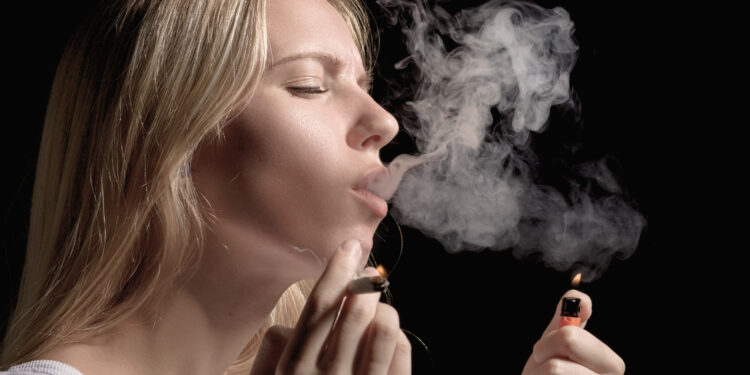

A new longitudinal study indicates that the amount of dried cannabis flower consumed by naturally cycling individuals with premenstrual symptoms fluctuates across the menstrual cycle, peaking in the days just before menstruation and rising again around ovulation. These premenstrual increases in cannabis consumption were particularly pronounced on days when individuals experienced worse-than-usual emotional sensitivity or interpersonal conflict. The findings, published in Addictive Behaviors, suggest that both symptom management and hormone-linked changes in reward processing may shape patterns of cannabis consumption across the reproductive cycle.
Menstrual cycles are driven by rhythmic changes in ovarian hormones, primarily estradiol (the main form of estrogen in reproductive-age females) and progesterone. A typical cycle has two stages: the follicular phase, spanning from the first day of menstrual bleeding until ovulation (when an ovary releases an egg), and the luteal phase, following ovulation until the next period begins.
In people with premenstrual disorders, such as premenstrual dysphoric disorder (a severe form of premenstrual syndrome marked by emotional and physical symptoms) or the premenstrual worsening of underlying mood conditions, substantial cyclical mood and behavioral changes in the days leading up to menstruation reflect a heightened sensitivity to normal hormone shifts.
Although men have historically used cannabis at higher rates than women, rising female consumption has narrowed that gap. Women tend to meet criteria for cannabis use disorder after fewer years of use than men and experience more severe withdrawal symptoms, pointing to a need to identify female-specific factors in substance use. Two emotion-based theories help explain why substance use may shift across the cycle: the self-medication theory proposes that people use substances to relieve negative moods that rise during the luteal and perimenstrual phases, while the reward-sensitivity theory suggests that pre-ovulatory estradiol surges heighten the brain’s responsiveness to pleasurable stimuli.
While patterns matching both theories appear in alcohol, nicotine, and stimulant use, evidence for cannabis has been inconclusive. A 2021 study of nearly daily cannabis users with premenstrual dysphoric disorder found that consumption rose during the premenstrual and menstrual phases, peaked in the follicular phase, and decreased around ovulation and the mid-luteal phase. However, that study confirmed the disorder using only depressed mood rather than all core emotional symptoms and did not biologically verify the day of ovulation.
Study lead author Gianna Zorzini, senior author Jennifer L. Gordon, and their colleagues in the Reproductive Mental Health Research Unit in the Department of Psychology at the University of Regina designed the new study to address both limitations.
“Cannabis use among women has increased in recent years, yet we still know relatively little about why and when women use cannabis,” Zorzini told PsyPost. “We wanted to better understand whether cannabis use changes throughout the menstrual cycle and how these changes relate to emotional symptoms, particularly those associated with premenstrual disorders.”
The researchers analyzed pre-treatment data from a registered clinical trial evaluating a self-help program for premenstrual disorders, with the raw dataset kept confidential. Sixty-four naturally cycling individuals aged 18 to 42 in Canada and the United States, recruited through a premenstrual disorder advocacy organization’s social media channels, completed the tracking phase. All had regular 21-to-35-day cycles and a diagnosed or suspected premenstrual disorder, and could not be pregnant, breastfeeding, using hormonal contraceptives or hormone medications, or receiving cognitive or dialectical behavior therapy. Participants completed daily surveys each evening at 6:00 p.m. across two to three menstrual cycles.
At baseline, participants completed clinical interviews and questionnaires assessing depression, anxiety, stressful life events over the past six months, and lifetime traumatic events. Reflecting a help-seeking sample, roughly 83 percent of the 64 participants met criteria for another psychiatric diagnosis and about 44 percent were taking antidepressants. Each evening, participants logged whether they had used cannabis the previous day and reported the amount by product type: grams of dried flower, milligrams of tetrahydrocannabinol (THC, the main psychoactive compound in cannabis) in edibles or oils, or hits of concentrate. They also rated daily symptoms on a six-point scale covering core emotional difficulties including depressed mood, anxiety, mood swings, anger or irritability, emotional or rejection sensitivity, and interpersonal conflict.
Using these daily logs, the team distinguished participants whose premenstrual disorder was confirmed through daily tracking, defined as at least a 30 percent premenstrual increase in four or more symptoms in at least one cycle, from those meeting only provisional criteria during their initial interview. That cutoff, chosen based on prior evidence of premenstrual impairment, is slightly broader than the formal diagnostic standard for premenstrual dysphoric disorder, which requires five symptoms across two cycles.
Because cycle lengths vary between and within individuals, simply counting days can misalign hormonal phases. The researchers combined self-reported menstruation dates with urine tests detecting luteinizing hormone surges, which typically precede ovulation by about a day. They then used phase-aligned cycle time scaling, a method that maps each cycle onto a continuous timeline anchored to both menstruation onset and ovulation. Generalized additive mixed models, which capture curved, non-linear trends over time, were used to test whether cannabis likelihood and quantity fluctuated cyclically, followed by exploratory models testing whether daily symptoms or baseline traits changed the shape of those cycle patterns.
Of the 64 participants, 25 used cannabis at least once across 47 to 87 tracked days (averaging 61.70 days and totaling 1,449 observations). Ovulation was confirmed by urine test for 49 cycles and estimated by counting backward for 5 cycles, and excluding those 5 cycles did not change the results. Compared to the 39 non-users, cannabis users reported more recent stressful life events (averaging 4.8 versus 2.7) and had higher odds of having a premenstrual disorder confirmed through daily tracking (80 percent versus 53.8 percent, representing roughly four times the odds, or nearly five times the odds after adjusting for age, country, and stressful events).
Users consumed cannabis on an average of 27.48 days, or 44.4 percent of tracked days. Eighty percent of users consumed edibles or oils at least once (178 observations, averaging 3.56 milligrams of THC and ranging from 0.02 to 50.00 milligrams), and 68 percent used dried flower (341 observations, averaging 0.95 grams and ranging from 0.02 to 5.00 grams). Another 32 percent used concentrates (95 observations, averaging 3.91 hits and ranging from 1 to 10 hits) and 16 percent used other THC products, with both of these categories excluded from cycle modeling due to few observations.
Across the group, the daily probability of using cannabis showed no statistically significant cyclical pattern, whether looking at overall cannabis use, dried flower, or edibles and oils. Participants differed substantially from one another in their average likelihood of use, and person-specific cyclical patterns appeared for overall cannabis use and for edibles and oils, though not for dried flower. However, the quantity of dried flower consumed on use days followed a cyclical pattern across the group when anchored to menstruation onset, peaking premenstrually and rising again around ovulation. The authors suggest that earlier research may have missed this ovulatory rise because it did not biologically confirm when ovulation occurred.
When the dried flower data were anchored to ovulation instead of menstruation onset, the group-level trend for quantity was not statistically significant, and individual patterns varied widely around ovulation, giving reason to treat the group-level pattern with some caution. The authors note that this person-to-person variability may have obscured a shared group pattern, or the sample may have been too small to detect one.
In the ovulation-anchored model, among the roughly 16 dried-flower users, about half showed only a premenstrual increase, three showed only an ovulatory increase, and five showed both. The authors describe the evidence for the ovulatory rise as weaker than for the premenstrual one, since fewer individuals showed it. For THC-infused edibles and oils, the group-level cyclical pattern in milligrams consumed on use days was not statistically significant, despite a slight upward trend right after menstruation onset and substantial variation in person-specific trajectories.
“We were surprised that increases in cannabis use before menstruation were more common than increases around ovulation,” Zorzini said. “Although we observed both patterns, they differed considerably between women. This raises interesting questions about why some women show different consumption patterns across the cycle.”
“Not everyone used more cannabis at the same points in their menstrual cycle or to the same extent,” she added. “This suggests that individual differences are important and that there is no single pattern that applies to everyone. Larger studies are needed to better understand what explains these differences.”
In exploratory within-person analyses, daily fluctuations in core emotional symptoms changed the shape of the cyclical pattern for dried flower quantity. Higher-than-usual daily emotional symptoms were associated with greater premenstrual dried flower consumption, whereas lower-than-usual symptoms corresponded with lower premenstrual intake. Around ovulation, by contrast, lower-than-usual emotional symptoms were tied to greater dried flower consumption than higher-than-usual symptoms.
After adjusting for multiple comparisons, higher-than-usual emotional or rejection sensitivity and interpersonal conflicts were the specific daily symptoms that shaped the premenstrual rise in dried flower quantity. Daily emotional symptoms had no statistically significant link to the daily likelihood of use or to edible and oil quantities.
“Women tended to use more cannabis on days when they experienced greater emotional sensitivity or more conflicts with others than usual,” Zorzini noted. “This suggests that emotional experiences may play a role in cannabis use, although we cannot determine whether women were using cannabis specifically to cope with these symptoms.”
Preliminary exploratory analyses suggested that baseline characteristics also shaped consumption curves, though the authors note these tests had low statistical power and very small, uneven subgroups. Stronger premenstrual increases in dried flower quantity appeared among the 20 users whose premenstrual disorder was confirmed through daily tracking (compared to the 5 users who met only provisional criteria), older participants, those with more past traumatic events, and the 17 users not taking antidepressants (compared to the 8 who were). For edibles and oils, older age was linked to a steeper increase during the early luteal phase, in the days soon after ovulation. Because age and trauma history were modeled separately and showed a positive correlation that was not statistically significant (r = 0.33), their independent contributions remain uncertain.
The authors suggest that the rise in dried flower use around ovulation aligns with the reward-sensitivity theory, as pre-ovulatory estradiol surges can heighten responsiveness to the rewarding effects of substances at a time in the cycle when emotional symptoms are relatively low. They also suggest that dried flower, which is usually smoked or vaped and acts quickly, may have been preferred for fast relief from premenstrual symptoms, whereas ingested edibles and oils act more slowly, though the study did not record how participants consumed their cannabis. Similarly, the researchers propose that individuals not taking antidepressants may use cannabis premenstrually to cope with mood changes, while those on antidepressants may already have their cyclical symptoms buffered pharmacologically.
There are a few things to keep in mind when interpreting these results. Because the study relied on observational tracking, it cannot establish whether premenstrual symptoms drove higher cannabis use or whether cannabis altered subsequent symptom ratings. Dried cannabis flower often contains cannabidiol (CBD), a non-intoxicating compound that some research suggests may ease menstrual symptoms, so cannabis itself may have affected the symptoms participants reported, and the study did not measure THC and CBD concentrations.
“An important limitation is the limited generalizability, as all women in our study suspected they had a premenstrual disorder because they experienced emotional changes throughout their menstrual cycle,” Zorzini explained. “Our findings may therefore be particularly relevant to women who experience premenstrual emotional symptoms, but we cannot assume that the same patterns apply to all women.”
The small sample of 25 cannabis users also limits generalizability, especially for the exploratory between-person comparisons, where limited statistical power can obscure true differences or inflate observed effect sizes. In addition, the researchers did not assess consumption motives or histories of clinical substance use disorders, leaving it uncertain whether the observed patterns reflect casual use, targeted symptom relief, or clinical dependence.
Future studies with larger, more balanced samples will be needed to verify whether these cyclical peaks in dried flower use replicate and whether baseline vulnerabilities to reward-seeking behaviors explain why a subset of users consumed more cannabis around ovulation. Incorporating direct measures of product potency, ingestion methods, and daily motives could help explain why people reach for specific cannabis products across the cycle and inform female-tailored prevention and treatment approaches.
“Our next step is to study larger and more diverse groups of women,” Zorzini told PsyPost. “We hope to better understand why and when cannabis use changes throughout the menstrual cycle for some women but not for others, and whether these patterns are related to emotional symptoms. Ultimately, this research could help inform more individualized prevention and treatment approaches.”
“Women have historically been underrepresented in substance use research, and factors related to the menstrual cycle have often received limited attention,” she added. “We hope our study encourages more research that considers women’s unique experiences and the factors that may influence their substance use.”
The study, “Menstrual cyclicity of cannabis use: a longitudinal study using phase-aligned cycle time scaling (PACTS),” was authored by Gianna Zorzini, May Ly, Taryn Wahl, and Jennifer L. Gordon.