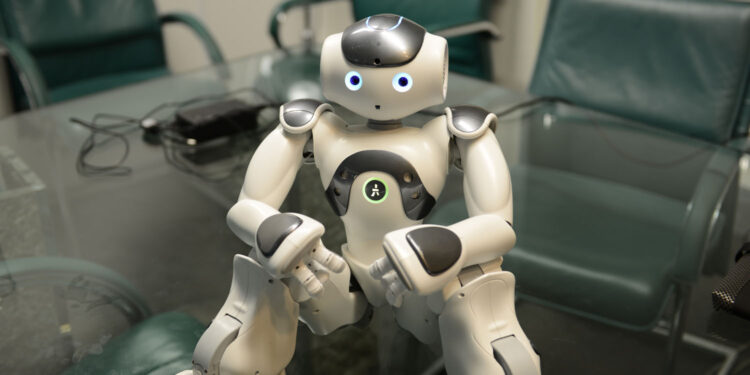

When interacting with highly realistic humanoid robots, the simple presence of eyes strongly shapes how humans perceive the machine’s mental abilities. A recent study published in Consciousness and Cognition provides evidence that people are far more likely to see a robot as capable of independent action and emotional experience if it has eyes on its face. The findings suggest that this specific facial feature plays a surprisingly powerful role in human interaction with artificial beings.
As artificial intelligence becomes more advanced, engineers are increasingly designing humanoid robots for everyday social environments. In human interaction, eyes act as important social signals that communicate attention, intentions, and emotions. Some ethicists have warned against adding eyes to robots, arguing that it creates a deceptive illusion of consciousness and empathy in a machine that does not actually possess them.
“Humanoid robots are becoming increasingly common in social environments, meaning that people are now expected to engage with artificial agents in ways that resemble human interaction. Prior research shows that humans rely heavily on eyes to convey information during social exchanges, and that people may even respond to robotic eye gaze as if it carries social intent,” said study author Samuli Linnunsalo, a postdoctoral researcher in the Human Information Processing Laboratory at Tampere University.
“Yet, despite this, surprisingly many new humanoid robots are designed without eyes. Because successful human–robot interaction depends on humans perceiving robots as having mental abilities, we wanted to examine whether simply adding eyes influences our tendency to attribute mental capacities to robots.”
To explore this, the researchers conducted two separate experiments using online participants from Western, English-speaking countries. In the first experiment, they recruited 200 adult participants to complete a self-evaluation questionnaire.
The scientists used an artificial intelligence image generator to create 48 highly realistic pictures of humanoid robots with full bodies. They produced two versions of each robot identity: one with eyes and one where the eyes were digitally removed.
To ensure a variety of appearances, the robots featured different characteristics, including adult-like or child-like proportions, humanoid faces or display screens, and direct or averted body orientations. Each participant viewed 24 robot images and answered four specific questions about each machine’s capabilities.
These questions asked participants to rate things like whether the robot could act with self-control or experience fear. Participants answered on a scale of one to nine.
The scientists found that participants gave higher agency and experience ratings to the robots with eyes compared to those without eyes. The addition of eyes increased perceived agency and experience even more for child-looking robots than for adult-looking robots.
Additionally, robots with digital screen faces tended to receive slightly higher ratings than those with physical, humanoid faces. The researchers suspect people might associate screens with advanced computer technology, leading to higher estimations of mental capability.
In the second experiment, the scientists wanted to see if these explicit survey answers matched people’s automatic, unconscious reactions. They recruited 100 new adult participants to complete a timed categorization task known as an implicit association test.
This type of test measures underlying biases by tracking how quickly a person pairs specific images with specific words. A faster reaction time suggests a stronger, more automatic connection in the person’s brain.
One group of 51 participants matched robot images with words related to agency, such as autonomous, passive, planful, or mindless. The researchers selected these specific words based on an earlier pilot study of 50 adults who rated various adjectives.
The other group of 49 participants matched the robot images with words related to experience, such as emotional, sensitive, impassive, or unfeeling. The scientists selected five robot identities from the first experiment, showing each participant the versions both with and without eyes.
The implicit association test results aligned perfectly with the first experiment. The participants demonstrated a strong, automatic mental link between the presence of eyes and higher levels of both agency and experience.
The researchers noted that this automatic bias occurred before participants had time to consciously think about their answers. It suggests that the effect is deeply rooted in human social cognition.
“We were surprised by the consistency of results across self-reports and the Implicit Association Test,” Linnunsalo told PsyPost. “Even when people weren’t consciously evaluating the robots, their automatic responses still showed the same bias toward robots with eyes. This suggests that the effect is robust and deeply rooted in human social cognition.”
The scientists note that humans have a natural tendency to assign human characteristics to objects with human-like features. Seeing a robot with two eyes causes a human to intuitively direct their attention to the machine’s head.
This reaction ties into theories of attention, which propose that humans assume a mind exists wherever they see directed attention. Because eyes are powerful cues for attention, they can trick our brains into perceiving a conscious being.
The scientists also asked participants about their general interest in new technology and their skepticism regarding whether robots could ever attain true consciousness. For people who reported a high interest in new technology, the absence of eyes caused an even sharper drop in their automatic associations with emotional experience.
The scientists suggest that tech enthusiasts might already expect modern robots to have some level of feeling or advanced capability. When presented with a completely eyeless face, that expectation was strongly disrupted.
“The key takeaway is that the presence of eyes strongly shapes how people perceive a robot’s mental abilities,” Linnunsalo explained. “When a robot has eyes, people are more likely to see it as capable of independent action and having emotional experiences, compared to robots without eyes.”
While these findings are informative, the study does have a few limitations. The researchers only used static, computer-generated images of robots, meaning the results might not fully capture how people react to real machines in three-dimensional space. It remains unclear if these exact effects would hold true in physical, real-life interactions with robots.
“This study used static images of robots as stimuli,” Linnunsalo noted. “Therefore, we cannot yet say to what extent these effects extend to real-life interactions with robots that can move or speak.”
Also, the study only included participants from Western countries.Cultural differences in how people view eye contact could alter the results in other parts of the world. For instance, some cultures view direct gaze differently, which could change how people interpret a robot looking at them.
“Our long-term goal is to understand how people respond to eye gaze cues from humanoid robots and how robots can use their eyes to facilitate interaction with humans,” Linnunsalo said. “Our next steps include investigating how different qualities of robot’s eyes, such as their realism, shape how the robot is perceived, and examining how the appearance and behavior of robots’ eyes influence real-life human-robot interaction.”
“The findings highlight how design choices that may seem purely aesthetic can have profound effects on human psychology. As robots increasingly enter homes, workplaces, and care settings, understanding the impact of their appearance becomes more important than ever. Our study underscores the need for thoughtful, evidence-based design in the development of humanoid robots.”
The study, “The impact of eyes on attributions of agency and experience in humanoid robots,” was authored by Jari K. Hietanen, Samuli Linnunsalo, and Dennis Küster.