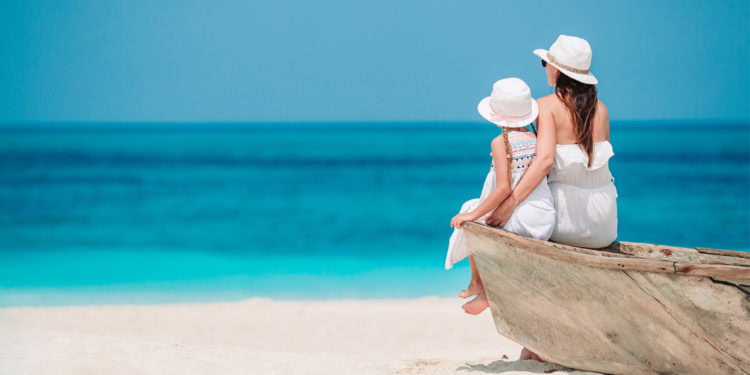

Results of new research published in the Journal of Environmental Psychology indicate that childhood exposure to “blue spaces” – rivers, lakes, and coasts – is linked to better subjective well-being as an adult. Researchers proposed that such experiences make a person more likely to spend recreational time in nature as an adult, leading to positive consequences for well-being.
Spending time in nature has long been considered good for health. A growing body of studies has linked nature experiences with better mental health, including greater subjective well-being. They have also shown that people prefer doing recreational activities in nature as compared to built-up areas.
However, studies have also shown that people are becoming increasingly detached from the natural world. For example, a large survey of people who do not visit natural environments regularly, done in 2018, in England, showed that one fifth of the survey participants stated that they were not interested in visiting nature and that it was “‘not for people like them.”
Other studies have shown that fewer nature visits during childhood often mean fewer recreational nature visits as an adult. This might come at a cost to mental health later given the association between these two.
Visits to places like coasts, rivers or lakes has not been previously studied much. While blue spaces can be seen as a type of nature environment, they do have certain specificities compared to green spaces like forests, camping sites and parks.
They may also contain risks that are not present in green spaces, such as risk of drowning, especially to children. On the other hand, childhood experiences with such spaces might make a person more confident in them and develop skills to mitigate or eliminate those risks (such as learning to swim well, dive etc.).
Valeria Vitale and her colleagues wanted to explore whether greater childhood exposure to blue spaces was associated with better subjective well-being as adults. They also wondered whether this relationship might be because childhood experiences with blue spaces makes a person more motivated to visit nature as an adult, leading to better mental health outcomes.
“Most of the studies examining childhood nature exposure and adulthood outcomes have largely focused on green space, or natural spaces in general,” explained Vitale, a PhD candidate at Sapienza University of Rome.
“Blue and green spaces have many common features, however blue spaces also have some unique sensory qualities (e.g., wave motion, sounds, etc.) and facilitate a distinct range of leisure activities (e.g., swimming). Thus, we wanted to examine whether the pattern of association between childhood nature exposure and adult wellbeing extends to blue space exposure in particular.”
The researchers analyzed data from the BlueHealth International Survey that examined recreational use of natural environments. The part analyzed in this study consisted of answers from 15,743 people across 14 European countries and 4 non-European regions.
The survey contained an assessment of adult subjective well-being (World Health Organization 5-item well-being index, WHO-5), 3 questions about how often the person visited blue spaces as a child, how easy it was, and how comfortable parents felt about the person playing in and around such spaces, a survey item about motivation to visit nature (“I find visiting green and blue spaces enjoyable or fun”) and a couple of questions about how important visiting nature is to the person.
The survey also asked about how often the person visits each of the 29 different types of green and blue spaces represented in the survey with pictures. These included parks, woods, meadows, seaside, urban rivers, lakes and others.
Overall results showed that people who reported more blue space experiences in childhood also tended to report greater subjective well-being now, when they are adults. The responses of participants supported the authors’ assumption that experience with blue spaces in childhood led to higher motivation to visit nature, either blue or green spaces, in adulthood. This, in turn, led to better subjective well-being.
“Findings of our study highlighted the relevance of spending time in blue spaces during childhood, that not only has many positive effects in the short-time as shown by previous literature, but provides benefits in the long term as well, in terms of improved well-being,” Vitale told PsyPost.
“In short, our research specifically demonstrated that greater contact with blue spaces during childhood may support better mental health in later life by enhancing intrinsic motivations and consequently the frequency of nature-based recreational activities in adulthood.”
“We were a bit more surprised about the results showing some consistency of our model across countries/regions,” Vitale said. “Indeed, prior evidence supports the idea that the way people relate to nature varies across cultures. Social and cultural backgrounds can also trigger different parental perceptions of risk and different educational approaches, that may differentially affect children’s exposure to blue spaces. So, we thought that such differences would have influenced the relationship between childhood exposure to blue spaces and adult outcomes.”
While the study highlights the importance of nature for our subjective well-being, the study authors also note that it is equally possible that it might be recent visits to nature that affect motivation to visit nature and not the other way around.
Notably, the study design does not allow definitive cause-and-effects conclusions to be made from the data and readers should be aware that the retrospective approach, asking adults to report on their childhood experiences years later is not the same as reporting on childhood experiences as they are happening.
“A number of mechanisms have been proposed to underpin the relationship between childhood nature exposure and adults’ outcomes (e.g., nature connectedness),” Vitale explained. “Thus, studies utilizing longitudinal designs, with more objective and comprehensive measurements of people’s nature experiences are therefore needed to assess the robustness of our findings.”
“We are aware that people are becoming increasingly detached from the natural world, due to technological distractions and indoor lifestyles,” she added. “This is particularly relevant for children that may lose the ability to understand and care for the natural world, and consequently benefit from it.”
“So, we hope that studies like this may help to promote more awareness and knowledge about all the potential positive effects derived from nature contact, and encourage people to give the right value to spend time in natural environments.”
The study, “Mechanisms underlying childhood exposure to blue spaces and adult subjective well-being: an 18-country analysis”, was authored by Valeria Vitale, Leanne Martin, Mathew P. White, Lewis R. Elliott, Kayleigh J. Wyles, Matthew H. E. M. Browning, Sabine Pahl, Patricia Stehl, Simon Bell, Gregory N. Bratman, Mireia Gascon, James Grellier, Maria L. Lima, Mare Lõhmus, Mark Nieuwenhuijsen, Ann Ojala, Jane Taylor, Matilda van den Bosch, Netta Weinstein, and Lora E. Fleming.