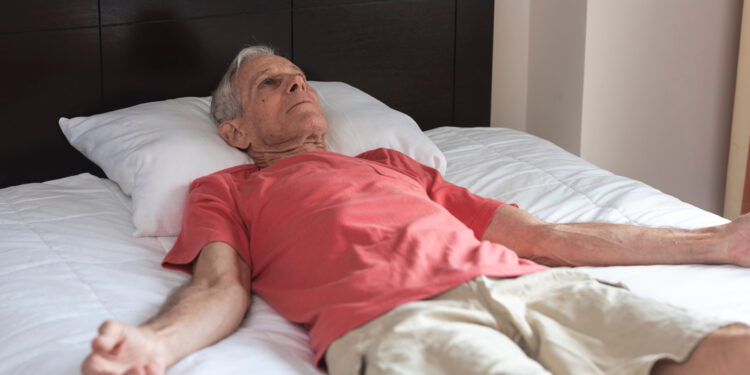

A new study published in Psychophysiology indicates that people are somewhat less sensitive to pain while lying down than while standing upright. The researchers propose that this reflects shifts in blood volume and blood pressure as the body adjusts to gravity, which may help explain why lying down eases acute discomfort. They also suggest the same relief could encourage inactivity in people with chronic pain, an idea the study did not test directly.
The human cardiovascular system does more than circulate oxygen and nutrients; it also helps regulate how the nervous system processes physical discomfort. Embedded within the walls of major blood vessels, such as the carotid arteries in the neck and the aorta near the heart, as well as inside the heart chambers and lungs, are microscopic stretch sensors called baroreceptors. When blood volume increases or blood pressure rises, the walls of these vessels expand, stretching the baroreceptors. Once stretched, these sensors send neural signals to the brain that slow the heart and relax blood vessels while simultaneously triggering pain-inhibiting pathways in the central nervous system.
Because of this built-in dampening mechanism, higher blood pressure tends to be accompanied by reduced sensitivity to physical pain. Early evidence from a 1994 human experiment demonstrated that artificially stimulating neck baroreceptors with gentle suction dulled pain reflexes and lowered how much pain participants reported feeling. Building on that work, a 2009 clinical study showed that giving medication to raise blood pressure in people with chronically low blood pressure reduced their pain sensitivity.
This link between the circulatory system and pain processing even extends beyond physical sensation. For instance, a study covered by PsyPost in 2019 found that higher resting blood pressure was associated with lower self-reported sensitivity to social pain and rejection. Closer to physical pain, a 2021 study of fibromyalgia patients by Reyes del Paso and colleagues found that individuals whose baroreceptors were less responsive to blood pressure changes experienced worse daily pain, fatigue, and anxiety.
Despite these established findings in psychophysiology, lead study author Gustavo A. Reyes del Paso, a full professor of psychophysiology at the University of Jaén in Spain, noted that “the general public is unaware that an increase in blood pressure has an inhibitory effect on pain: people with hypertension report fewer pain complaints, whereas those with chronic low blood pressure are more sensitive to pain.”
Recognizing that blood flow alters pain sensitivity, Reyes del Paso and his colleagues in Spain and Austria wanted to test whether everyday changes in body posture naturally move enough blood to change how much pain people feel. When a person stands up, gravity pulls blood down into the legs, reducing blood return to the heart and temporarily lowering blood pressure and baroreceptor stretching. When a person lies flat on their back, blood flows easily back to the chest, increasing the volume of blood pumped with each beat and stretching the baroreceptors, which the researchers hypothesized would dampen pain sensitivity.
“Changes in body posture alter blood pressure (it decreases during standing up and increases during lying down), so they may also affect pain,” Reyes del Paso told PsyPost. “We wanted to probe this hypothesis. Also, patients with chronic pain usually are very sedentary (i.e., have kinesiophobia) and are lying down much of the time. Is there a cause for that?”
In clinical settings, kinesiophobia refers to an excessive, debilitating fear of physical movement and activity resulting from a feeling of vulnerability to painful injury. To test how posture affects pain and circulation, the researchers recruited 83 healthy university students, consisting of 61 women and 22 men with an average age of about 20 years. None of the participants had cardiovascular conditions or chronic pain, and all abstained from pain medications for 24 hours and alcohol or vigorous exercise for three hours beforehand. Women taking oral contraceptives were excluded because synthetic hormones alter both blood pressure regulation and pain sensitivity, which could obscure the natural effects of posture.
During the experiment, the researchers measured cardiovascular activity and pain perception while participants assumed three postures: sitting, standing upright, and lying flat on their backs. The sequence included an initial sitting phase, a first standing phase, a lying down phase, and a second standing phase, with cardiovascular measurements recorded across four-minute intervals in each position. Pain testing was carried out during sitting, lying down, and the second standing phase, and the study protocol was publicly registered before data collection began.
To measure pain in a controlled way, the team used a computer-guided pressure algometer, a device that applies steadily increasing mechanical pressure to a one-square-centimeter area on the third fingernail of the left hand. The researchers recorded two behavioral thresholds: the pain threshold, defined as the pressure at which the participant first began to feel pain, and pain tolerance, defined as the maximum pressure the participant could endure. Participants also received five-second pressure stimuli ranging from 1.5 to 4 kilograms per square centimeter and rated how painful each press felt on a 10-centimeter visual scale from painless to extremely painful.
Throughout these postures, participants wore chest electrodes to record an electrocardiogram, which tracks the timing between heartbeats, and an impedance cardiogram, a non-invasive method that uses mild electrical currents across the chest to estimate blood flow volume. Continuous blood pressure sensors on the fingers of the right hand were calibrated every minute with an upper-arm cuff.
From these recordings, the team tracked blood pressure, heartbeat intervals, stroke volume (the blood pumped per beat), cardiac output (the blood pumped per minute), total peripheral resistance (how tightly constricted the blood vessels are), and baroreflex sensitivity, which measures how effectively the heart adjusts its beat timing in response to blood pressure shifts.
The results supported the hypothesis that lying down dulls pain sensitivity compared to standing upright. Participants exhibited higher pain thresholds while lying down than when standing, and their maximum pain tolerance was higher while lying down than during both standing and sitting. Across the sample, average pain thresholds varied only modestly between 3.4 and 3.6 kilograms per square centimeter across postures, and the authors noted that the clinical relevance of these small differences remains uncertain.
Subjective pain intensity ratings followed a similar pattern once the applied pressure crossed that threshold into actual pain. At the highest pressure of 4 kilograms per square centimeter, participants rated the sensation as more painful while standing than while either sitting or lying down. At 3 and 3.5 kilograms per square centimeter, standing also produced higher pain ratings than sitting. Contrary to the researchers’ hypothesis, for lighter pressures between 1.5 and 2.5 kilograms per square centimeter, ratings were slightly higher while lying down than sitting, though the authors noted that pressures below 3.4 kilograms may not have been perceived as painful by most participants.
The cardiovascular recordings confirmed that shifting postures produced substantial changes in blood flow and pressure regulation. When participants moved from sitting to the first standing period, their systolic blood pressure dropped from an average of 109.36 to 104.97 millimeters of mercury, and their stroke volume fell from 73.39 to 63.61 milliliters per beat. When they lay flat on their backs, systolic blood pressure rose to 111.33 millimeters of mercury, stroke volume climbed to 89.47 milliliters, and baroreflex sensitivity nearly tripled from 11.52 while standing to 30.35 milliseconds per millimeter of mercury while lying down, which the authors interpret as stronger heart-slowing nervous system activity.
When the researchers analyzed how baseline cardiovascular traits while sitting predicted pain responses, they found that mean arterial blood pressure was inversely linked to pain intensity ratings. Participants with higher resting blood pressure tended to rate the presses as less painful, a pattern that appeared at every pressure level when stimuli came in random order and at three of six levels when they increased step by step.
Total peripheral resistance, or the tightness of the blood vessels, was positively associated with both pain threshold and pain tolerance across the entire group, suggesting that blood vessel constriction may play a role in dampening pain. Stroke volume, cardiac output, heart rate, and baroreflex sensitivity, the measures that shifted most with posture, were not linked to any of the pain measures.
The researchers also observed distinct differences between men and women in both pain and circulatory measurements. Men had higher overall blood pressure, greater blood vessel resistance, and higher pain thresholds and pain tolerance than women, although men and women gave similar subjective pain intensity ratings on the visual scale. In addition, higher blood pressure was directly associated with a higher pain threshold in men, with correlation coefficients ranging from 0.43 to 0.47, whereas this specific association was not statistically significant in women, though the male subsample included only 22 participants.
The authors noted that lying down appears to be an intuitive, functional behavior for easing acute physical pain, which they attribute to greater blood return to the heart and stronger stimulation of pain-blocking baroreceptors. At the same time, they pointed out that this biological mechanism could have unintended drawbacks for people with chronic pain conditions.
“The reduction in pain during lying down could be a mechanism explaining the typical sedentarism and low physical activity in chronic pain patients, in which bed rest is considered counterproductive for pain rehabilitation, as this inhibitory effect can negatively reinforce inactivity by reducing pain,” Reyes del Paso explained.
“If you feel an acute pain, the maintenance of a lying down posture will help alleviate the pain,” he added. “However, if a person suffers from chronic pain, he/she should avoid the frequent use of a supine position, because it reinforces inactivity and in the medium and long term can aggravate the pain problem.”
As with all research, there are some caveats to consider when interpreting the results. The study sample consisted entirely of young, healthy university students who generally had low-to-normal resting blood pressure, and nearly three-quarters of the participants were women. Because the pain-dampening effects of blood pressure are typically strongest in people with elevated or high-normal blood pressure, the modest effects observed here might differ in older adults, people with hypertension, or patients living with chronic pain syndromes. The idea that pain relief while lying down reinforces inactivity in chronic pain is the authors’ hypothesis, and the study did not test it.
In addition, the links between blood pressure and pain were measured only while participants were seated, by comparing people with one another. The study did not test whether each person’s blood pressure changes across postures explained their own changes in pain.
Another detail to keep in mind is that the researchers did not randomize the order of the postures, meaning every participant went through the sitting, lying, and standing phases in the exact same sequence. When participants stood up for the second time, directly after lying down, which is when standing pain was measured, their blood pressure did not drop as it had during the first standing phase, averaging 110.30 millimeters of mercury. The authors explained that standing up from a flat position causes a bigger, faster shift of blood toward the legs than standing up from a chair, which likely triggered a rapid reflex that kept blood pressure from dropping. They suggest this may have weakened the posture effect on pain.
Looking ahead, the research team plans to directly investigate how these postural mechanisms operate in clinical populations. “We are going to replicate this study in individuals with chronic pain disorders, such as fibromyalgia or chronic back pain,” Reyes del Paso said.
The study, “Body Posture-Related Differences in Pain Perception and Their Mediation by Cardiovascular Factors,” was authored by Gustavo A. Reyes del Paso, Dolores Santiago, Belén Moreno, Casandra I. Montoro, Stefan Duschek, and Dmitry M. Davydov.