Subscribe
The latest psychology and neuroscience discoveries.
My Account
  • Mental Health
  • Social Psychology
  • Cognitive Science
  • Neuroscience
  • About
No Result
View All Result
PsyPost
PsyPost
No Result
View All Result
Home Exclusive Social Psychology Political Psychology

Political beliefs more likely to be rooted in personality traits among those who see politics as a means of self-expression

by Eric W. Dolan
May 26, 2018
in Political Psychology
(Photo credit: olly)

(Photo credit: olly)

Share on TwitterShare on Facebook

Conservatives who view their political beliefs as an important part of their identity have a greater aversion toward ambiguity and don’t like situations that are uncertain, according to new psychology research. But this doesn’t appear to be true for conservatives who don’t view their political beliefs as important to their identity.

“Psychologists and political scientists have argued more and more in recent years that people with different personality traits may be attracted to different political positions,” said the corresponding author of the study, Christopher M. Federico of University of Minnesota.

“For example, the trait we look at — the need for closure — refers to how much certainty people want to feel. Those who are high in the need for closure want to feel more certain about things, and a good bit of research suggests that people like this are more likely to be conservative. The idea is that sticking with the status quo — a defining goal of conservatism — helps people feel certain.”

“But we also know that people vary enormously in the extent to which they see politics as important or see their own political beliefs as important to their sense of who they are. In fact, a lot of research in political science suggests that much of the public does not see politics as important,” Federico explained.

“So, we thought it might be interesting to see whether people who see their political beliefs as important to their sense of who they are were more likely to ‘choose’ their political beliefs on the basis of personal traits. Individuals who see their political beliefs as more important to their sense of self should hold political beliefs that better reflect aspects of the self — like personality traits.”

An analysis of data from a nationally representative survey of 1,511 American adults confirmed that the need for closure was related to political ideology. The findings were published in the journal Psychological Science.

“We know from a lot of previous research that individuals who are high in need for closure — in other words, people who want to feel more certain about things — are more likely to have conservative beliefs,” Federico told PsyPost.

“What we show in our study is that this relationship is found mainly among people who see their political beliefs as important to their sense of who they are. Among people who see their political beliefs as important to their identity, need for closure predicts conservatism.”

Google News Preferences Add PsyPost to your preferred sources

In other words, the link between need for closure and conservatism mostly existed among those who agreed with statements such as “My political attitudes and beliefs are an important reflection of who I am” and “In general, my political attitudes and beliefs are an important part of my self-image.”

“However, among those who do not see their political beliefs as important to their identity, political beliefs do not seem to reflect personality traits like the need for closure much,” Federico noted.

The study, like all research, has some limitations.

“Our data are observational and come from a single study that examines attitudes at a single point in time,” Federico said. “So, while we find our results interesting, we are appropriately cautious. They need to be replicated in additional studies, and we cannot be sure that personality traits ’cause’ political beliefs rather than vice versa.”

The study, “The Political Self: How Identity Aligns Preferences With Epistemic Needs“, was authored by Christopher M. Federico and Pierce D. Ekstrom.

Previous Post

Attempts to suppress sexual thoughts could result in an increase of those thoughts

Next Post

Veterans with both PTSD and depression face much higher risk of suicidal thoughts

RELATED

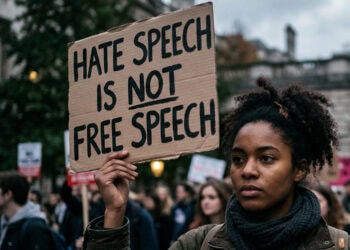
Belief in the harmfulness of speech is linked to both progressive ideology and symptoms of depression
Political Psychology

Belief in the harmfulness of speech is linked to both progressive ideology and symptoms of depression

April 1, 2026
Shifting genetic tides: How early language skills forecast ADHD and literacy outcomes
Authoritarianism

How a twin study untangled the surprising roots of authoritarian political beliefs

March 31, 2026
High meat consumption may protect against cognitive decline in people with a specific Alzheimer’s gene
Political Psychology

Metacognitive training reduces hostility between left-wing and right-wing voters

March 28, 2026
New Harry Potter study links Gryffindor and Slytherin personalities to heightened entrepreneurship
Moral Psychology

New psychology research pinpoints a key factor separating liberal and conservative morality

March 25, 2026
Brain MRI scans showing different views and slices for neurological and psychological research, highlighting brain structure and function analysis.
Neuroimaging

Brain scans reveal Democrats and Republicans use different neural pathways to buy groceries

March 23, 2026
Severe borderline traits in bipolar disorder are linked to early maladaptive schemas
Political Psychology

Left-leaning support for redistribution stems from perceived unfairness rather than malicious envy

March 23, 2026
Left-wing authoritarianism tied to greater acceptance of brutal war tactics
Political Psychology

Political ideology shapes views on acceptable civilian casualties in war

March 21, 2026
Machiavellianism most pronounced in students of politics and law, least pronounced in students of social work, nursing and education
Cognitive Science

Intelligence predicts progressive views, but only after college

March 21, 2026

STAY CONNECTED

RSS Psychology of Selling

  • Emotional intelligence linked to better sales performance
  • When a goal-driven boss ignores relationships, manipulative employees may fight back
  • When salespeople fail to hit their targets, inner drive matters more than bonus checks
  • The “dark” personality traits that predict sales success — and when they backfire
  • What communication skills do B2B salespeople actually need in a digital-first era?

LATEST

Scientists use brain measurements to identify a video that significantly lowers racial bias

Brief mindfulness practice accelerates visual processing speeds in adults

Belief in the harmfulness of speech is linked to both progressive ideology and symptoms of depression

Better parent-child communication is linked to stronger soft skills and emotional stability in teens

Men who favor the tradwife lifestyle often view the women in it with derision

A diet based on ultra-processed foods impairs metabolic and reproductive health, study finds

Psychologists identify nine core habits associated with healthy non-monogamous partnerships

Childhood trauma linked to elevated risk of simultaneous physical and mental illness in old age

PsyPost is a psychology and neuroscience news website dedicated to reporting the latest research on human behavior, cognition, and society. (READ MORE...)

  • Mental Health
  • Neuroimaging
  • Personality Psychology
  • Social Psychology
  • Artificial Intelligence
  • Cognitive Science
  • Psychopharmacology
  • Contact us
  • Disclaimer
  • Privacy policy
  • Terms and conditions
  • Do not sell my personal information

(c) PsyPost Media Inc

Welcome Back!

Login to your account below

Forgotten Password?

Retrieve your password

Please enter your username or email address to reset your password.

Log In

Add New Playlist

Subscribe
  • My Account
  • Cognitive Science Research
  • Mental Health Research
  • Social Psychology Research
  • Drug Research
  • Relationship Research
  • About PsyPost
  • Contact
  • Privacy Policy

(c) PsyPost Media Inc