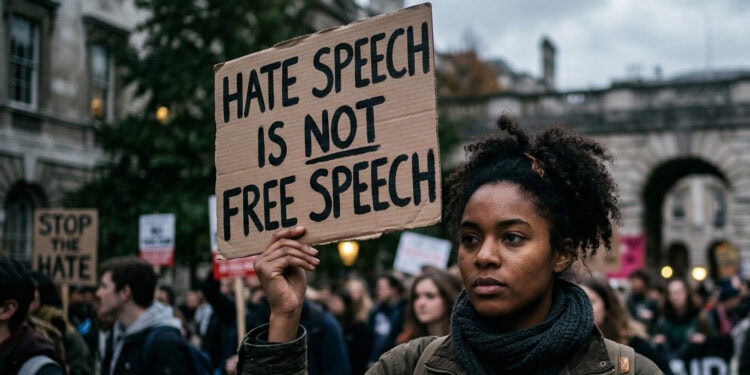

A recent study published in Personality and Individual Differences suggests that people who believe words can cause lasting psychological damage tend to experience worse mental health. The findings provide evidence that this specific belief is measurable and stable over time. This research helps explain modern cultural divides surrounding free speech, safe spaces, and political correctness.
The researchers conducted this work because public debates often center on whether certain speech is merely offensive or truly damaging to a person’s well-being. These disagreements influence policies on college campuses and in workplaces regarding things like trigger warnings or restricted language.
“People disagree about whether words can cause lasting psychological harm. Some argue that speech can be violent or traumatizing. Others argue that expanding the concept of harm to offensive or controversial speech coddles people and discourages open discourse,” explained study author Sam Pratt, a PhD student at the University of California, Los Angeles.
“Where you stand on this likely determines your stance on other issues, like whether instructors should provide trigger warnings in the classroom, whether social media sites should regulate what their users can say, and whether schools should ever ban students from reading certain books.”
“To study the belief that words can harm, we need a good way of measuring it. So we created the Words Can Harm Scale (WCHS), a 10-item measure of the belief that words can cause lasting psychological harm.”
The research team recruited 956 adults living in the United States through an online platform called Prolific. This group was stratified to reflect the national population in terms of age, sex, and race to ensure the findings were representative of the country. The participants had a mean age of approximately 46 years and were almost evenly split between males and females.
Participants completed the Words Can Harm Scale, where they rated their agreement with statements about the power of language. For example, one item asked if a person could be left emotionally scarred by something they read, while another focused on whether vulnerable people should be protected from certain speech. Each response was provided on a sliding scale from one to one hundred, with higher numbers indicating stronger agreement that words cause lasting harm.
Two weeks after the first survey, 756 of the original participants returned to take the test a second time. This follow up allowed the researchers to check if the participants’ beliefs remained stable over a short period. The results suggest that the scale is a reliable tool, as the scores from the first and second tests were very similar.
The study provides evidence that people higher in the belief that words can harm tend to have certain demographic characteristics. These individuals are often younger, female, and from non-White backgrounds. Black participants in the study scored higher on the scale than White or Asian participants did.
Political leanings also show a strong relationship with these beliefs about language. People who identified as liberal or as members of the Democratic party were more likely to endorse the idea that speech is harmful. This connection suggests that progressives may see language as being closely tied to power structures and social justice.
One of the most notable findings involved attitudes toward restricting speech in public and educational settings. There was a strong link between high scores on the scale and support for top down censorship. People who believed words are harmful were much more likely to agree that the government should shut down websites that promote hateful positions.
Individuals who scored high on the Words Can Harm Scale also expressed more support for the use of trigger warnings and the creation of safe spaces in classrooms. The data indicate a correlation between believing words are harmful and the belief in the importance of silencing others. This suggests that the perception of harm is a central driver in modern debates about free speech and censorship.
“Most of the correlations we observed were small to medium in size,” Pratt told PsyPost. “However, the WCHS had a notably strong relationship (a correlation of r = 0.52) with support for top-down censorship – the endorsement of using institutional power to suppress problematic speech.”
“This is a large effect, meaning that people who believed more strongly that words can harm were much more likely to agree with statements like ‘classroom discussions should be safe places that protect students from disturbing ideas’ and ‘I am in favor of allowing the government to shut down right-wing internet sites and blogs that promote nutty, hateful positions.'”
The researchers also examined how these beliefs relate to personality traits and social motivations. People with higher scores on the scale rated themselves as being more empathic and agreeable toward others. At the same time, they were more likely to engage in moral grandstanding, which involves sharing moral beliefs to gain social status.
The study also provides evidence of a link between these beliefs and a person’s sense of victimhood. Individuals who scored high on the scale tended to see themselves as victims in their daily interactions more often than others did. They also reported lower levels of emotional stability, which is a personality trait related to how people handle stress.
The findings regarding mental health were consistent across several different measures used in the study. People with higher beliefs in the harmfulness of words reported higher levels of both anxiety and depression over the previous two weeks. They also described themselves as being less resilient, meaning they felt less able to recover from stressful events.
The researchers used specific screening tools for clinical symptoms, such as the Patient Health Questionnaire and the Generalized Anxiety Disorder scale. Participants who met the criteria for moderately severe depression scored about seven points higher on the scale than those who did not. Similarly, those with moderate or severe anxiety scored significantly higher than those with minimal symptoms.
The data also suggest that people who believe words can harm are more sensitive to the physical symptoms of anxiety. This is a concept known as anxiety sensitivity, where a person fears the experience of feeling anxious. These individuals also viewed themselves and other people as being more vulnerable to experiencing post traumatic stress disorder after a difficult event.
Difficulties in managing emotions were also associated with higher scores on the scale. People who agreed that words cause lasting damage often reported that they struggled to regulate their feelings when they were upset. These correlations suggest that a person’s belief about the danger of words is closely tied to their overall psychological well-being.
As with all research, there are some caveats to consider. “Our study was correlational, so we can’t make claims about causality,” Pratt noted. “For example, we know that the WCHS is associated with worse mental health, but we don’t yet know why.”
In other words, the study does not show whether believing words are harmful causes poor mental health or if poor mental health causes people to view words as more dangerous.
“One possibility is that people who are more often targeted by negative speech – like women and racial minorities – develop a belief that words can harm from firsthand experience,” Pratt explained. “A second possibility is that believing words can harm causes worse mental health, for example by leading people to interpret speech more negatively. Or both could be true: experiencing negative speech leads people to believe words can harm, which in turn worsens their mental health.”
Future research would need to follow people over many years to see how these beliefs develop and change. The researchers also noted that people might sometimes answer survey questions in a way that makes them look good to others. This is known as socially desirable responding, and it could potentially influence how people report their beliefs about empathy or harm.
There are also questions about whether these beliefs are becoming more common because of cultural shifts. Some experts suggest that younger generations are more sensitive to harm due to changes in parenting or the influence of social media. The small negative correlation between age and scale scores provides some support for the idea that younger people hold these views more strongly.
“One natural question is: where does the belief that words can harm come from?” Pratt said. “Is this a new belief that emerged from younger generations who champion political correctness? Or has everyone in society gradually come to believe that words can harm over time? Or have people always held this belief, and it’s only now generating political discussion?”
“Answering these questions will require tracking how beliefs about the harmfulness of words have changed across generations and over time, which is exactly the type of research that the WCHS was designed to help with.”
The study, “The words can harm scale: Measuring beliefs about harmful speech,” was authored by Samuel Pratt, Payton J. Jones, Benjamin W. Bellet, Richard J. McNally, and Kurt Gray.