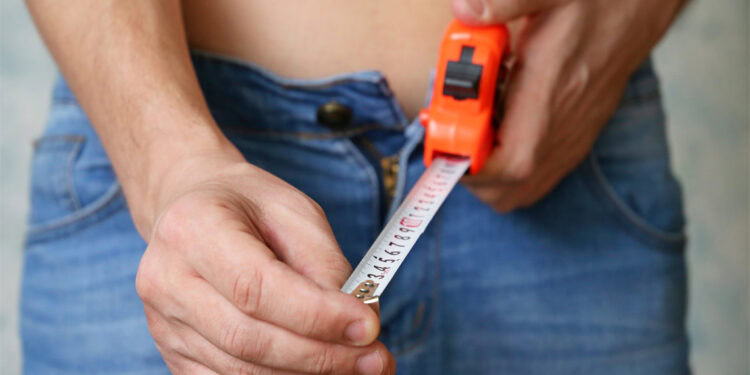

A recent study of Dutch men published in Frontiers in Psychology revealed that the men were likely to exaggerate when asked to self-report traits relevant to masculinity (athleticism, height, weight, and penis size). The greatest exaggeration was erect penis size, which was 21% over the average. When the men were financially compensated well for their time, the magnitude of their exaggeration decreased but was still above average.
Various physical attributes of men, including their height, physique, and penis size, have been associated with body satisfaction, self-image, feelings of masculinity, and mating success. Although there is no clear consensus on whether women prefer men with larger penises, it is well-established that penis size is seen as a marker of masculinity.
In addition to penis size, height and other physical characteristics that indicate physical dominance are crucial for men’s reproductive, occupational, and financial success. Men often exaggerate their height and athleticism on online dating sites to increase their chances in the mating market.
Study author Jacob Dalgaard Christensen and his colleagues sought to investigate the magnitude of the exaggeration of reported physical characteristics and whether or not the amount of financial compensation they received for the task made a difference in how much one exaggerated.
The sample size comprised 191 Danish men aged between 18 and 35. The study gathered information on various human factors, including consumer preferences, life history characteristics, subjective life expectancy, and physical markers such as height, weight, athleticism, and penis size (flaccid and erect). Participants were divided into two groups, one was paid $5, and the second paid $22.
Responses to questions relating to athleticism, height, weight, and penis size were analyzed for this study. All participants were provided a ruler they were to print out for the purpose of measuring penis size. The research team then compared participant responses to known averages for the Dutch population.
Analysis of the collected data indicates that men tend to overestimate their height, athleticism, and penis size but not their weight. “Specifically, at the aggregate level, men reported being marginally more athletic compared to the scale midpoint, claimed to be significantly taller compared to the Danish mean for individuals of similar ages, and stated that their erect penis size was several centimeters longer than the available Danish population mean,” the researchers wrote.
The data also revealed that the reports of erect penis size were 21% over the average, where height was only 1% over, indicating that it may feel easier to exaggerate when the trait cannot be seen. In addition, those who only received $5 for their efforts were more likely to report penis sizes over the average compared to the group receiving $22. The research team “further found participants in this group ($5) to be significantly more likely to report that their erect and flaccid penis size was larger than the claimed world record of 34cm.”
This self-reporting behavior is believed to be driven by men’s desire to boost their self-esteem, particularly in areas related to their self-image and identity. The study also reveals that men are more likely to deviate from accurate reporting regarding private bodily measures, as opposed to those that are more publicly visible. Furthermore, the study shows that higher monetary incentives reduce the average self-reported estimates of both flaccid and erect penis size but do not impact more publicly visible measures.
“It is possible that participants who received the larger monetary payment, on average, were less inclined to exaggerate the size of their penis because they felt a stronger need to reply (more) honestly,” the researchers said. “In contrast, those who received the smaller monetary payment may have been more motivated to exaggerate their penis size due to anger for the low payment coupled with the activation of self-threat when receiving questions about male markers of masculinity.”
The results imply that self-reported data on private aspects of masculinity, such as penis size, should be approached with caution and that such data may only be accurately collected in a controlled laboratory environment. The study highlights the importance of offering higher monetary incentives to obtain more accurate data on private measures, particularly regarding penis size.
Additionally, future research may explore the effectiveness of interactive survey techniques with immediate feedback to participants when their responses exceed certain probability thresholds in reducing exaggerated responses in studies that use self-report measures.
The study, “Smaller prize, bigger size? Exploring the impact of money on men’s self-reported markers of masculinity“, was authored by Jacob Dalgaard Christensen, Tobias Otterbring, and Carl-Johan Lagerkvist.