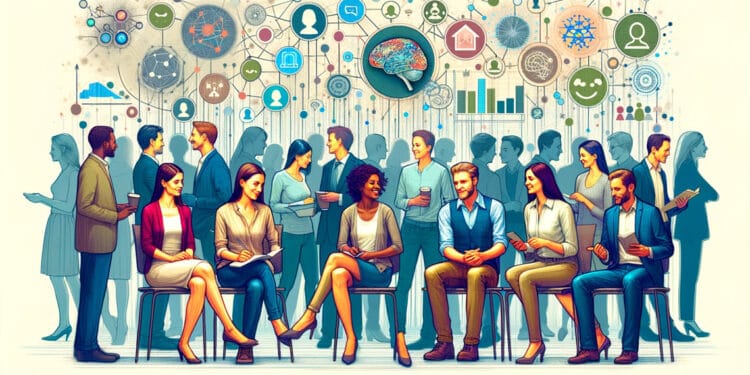

A new study has found that individuals who display both agentic and communal behaviors when interacting with others for the first time tend to become popular. Individuals displaying unusually high communal, but not agentic, behaviors toward a specific person tend to become well-liked by that particular person. The study was published in Psychological Science.
When two individuals meet for the first time, they quickly form initial impressions of each other. These impressions are often formed within seconds and are based on factors such as appearance, body language, vocal tone, and the content of their initial conversation, frequently relying on subtle cues. The brain processes this information rapidly and instinctively, utilizing past experiences and societal norms to make quick judgments. These first impressions can significantly influence future interactions by shaping expectations and perceptions.
Due to all this, being able to leave a good first impression and to be liked after the first interaction with another person confers great benefits in many real-life situations. Individuals able to leave good first impressions will have higher chances of getting a job after an interview, a long-term romantic partner after a date, a client after a sales meeting, and better outcomes in many other situations. In contrast, people who are disliked after a first meeting often develop psychological problems such as low self-esteem as a consequence, aside from less favorable outcomes of interactions with others.
What behaviors improve one’s chances of leaving a good first impressions and becoming liked by people? Study authors Michael Dufner and Sascha Krause analyzed data from a study utilizing a round-robin design in which previously unacquainted individuals met one another for the first time in a laboratory for brief conversations in pairs. After these conversations, conversation partners rated how much they liked each other.
The study involved 139 undergraduate students from various fields, who participated in exchange for a compensation of 20 EUR. The average age of the participants was 24 years. They were recruited through newspaper advertisements and a website.
After arriving at the laboratory, participants were photographed in order to produce pictures that the researchers would use for a liking measure. They were then divided into same-sex groups, ensuring that each group only included participants who were unfamiliar with each other.
The procedure started with each participant introducing him/herself briefly to his/her group. After these introductions, participants provided ratings of how much they liked each person in their group. Next, each participant had a 5-minute conversation with each member of his/her group on a topic of their choice. The researchers videotaped all conversations. After the last conversation, participants were again asked to rate how much they liked each member of the group.
Aside from the liking ratings, the researchers hired independent observers to watch the videos of the conversations and rate the behavior of each participant. The researchers provided a rating manual for the observers that instructed them to look for two types of behaviors – agentic and communal. Agentic behaviors included characteristics such as being ‘leading,’ ‘dominant,’ ‘confident,’ and ‘boastful,’ while communal behaviors were described as ‘polite,’ ‘benevolent,’ ‘warm,’ and ‘friendly.’
The results showed that participants consistently behaved in similar ways with different interaction partners. However, they often developed specific levels of liking or disliking for specific individuals.
Participants who displayed high levels of both communal and agentic behaviors were generally liked more by group members, thus becoming more popular. When examining factors influencing how much a specific individual was liked (unique liking), communal behaviors, particularly being benevolent and friendly, along with the overall level of communal behavior, were significant. However, higher levels of agentic behavior were associated with lower unique liking levels.
“How should persons behave when they want to be popular?” the study authors concluded. “According to our results, they should generally show a mixture of high agentic and high communal behavior, as these behaviors are both positive and unique predictors of popularity. How should persons behave when they want to win a specific other as a friend? For communal behavior, the effects on the two levels are both positive, so the recommendation is straightforward: Be as communal as you can!”
“For agentic behavior, the effect is positive on the level of the individual but null, or even negative, on the level of the dyad. Hence, even though agentic behavior might generally make one popular, it might not be good advice to show a higher than usual level of agentic behavior when trying to win a new friend. We hope that these recommendations are useful for navigating through everyday interactions.”
The study significantly contributes to understanding how first impressions are formed. However, it has limitations that should be considered. Notably, all participants were undergraduate students, and results may differ in other demographic groups. Furthermore, the study focused on first impressions formed during casual conversations, which differ from real-life first meetings that usually occur in goal-oriented contexts (e.g., job interviews, dating, sales meetings, building relationships with colleagues or neighbors, business transactions).
The paper, “On How to Be Liked in First Encounters: The Effects of Agentic and Communal Behaviors on Popularity and Unique Liking”, was authored by Michael Dufner and Sascha Krause.