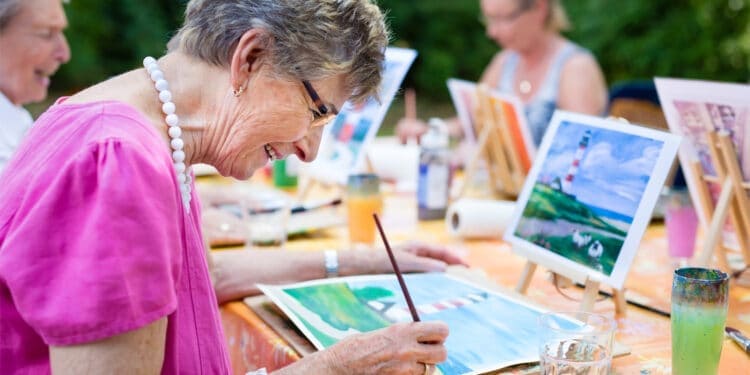
Older adults who engage in recreational art activities enjoy better mental wellbeing, according to new psychology research. The study, published in Frontiers in Public Health, revealed that those who actively participated in arts-related activities, such as attending concerts or painting, reported higher levels of mental health and general wellbeing compared to those who did not.
With an increasing number of people living beyond 60 years, understanding how lifestyle choices affect their health and wellbeing is more important than ever. Prior research has shown that events such as bereavement, social isolation, and financial difficulties can significantly impact the mental and physical health of older adults. Additionally, previous studies have suggested that engagement in activities like sports positively influences mental health.
However, the specific impact of arts engagement on health and wellbeing in the aging population had not been extensively explored. This gap in research led scientists from The University of Western Australia to investigate how participation in the arts could serve as a non-medical strategy to enhance the quality of life in older adults.
“For many people, a long life is an expectation rather than the exception. However, as people age into older adulthood they are likely to experience events and risk factors which have the potential to adversely impact their health and wellbeing,” said study author Christina Davies, the director of the UWA Centre for Arts, Mental Health and Wellbeing and chief investigator of the Good Arts, Good Mental Health Project.
“Low cost/zero cost solutions that are person-centred and prevention (rather than illness) focused are needed. With an emphasis on social inclusion, happiness, relaxation, enjoyment, self-expression and creativity, recreational arts engagement (like recreational sport engagement which is an established health promotion strategy) could provide wellbeing benefits.”
The study was conducted as part of the larger Busselton Healthy Ageing Study. It targeted non-institutionalized adults born between 1946 and 1964 residing in the City of Busselton. The researchers managed to contact 82% of eligible individuals, with a robust final sample size of 2,843 participants. The participants were asked about their involvement in various forms of arts – including attending events, participating in artistic creation, and volunteering in art-related activities – over the previous year.
About 85% of the participants had engaged in some form of recreational arts in the last year. Women, and those with higher income and education levels, were more likely to participate in these activities.
One of the most significant findings was the positive correlation between recreational arts engagement and mental wellbeing. This was measured using the Warwick-Edinburgh Mental Wellbeing Scale (WEMWBS), which assesses factors like happiness and psychological functioning. The results showed that those who engaged in arts activities had higher wellbeing scores compared to those who did not. This trend persisted even after accounting for variables such as income, education, and recent life events, indicating a robust association between arts engagement and improved mental wellbeing.
While the link between arts engagement and physical health wasn’t as strong as it was with mental wellbeing, the study still found a positive association. Participants who engaged in recreational arts reported better overall health than those who did not. This was measured using the SF-12 questionnaire, which evaluates both physical and mental health components.
“We found that older adults who took part in any recreational arts (in the last 12 months) had significantly better mental wellbeing and physical health than those who didn’t take part in the arts (i.e. 0 hours per year),” Davies said.
The researchers also found variability in the level of engagement in arts activities among participants, with some spending significantly more time in these activities than others. Importantly, higher levels of engagement were correlated with greater benefits to mental wellbeing. This suggests that not just participation, but the extent of involvement in recreational arts, may play a role in enhancing mental health.
“You don’t have to be good at art for the arts to be good for you,” Davies told PsyPost. “It’s about having a go and taking part in the arts activities and events that make you feel good. We know from the literature that individual differences are important. This means that people should take part in the arts activities and events that give them joy, happiness, relaxation, etc. For one person this may be listening to music, for another person it could be singing or dancing or paint or photography, etc.”
While the study’s findings are promising, there are limitations to consider. The cross-sectional nature of the research means it cannot definitively establish causality – it’s unclear whether engaging in the arts leads to better mental wellbeing, or if individuals with better mental wellbeing are more likely to engage in the arts. Future research is needed to explore this relationship further. Longitudinal studies or randomized controlled trials could provide more definitive evidence.
“Our study suggests that activities, events and programs that encourage engagement in recreational arts may be a useful approach for healthy aging for older adults living in the community and in aged care,” Davies said. “However, our study is a starting point and our results are an association. Further research is needed to determine causality.”
“The gift of art could make the perfect present or could be a way of connecting with older friends and relatives e.g. you could create a music playlists of their favourite songs, take part in an art course together, go to a concert or the theatre together,” she added. “If your budget is tight at the moment, you could buy some pencils from your local shop and download colouring pages to do together from our ‘Good Arts, Good Mental Health’ website for free.”
The study, “The art of aging well: a study of the relationship between recreational arts engagement, general health and mental wellbeing in cohort of Australian older adults“, was authored by Christina R. Davies, Charley A. Budgeon, Kevin Murray, Michael Hunter, and Matthew Knuiman.