![[Photo credit: Gage Skidmore]](https://sp-ao.shortpixel.ai/client/to_webp,q_glossy,ret_img,w_750,h_375/https://www.psypost.org/wp-content/uploads/2025/10/donald-trump-shrug-750x375.jpg)
A new study indicates that Donald Trump’s frequent shrugging is a deliberate communication tool used to establish common ground with his audience and express negative evaluations of his opponents and their policies. The research, published in the journal Visual Communication, suggests these gestures are a key component of his populist performance style, helping him appear both ordinary and larger-than-life.
Researchers have become increasingly interested in the communication style of right-wing populism, which extends beyond spoken words to include physical performance. While a significant amount of analysis has focused on Donald Trump’s language, particularly on social media platforms, his live performances at rallies have received less systematic attention. The body is widely recognized as being important to political performance, but the specific gestures used are not always well understood.
This new research on shrugging builds on a previous study by one of the authors that examined Trump’s use of pointing gestures. That analysis found that Trump uses different kinds of points to serve distinct functions, such as pointing outwards to single out opponents, pointing inwards to emphasize his personal commitment, and pointing downwards to connect his message to the immediate location of his audience. The current study continues this investigation into his non-verbal communication by focusing on another of his signature moves, the shrug.
“The study was motivated by several factors,” explained Christopher Hart, a professor of linguistics at Lancaster University and the author of Language, Image, Gesture: The Cognitive Semiotics of Politics.
(1) Political scientists frequently refer to the more animated bodily performance of right wing populist politicians like Trump compared to non-populist leaders. We wanted to study one gesture – the shrug – that seemed to be implicated here. (2) Trump’s shrug gestures have been noted by the media previously and described as his “signature move”. We wanted to study this gesture in more detail to examine its precise forms and the way he uses it to fulfil rhetorical goals.”
“(3) To meet a gap: while a great deal has been written about Donald Trump’s speech and his use of language online, much less has been written about the gestures that accompany his speech in live settings. This is despite the known importance of gesture in political communication.”
To conduct their analysis, the researchers examined video footage of two of Trump’s campaign rallies from the 2016 primary season. The events, one in Dayton, Ohio, and the other in Buffalo, New York, amounted to approximately 110 minutes of data. The researchers adopted a conservative approach, identifying 187 clear instances of shrugging gestures across the two events.
Each shrug was coded based on its physical form and its communicative function. For the form, they classified shrugs based on the orientation of the forearms and the position of the hands relative to the body. They also noted whether the shrug was performed with one or two hands and whether it was a simple gesture or a more complex, animated movement. To understand the function, they analyzed the spoken words accompanying each shrug to determine the meaning being conveyed.
Hart was surprised “just how often Trump shrugs – 1.7 times per minute in the campaign rallies analyzed. Trump is a prolific shrugger and this is one way his communication style breaks with traditional forms of political communication.”
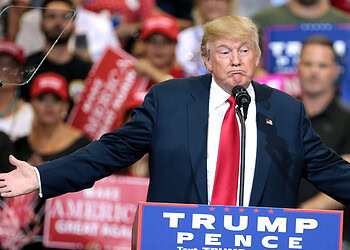
The analysis of the physical forms of the shrugs provided evidence for what has been described as a strong “corporeal presence.” Trump tended to favor expansive shrugs, with his hands positioned outside his shoulder width, a form that physically occupies more space.
The second most frequent type was the “lateral” shrug, where his arms extend out to his sides, sometimes in a highly theatrical, showman-like manner. This use of large, exaggerated gestures appears to contribute to a performance style more commonly associated with live entertainment than with traditional politics.
The researchers also noted that nearly a third of his shrugs were complex, meaning they involved animated, oscillating movements. These gestures create a dynamic and sometimes caricatured performance. While these expansive and animated shrugs help create an extraordinary, entertaining persona, the very act of shrugging is an informal, everyday gesture. This combination seems to allow Trump to simultaneously signal both his ordinariness and his exceptionalism.
When examining the functions of the shrugs, the researchers found that the most common meaning was not what many people might expect. While shrugs are often associated with expressing ignorance (“I don’t know”) or indifference (“I don’t care”), these were not their primary uses in Trump’s speeches. Instead, the most frequent function, accounting for over 44 percent of instances, was to signal common ground or obviousness. Trump often uses a shrug to present a statement as a self-evident truth that he and his audience already share.
For example, he would shrug when asking rhetorical questions like “We love our police. Do we love our police?” The gesture suggests the answer is obvious and that everyone in the room is in agreement. He also used these shrugs to present his own political skills as a given fact or to frame the shortcomings of his opponents as plainly evident to all. This use of shrugging appears to be a powerful tool for building a sense of shared knowledge and values with his supporters.
“Most people think of shrugs as conveying ‘I don’t know’ or ‘I don’t care,” Hart told PsyPost. “While Trump uses shrugs to convey these meanings, more often he uses shrugs to indicate that something is known to everyone or obviously the case. This is one of the ways he establishes common ground and aligns himself with his audience, indicating that he and they hold a shared worldview.”
The second most common function was to express what the researchers term “affective distance.” This involves conveying negative emotions like disapproval, dissatisfaction, or dismay towards a particular state of affairs. When discussing trade deals he considered terrible or military situations he found lacking, a shrug would often accompany his words. In these cases, the gesture itself, rather than the explicit language, carried the negative emotional evaluation of the topic.
Shrugs that conveyed “epistemic distance,” meaning ignorance, doubt, or disbelief, accounted for about 17 percent of the total. A notable use of this function occurred during what is known as “constructed dialogue,” where Trump would re-enact conversations. In one instance, he used a mocking shrug while impersonating a political opponent to portray them as clueless and incompetent, a performance that drew laughter from the crowd.
The least common function was indifference, or the classic “I don’t care” meaning. Though infrequent, these shrugs served a strategic purpose. When shrugging alongside a phrase like “I understand that it might not be presidential. Who cares?,” Trump used the gesture to dismiss the conventions of traditional politics. This helps him position himself as an outsider who is not bound by the same rules as the political establishment.
The findings highlight that “what politicians do with their hands and other body parts is an important part of their message and their brand,” Hart told PsyPost. However, he emphasizes that “gestures are not ‘body language.’ They do not accidentally give away one’s emotional state. Gestures are built in to the language system and are part of the way we communicate. They carry part of the information speakers intend to convey and that information forms part of the message audiences take away.”
The study does have some limitations. Its analysis is focused exclusively on Donald Trump, so it remains unclear whether this pattern of shrugging is unique to his style or a broader feature of right-wing populist communication. Future research could compare his gestural profile to that of other populist and non-populist leaders.
Additionally, the study centered on one specific gesture, and a more complete picture would require analyzing the full range of a politician’s non-verbal repertoire. The authors also suggest that future work could examine other elements, like facial expressions and the timing of gestures, in greater detail.
Despite these limitations, the research provides a detailed look at how a seemingly simple gesture can be a sophisticated and versatile rhetorical tool. Trump’s shrugs appear to be a central part of a performance style that transgresses political norms, creates entertainment value, and forges a strong connection with his base. The findings indicate the importance of looking beyond a politician’s words to understand the full, embodied performance through which they communicate their message.
“We hope to look at other gestures of Trump to build a bigger picture of how he uses his body to distinguish himself from other politicians and to imbue his performances with entertainment value,” Hart said. This might include, for example, his use of chopping or slicing gestures. I also hope to explore the gestural performances of other right wing populist politicians in Europe to see how their gestures compare. ”
The study, “Taking a stance through stance: the forms and functions of shrugs in the spoken discourse of Donald Trump
,” was authored by Christopher Hart and Steve Strudwick.