A recent study published in the Proceedings of the National Academy of Sciences suggests that political emotions are not just abstract thoughts, but are distinctly felt physical experiences that shape democratic engagement. The research provides evidence that people feel politically driven emotions differently in their bodies compared to everyday emotions. These physical sensations reliably predict whether someone will actually participate in political actions like voting or protesting.
Scientists recognize that emotions drive political engagement and public division. Yet, the way people physically experience these feelings remains mostly unexplored in political science. Typically, political emotions are measured by asking people to rate their feelings on a simple numerical scale. This approach treats emotions as detached mental states.
The authors of this study argue that physical sensations form the core of any emotional experience. When people feel an emotion, they experience interoceptive states, which are the brain’s internal perceptions of signals from inside the body, like a racing heart or a tense stomach. The researchers wanted to map these self-aware, physical feelings, known as somatosensory experiences, to see what a state of political anger or political hope actually feels like in the human body.
Andrea Vik, a postdoctoral research fellow at the Centre for the Politics of Feeling at Royal Holloway and the School of Advanced Study, University of London, helped lead the research. She explained how her academic background inspired the project.
“It really started during my master’s, when I took a political psychology course with Dr. Bert Bakker at the University of Amsterdam, and I became hooked on the question of how emotions shape political behavior,” Vik told PsyPost. “At the same time, I was fascinated by the body’s role in all of this: what our physiology can tell us that self-reports can’t. Then Professor Manos Tsakiris, who leads the Centre for the Politics of Feelings and is the senior author on this paper, introduced me to the emBODY-tool, a body-mapping method, and things clicked into place.”
Understanding these bodily sensations can shed light on how political contexts alter basic psychological responses. To explore these physical patterns, the researchers conducted a study with 992 adult participants from the United States. The sample was designed to be nationally representative in terms of age, gender, ethnicity, and political party affiliation. The median age of the participants was 46 years, and the group included exactly 50 percent women.
The scientists used a validated digital mapping technique called the emBODY tool to measure physical reactions. During the experiment, participants viewed digital silhouettes of the human body and used a coloring tool to indicate exactly where they felt physical sensations. They painted regions red to show increased activation, such as warmth or tension, and they used blue to show decreased activation, such as numbness or physical heaviness.
First, the participants completed this mapping task for five everyday, nonpolitical emotions, which included anger, anxiety, depression, disgust, and hope. Later in the study, participants repeated the exact same mapping process for the political versions of these five emotions. For the political emotions, participants were asked to choose a contemporary political issue from a list that personally made them feel the specific emotion before coloring the body silhouette. They also rated the overall intensity of their emotional response on a numerical scale from zero to 100.
The body maps revealed that adding a political context to an emotion changes how that emotion is physically experienced. For instance, everyday depression tends to cause a sensation of numbness or reduced activation in the arms and legs. Political depression, in contrast, showed a much more widespread pattern of physical activation across the whole body.
Political disgust also produced an entirely different physical map compared to everyday disgust. Everyday disgust, such as the natural physical reaction to spoiled food, tends to be felt heavily in the stomach and throat. When participants mapped political disgust, the physical sensation looked remarkably similar to anger, with high activation concentrated in the head and upper body.
Vik noted that this finding stood out during the analysis. “In this project, we only pre-registered our research questions, because we had no strong predictions about whether politics would alter the embodied signature of an emotion. Either direction, political emotions being similar or different, would have been meaningful,” she said.
“So I was struck by just how much the political context changed how emotions are embodied, particularly how disgust shifted away from something like straightforward pathogen avoidance (such as reacting to something physically repulsive) and towards something closer to moral outrage,” Vik continued. “That shift matters, I think, because it suggests that political context doesn’t just intensify or weaken your emotions. It can fundamentally transform what kind of emotional experience you’re having.”
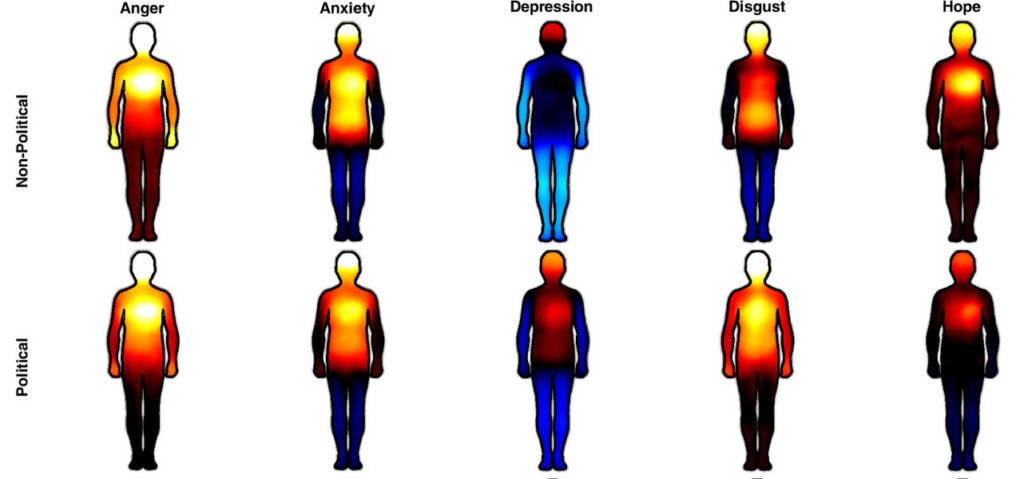
Other emotions showed more subtle changes or remained largely similar to their everyday counterparts. Political hope produced weaker physical activation than everyday hope, possibly because political hope is mixed with adversarial feelings toward political opponents. Political anxiety was generally similar to everyday anxiety but featured slightly less sensation in the stomach area, leaning more toward mental vigilance.
The scientists also looked at how individual political differences influenced these physical sensations. Political party affiliation altered the physical experience of these emotions. Democrat-leaning participants reported stronger bodily sensations for negative political emotions compared to Republican-leaning participants. For political anger, anxiety, depression, and disgust, Democrat-leaning individuals showed much higher physical activation, primarily concentrated in the head and upper torso.
When examining how these physical feelings impact real-world behavior, the researchers found a strong link to democratic participation. The physical intensity and physical spread of a political emotion across the body reliably predicted whether a person engaged in real political activities. These activities included voting in elections, signing petitions, posting online advocacy messages, or attending public protests.
Interestingly, the physical intensity of political emotions did not predict affective polarization. Affective polarization refers to the intense emotional dislike or distrust of people belonging to an opposing political party. This suggests that the physical urge of a political emotion drives people toward taking civic action rather than simply disliking the opposing side.
“I hope it gives people a moment to reflect on how their emotions are embodied, and how politics shapes that,” Vik said. “We tend to think of political emotions as something we can simply rate: how angry are you, on a scale of one to ten? But emotions are so much more than a number.”
“They are felt and lived through the body, the butterflies in your stomach, the tension in your chest, the weight in your limbs,” Vik added. “What we find is that politics changes those bodily experiences of anger, anxiety, disgust, and hope. And it may be that embodied experience, not the number someone gives on a survey, that actually moves people to participate. Our bodies, it turns out, are part of our politics too.”
While the study provides extensive evidence regarding how we physically feel politics, the authors acknowledge several boundaries to their findings. The research relies on a cross-sectional design, meaning the data was collected at a single point in time. Because of this, the scientists cannot definitively prove that the physical sensation of an emotion directly causes political action.
Vik emphasized the need for measured interpretations of the results. “I want to be careful not to overstate the effects. This is an initial study, and the findings should be read as such,” Vik said. “There are some important limitations to our study: achieving true equivalence in emotional intensity across political and non-political conditions is inherently difficult, the U.S. context may represent a particularly strong case given the salience of partisan identity, and establishing causal direction will require longitudinal designs. But I’d rather readers see those as directions than dealbreakers.”
Despite these cautions, the researchers said that understanding physical emotional responses could reshape political science. “The practical significance, I think, is real,” Vik said. “If political emotions are embodied, and if that embodiment shapes political behavior in ways that self-reported intensity does not capture, it has genuine implications for how we study political emotions going forward. If political participation depends partly on how politics is felt in the body, then inequalities in that felt experience, who gets to feel it, who has learned not to, whose embodied responses have been suppressed or dismissed, are not just personal.”
“They are political,” she added. “They shape who acts, and whose voices are heard. Democracy may depend less on what people think than on what they are able to feel.”
The concept of “ideological bodies” is one area where the authors urge caution. “The finding I think is most vulnerable to misinterpretation is what we call ‘ideological bodies,’ the pattern where Democrat-leaning participants reported stronger and more widespread bodily sensations than Republican-leaning participants for negative political emotions,” Vik said.
“Some might read this as suggesting that one group is more emotional and therefore less rational, a notion that has long been debunked, but stubbornly persists. I want to preempt that: embodying emotions more or less says nothing about your rationality or moral character.”
“What it reflects is that political worldviews are potentially lived not just in how we think, but in how we feel the world from the inside,” she continued. “Here, our case selection and study design also matter; partisan divides might be especially stark in the US, and at the time of data-collection democrats were ‘electoral losers’, so we don’t know how this finding holds up in other contexts.”
Looking ahead, the research team plans to expand their focus to different demographics and societal issues. “The very concrete next steps are a project on how young men experience relative deprivation, i.e., the feeling that their group is unfairly worse off than others, in their bodies, and the consequences this has for violent extremism,” Vik said.
“My long-term goal is to build a fuller picture of how political emotions live in both the brain and the body, and how that shapes our politics,” Vik said. “I’d love to see that knowledge used in ways that are relevant for evidence-based communication, analysis, and policy, whether that’s building emotional resilience in populations, resilience to radicalization, or knowledge resilience to combat misinformation.”
“And perhaps most of all, I hope it can contribute in some way to societies that are better able to channel emotions and frustrations constructively, into participation rather than disenchantment, and into something positive both for individuals and for our democracies.”
The study, “Politics embodied: How politics shapes and is shaped by the bodily experience of emotions,” was authored by Andrea Vik, Alejandro Galvez-Pol, Sohee Park, and Manos Tsakiris.