![[Adobe Stock]](https://sp-ao.shortpixel.ai/client/to_webp,q_glossy,ret_img,w_750,h_375/https://www.psypost.org/wp-content/uploads/2025/09/brain-scans-1-750x375.jpg)
Scientists may have identified a way to detect the earliest biological signs of Alzheimer’s disease, long before the onset of memory loss and cognitive decline. A new study published in Acta Neuropathologica reveals that a protein indicating brain inflammation appears in a specific brain region at the same time as the first pathological hallmarks of the disease. This discovery could pave the way for earlier diagnoses and new therapeutic strategies aimed at halting the neurodegenerative disorder in its initial stages.
Alzheimer’s disease is a progressive brain disorder that gradually destroys memory, thinking skills, and eventually, the ability to carry out simple tasks. For decades, research has focused on two key features of the disease: the buildup of sticky protein clumps called amyloid-beta plaques outside of nerve cells, and the formation of tangled tau proteins inside them. Another significant component of the disease is neuroinflammation, a persistent inflammatory response in the brain.
This inflammation is largely driven by the brain’s resident immune cells, known as microglia. While neuroinflammation is known to be an early event in Alzheimer’s, the precise timing, location, and cellular details of its onset have remained unclear. Researchers conducted this study to create a detailed timeline of these early changes, hoping to identify a reliable biomarker that could signal the disease’s presence at its most nascent phase.
To achieve this, the research team used a comprehensive approach, tracking the disease’s progression in a well-established mouse model of Alzheimer’s. The mice, known as 5XFAD mice, are genetically engineered to develop an aggressive, early-onset form of the disease that mirrors some aspects of inherited Alzheimer’s in humans. The scientists studied both male and female mice at multiple life stages: 1.5, 3, 7, and 12 months of age. This life-course analysis allowed them to map out the sequence of pathological events, from the molecular level to observable behavioral changes.
The investigation began by establishing when cognitive symptoms appeared. Using a spatial learning test called the Barnes maze, the researchers found that female 5XFAD mice began showing significant memory deficits at 7 months of age, while males showed deficits at 12 months. This confirmed that any biological changes occurring before these time points could be considered pre-symptomatic.
Next, the team examined the brains of the mice for the telltale amyloid-beta plaques. They discovered that the very first plaques appeared at just 1.5 months of age, and they did so in a specific brain region called the subiculum, an area associated with the hippocampus and involved in memory. In concert with this, blood tests revealed that a serum ratio of two amyloid-beta peptides, a known indicator of early plaque formation, was also elevated at 1.5 months.
In contrast, another blood biomarker called neurofilament light chain, which signals neuron damage, did not rise until much later, around 7 months of age. This timeline showed that amyloid pathology begins months before cognitive symptoms emerge and well before widespread nerve cell damage occurs.
The central focus of the study was a protein called Translocator protein 18 kDa, or TSPO. This protein is present at low levels in a healthy brain but increases significantly when brain cells are under stress or during inflammation, making it a key indicator of neuroinflammation. Using a technique called quantitative autoradiography, which measures protein levels in brain slices, the researchers measured TSPO across different brain regions and ages.
TSPO levels first increased at 1.5 months of age, at the same time and in the exact same brain region, the subiculum, where the first amyloid plaques appeared. As the mice aged and plaques spread to other areas like the hippocampus and cortex, TSPO levels rose in those regions as well. This finding directly linked the onset of neuroinflammation to the initial formation of amyloid pathology, long before any cognitive impairment was detectable.
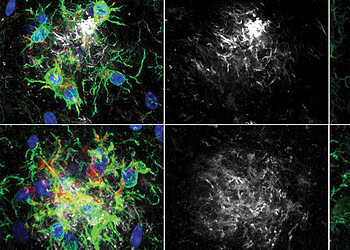
Having established this connection, the researchers sought to identify which brain cells were responsible for producing the excess TSPO. Using an advanced imaging technique called quadruple-label immunofluorescence confocal microscopy, they were able to simultaneously visualize amyloid plaques, TSPO, microglia, and a second type of brain support cell called astrocytes.
The analysis revealed that the surge in TSPO was almost exclusively located in microglia. While astrocytes also became activated as the disease progressed, they did not show an increase in TSPO. Going a step further, the analysis showed that the microglia with the highest concentrations of TSPO were those in direct physical contact with amyloid plaques. Microglia located farther away from plaques showed much lower TSPO levels. This indicates that the TSPO signal seen in brain scans is not just a general sign of inflammation but specifically reflects the activity of immune cells engaging with amyloid pathology.
To determine if these findings in mice were relevant to humans, the team performed a similar analysis on postmortem brain tissue from people who had an aggressive, early-onset form of Alzheimer’s caused by a specific genetic mutation (PSEN1-E280A). This form of the disease has a rapid progression similar to that seen in the 5XFAD mice. The human brain tissue analysis confirmed the mouse findings.
TSPO levels were significantly elevated in the brains of Alzheimer’s patients compared to healthy controls. The increased TSPO was again localized to microglia, and the microglia containing the most TSPO were those clustered around amyloid plaques. This confirmation provides strong evidence that the mechanisms observed in the mouse model are applicable to human disease.
The study does have some limitations. The analysis of human tissue was conducted on a small number of samples, all of which were from male subjects. Future work should include a larger and more diverse group of human samples. Additionally, both the mouse model and the human cases studied represent early-onset, genetically driven forms of Alzheimer’s, which account for a small fraction of all cases. Research is needed to see if these findings hold true for the more common, late-onset sporadic form of the disease.
The researchers are already beginning to address these questions by studying mouse models that lack the TSPO protein and by expanding their work to include late-onset Alzheimer’s cases. The ultimate goal is to translate these findings into clinical applications that can help patients before irreversible brain damage occurs.
The study, “Amyloid-β plaque-associated microglia drive TSPO upregulation in Alzheimer’s disease,” was authored by Daniel A. Martinez-Perez, Jennifer L. McGlothan, Alexander N. Rodichkin, Karam Abilmouna, Zoran Bursac, Francisco Lopera, Carlos Andres Villegas-Lanau, and Tomás R. Guilarte.