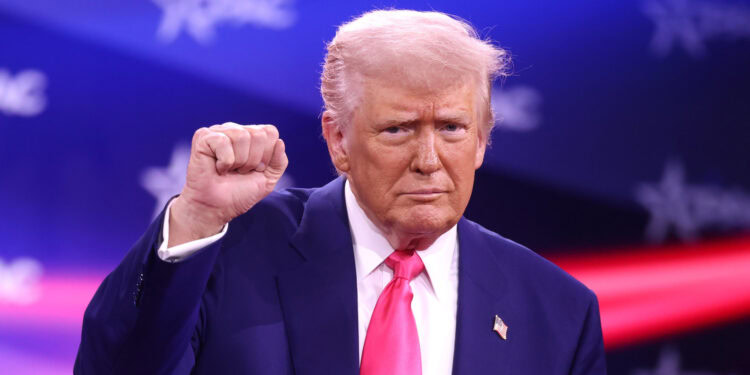

A new study published in the Journal of Race, Ethnicity, and Politics challenges common assumptions about gender and racial group behavior in American politics. The researchers found that support for Donald Trump’s “Make America Great Again” (MAGA) agenda is strongly influenced by right-wing authoritarianism, but this influence varies depending on the race and gender of the voter. Notably, white women displayed levels of support for the MAGA agenda and authoritarian beliefs that closely resembled those of white men, while women of color were consistently the least supportive and least authoritarian.
The researchers set out to explore how race and gender together shape support for the MAGA agenda, rather than examining these factors in isolation. While political scientists have long recognized that white voters lean Republican and that women, particularly women of color, are more likely to vote for Democrats, the researchers wanted to investigate why certain groups—especially white women and men of color—still supported MAGA, despite its alignment with patriarchal and racially exclusionary values. They proposed that “positionality”—how a person is advantaged or disadvantaged in the social hierarchy of race and gender—might explain this pattern.
To test this theory, the authors used data from the 2022 Notre Dame Health of Democracy study, a national survey that included 1,580 participants across four race-gender groups: white men, white women, men of color, and women of color. The researchers measured participants’ support for the MAGA agenda using seven questions, including whether they believed Donald Trump was the “true voice” of America, whether they believed the 2020 election was stolen, and whether they supported or minimized the violence that took place on January 6th, 2021. These items were combined into a scale that reflected overall support for the MAGA movement.
To understand what might drive this support, the study also measured right-wing authoritarianism using statements about the need for a strong leader who would restore traditional values and punish those seen as disrupting the social order. Participants also completed other political psychology scales, including measures of social dominance orientation (a belief in group-based hierarchy), system justification (support for the status quo), and racial resentment.
The researchers found that support for the MAGA agenda differed significantly across race-gender lines. White men had the highest average support score, followed closely by men of color and white women, while women of color scored significantly lower. When looking at right-wing authoritarianism, white men and white women again had the highest levels, while women of color showed the lowest. Men of color showed mixed levels—high on some indicators of authoritarianism, but not others.
The most striking finding was that right-wing authoritarianism strongly predicted MAGA support for white men and white women, but not for women of color. This pattern remained even after controlling for political party, education, income, religiosity, racial resentment, and other factors. For men of color, the relationship between authoritarianism and MAGA support was present, but weaker and more inconsistent. The data suggested that women of color were the only group largely unaffected by authoritarian beliefs when it came to supporting the MAGA movement.
The researchers also found that social dominance orientation predicted MAGA support among both white and nonwhite women, suggesting that belief in group-based hierarchies can also shape political preferences, even among those structurally disadvantaged by them. However, system justification did not significantly affect MAGA support across any group. This suggests that the MAGA movement, with its revolutionary rhetoric and willingness to undermine democratic norms, is not driven by a desire to preserve the existing system but by an urge to restore a perceived lost social order.
While the study sheds light on how race and gender intersect to influence support for authoritarian politics, it does have some limitations. The sample size, while respectable overall, was not large enough to break down subgroups within voters of color, such as distinguishing between Black, Latino, and Asian American men or women. The study also relied on self-reported measures of political attitudes, which can sometimes be influenced by social desirability or lack of awareness. Future research could benefit from more detailed subgroup analysis and from examining how these dynamics play out in different regional or cultural contexts.
The new findings from the 2024 election reinforce and build upon earlier research that also challenged assumptions about women as a unified voting bloc. A 2020 study published in Politics & Gender had already highlighted that women’s political preferences are deeply shaped by both race and gender attitudes, with important distinctions emerging across racial groups.
In that study, researchers found that white women’s support for Trump was strongly predicted by racial resentment, while Latina and Asian American women who endorsed hostile sexist views were also more likely to vote for Trump. These findings directly anticipated the pattern observed in 2024, where right-wing authoritarianism—a belief system tied to support for hierarchy, conformity, and punishment—was similarly associated with MAGA support among white women and some men of color, but not women of color.
Both studies converge on a key insight: women of color, and particularly Black women, show consistent resistance to Trump and the MAGA agenda, regardless of which psychological attitudes are measured. In the 2020 study, Black women exhibited the lowest levels of racial resentment and consistently supported the Democratic candidate, Joe Biden. In the 2024 data, women of color again stood apart—not only in their low levels of support for MAGA, but also in the weak or nonexistent relationship between right-wing authoritarianism and their political preferences.
The study, “Support for the MAGA Agenda: Race, Gender, and Authoritarianism,” was authored by Kayla Wolf, Chaerim Kim, Laura Brisbane, and Jane Junn.