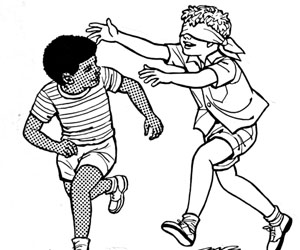
 A new study has found that chasing down a moving object is not only a matter of sight or of sound, but of mind.
The study found that people who are blindfolded employ the same strategy to intercept a running ball carrier as people who can see, which suggests that multiple areas of the brain cooperate to accomplish the task.
Regardless of whether they could see or not, the study participants seemed to aim ahead of the ball carrier’s trajectory and then run to the spot where they expected him or her to be in the near future. Researchers call this a “constant target-heading angle” strategy, similar to strategies used by dogs catching Frisbees and baseball players catching fly balls.
It’s also the best way to catch an object that is trying to evade capture, explained Dennis Shaffer, assistant professor of psychology at The Ohio State University at Mansfield.
“The constant-angle strategy geometrically guarantees that you’ll reach your target, if your speed and the target’s speed stay constant, and you’re both moving in a straight line. It also gives you leeway to adjust if the target abruptly changes direction to evade you,” Shaffer said.
“The fact that people run after targets at a constant angle regardless of whether they can see or not suggests that there are brain mechanisms in place that we would call ‘polymodal’—areas of the brain that serve more than one form of sensory modality. Sight and hearing may be different senses, but within the brain the results of the sensory input for this task may be the same.”
The study appears in the journal Psychonomic Bulletin and Review.
Nine people participated in the study—mainly students at Ohio State and Arizona State University, where the study took place. Some had experience playing football, either at a high school or collegiate intramural level, while others had limited or no experience with football.
The nine of them donned motion-capture equipment and took turns in pairs, one running a football across a 20-meter field (nearly 22 yards), and one chasing. They randomly assigned participants to sighted and blindfolded conditions. In the blindfolded condition, participants wore a sleep mask and the runner carried a foam football with a beeping device inside, so that the chaser had a chance to locate them by sound. The runners ran in the general direction of the chasers at different angles, and sometimes the runner would cut right or left halfway through the run.
The study was designed so that the pursuer wouldn’t have time to consciously think about how to catch the runner.
“We were just focused on trying to touch the runner as soon as possible and before they exited the field,” Shaffer said. “The idea was to have the strategy emerge by instinct.”
About 97 percent of the time, the person doing the chasing used the constant-angle strategy—even when they were blindfolded and only able to hear the beeping football.
The results were surprising, even to Shaffer.
“I knew that this seemed to be a universal strategy across species, but I expected that people’s strategies would vary more when they were blindfolded, just because we aren’t used to running around blindfolded. I didn’t expect that the blindfolded strategies would so closely match the sighted ones.”
The findings suggest that there’s some common area in the brain that processes sight and sound together when we’re chasing something.
There is another strategy for catching moving targets. Researchers call it the pursuit or aiming strategy, because it involves speeding directly at the target’s current location. It’s how apex predators such as sharks catch prey.
“As long as you are much faster than your prey, the pursuit strategy is great. You just overtake them,” Shaffer said.
In a situation where the competition is more equal, the constant-angle strategy works better—the pursuer doesn’t have to be faster than the target, and if the target switches direction, the pursuer has time to adjust.
The study builds on Shaffer’s previous work with how collegiate-level football players chase ball carriers. He’s also studied how people catch baseballs and dogs catch Frisbees. All appear to use strategies similar to the constant target-heading angle strategy, which suggests that a common neural mechanism could be at work.