Subscribe
The latest psychology and neuroscience discoveries.
My Account
  • Mental Health
  • Social Psychology
  • Cognitive Science
  • Neuroscience
  • About
No Result
View All Result
PsyPost
PsyPost
No Result
View All Result
Home Exclusive Cognitive Science

Brain imaging study suggests maternal sensitivity influences infants’ neural responses to affective touch

by Eric W. Dolan
August 14, 2021
in Cognitive Science
Share on TwitterShare on Facebook

A new study sheds light on how parental behaviors modulate infants’ processing of affective (soothing) touch. The research indicates that infants tend to have a greater brain response to touch when their mothers are less sensitive to their signals and needs. The findings have been published in Social Cognitive and Affective Neuroscience.

“Touch is essential to the establishment of affective bonds and to a person’s well-being,” said study author Ana Osório, an assistant professor at the Center for Biological and Health Sciences at Mackenzie Presbyterian University in Brazil.

“The interpersonal touch experience is particularly important in early childhood since it is the most fundamental form of parental care. However, the study of this sensory modality remains surprisingly neglected. We wanted to know whether the way mothers care for their infants — how warm and attentive they are to their child’s needs — impacts how infants’ brains process affective, gentle touch.”

The study included 24 infants and their mothers. When the infants were 7 months old, the mothers were instructed to play with them for 9 minutes. “We watched them interact with their infants and assessed maternal sensitivity — how well they acknowledged the infant’s needs and communications, interpreted them correctly and provided a contingent and appropriate response — for instance, holding the child when upset or afraid,” Osório said.
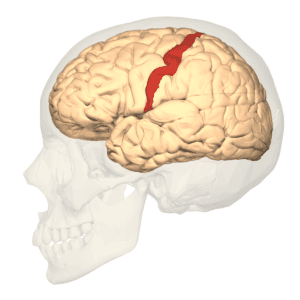
Primary somatosensory cortex highlighted in red. (Polygon data generated by Database Center for Life Science)

The infants underwent brain scans when they were 12 months old. To simulate affective touch, the infants were slowly stroked with a watercolor brush. “We looked at how their brains reacted to gentle touch using a technique called fNIRS (functional near-infrared spectroscopy). fNIRS uses near-infrared light to detect changes in brain tissue oxygenation,” Osório explained.

Osório and her colleagues found increased brain responses to affective touch in the somatosensory cortex among infants whose mothers were less sensitive.

“We found that when mothers were less sensitive, their infant’s brains actually showed stronger activation patterns in areas that process touch,” Osório told PsyPost. “It can be hypothesized that infants exposed to less sensitive maternal interactions – in which maternal touch might be absent, inconsistent, non-contingent and non-attuned to the infants’ cues and signals – may have perceived the light touch received during the fNIRS task as more novel, thus engaging in increased neural processing of the stimulus’ characteristics and meaning.”

But the study — like all research — includes some limitations.

Google News Preferences Add PsyPost to your preferred sources

“We did not have a measure of maternal touch, but a more general index of maternal sensitivity (which includes touch, but also other types of behaviors),” Osório explained. “Future research may explore the links between frequency, type and contingency of maternal touch during mother–infant interactions and infants’ brain responses to gentle touch to clarify how everyday touch experiences modulate brain responses to this sensory input.”

The study, “Maternal sensitivity and infant neural response to touch: an fNIRS study“, was authored by Vera Mateus, Ana Osório, Helga O Miguel, Sara Cruz, and Adriana Sampaio.

Previous Post

Deep machine learning study finds that body shape is associated with income

Next Post

New research indicates Trump contributed to Americans embracing beliefs that neutralized social distancing norms

RELATED

What was Albert Einstein’s IQ?
Cognitive Science

What was Albert Einstein’s IQ?

February 19, 2026
Genetic factors likely confound the link between c-sections and offspring mental health
Cognitive Science

Neuroscientists identify a unique feature in the brain’s wiring that predicts sudden epiphanies

February 19, 2026
Psychologists developed a 20-minute tool to help people reframe their depression as a source of strength
Cognitive Science

High IQ men tend to be less conservative than their average peers, study finds

February 18, 2026
Concept cells and pronouns: Neuroscientists shed light on key aspect of language comprehension
Memory

Scientists have found a fascinating link between breathing and memory

February 17, 2026
Cannabis use associated with better decision-making skills in people with bipolar disorder
Cognitive Science

Standard mental health tests may be inaccurate for highly intelligent people

February 16, 2026
Scientists find age-related links between beverage choices and mental health risks
Cognitive Science

Daily soda consumption linked to cognitive difficulties in teens

February 15, 2026
Younger women find men with beards less attractive than older women do
Cognitive Science

Ultra-processed foods in early childhood linked to lower IQ scores

February 13, 2026
High rates of screen time linked to specific differences in toddler vocabulary
Cognitive Science

High rates of screen time linked to specific differences in toddler vocabulary

February 11, 2026

STAY CONNECTED

LATEST

The neuroscience of limerence and how to break the cycle of romantic obsession

What was Albert Einstein’s IQ?

Evolutionary psychology is unfalsifiable? New scientific paper aims to kill this “zombie idea”

Neuroscientists identify a unique feature in the brain’s wiring that predicts sudden epiphanies

Video games may offer small attention benefits for children with ADHD

Rising number of Americans report owning firearms for protection at public political events

High IQ men tend to be less conservative than their average peers, study finds

Study finds a disconnect between brain activity and feelings in lonely people

PsyPost is a psychology and neuroscience news website dedicated to reporting the latest research on human behavior, cognition, and society. (READ MORE...)

  • Mental Health
  • Neuroimaging
  • Personality Psychology
  • Social Psychology
  • Artificial Intelligence
  • Cognitive Science
  • Psychopharmacology
  • Contact us
  • Disclaimer
  • Privacy policy
  • Terms and conditions
  • Do not sell my personal information

(c) PsyPost Media Inc

Welcome Back!

Login to your account below

Forgotten Password?

Retrieve your password

Please enter your username or email address to reset your password.

Log In

Add New Playlist

Subscribe
  • My Account
  • Cognitive Science Research
  • Mental Health Research
  • Social Psychology Research
  • Drug Research
  • Relationship Research
  • About PsyPost
  • Contact
  • Privacy Policy

(c) PsyPost Media Inc