Subscribe
The latest psychology and neuroscience discoveries.
My Account
  • Mental Health
  • Social Psychology
  • Cognitive Science
  • Neuroscience
  • About
No Result
View All Result
PsyPost
PsyPost
No Result
View All Result
Home Exclusive Cognitive Science

Brain imaging study suggests maternal sensitivity influences infants’ neural responses to affective touch

by Eric W. Dolan
August 14, 2021
in Cognitive Science
Share on TwitterShare on Facebook

A new study sheds light on how parental behaviors modulate infants’ processing of affective (soothing) touch. The research indicates that infants tend to have a greater brain response to touch when their mothers are less sensitive to their signals and needs. The findings have been published in Social Cognitive and Affective Neuroscience.

“Touch is essential to the establishment of affective bonds and to a person’s well-being,” said study author Ana Osório, an assistant professor at the Center for Biological and Health Sciences at Mackenzie Presbyterian University in Brazil.

“The interpersonal touch experience is particularly important in early childhood since it is the most fundamental form of parental care. However, the study of this sensory modality remains surprisingly neglected. We wanted to know whether the way mothers care for their infants — how warm and attentive they are to their child’s needs — impacts how infants’ brains process affective, gentle touch.”

The study included 24 infants and their mothers. When the infants were 7 months old, the mothers were instructed to play with them for 9 minutes. “We watched them interact with their infants and assessed maternal sensitivity — how well they acknowledged the infant’s needs and communications, interpreted them correctly and provided a contingent and appropriate response — for instance, holding the child when upset or afraid,” Osório said.
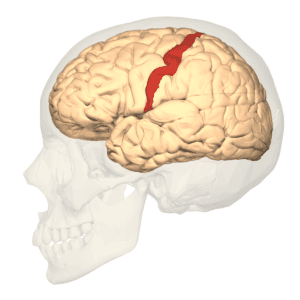
Primary somatosensory cortex highlighted in red. (Polygon data generated by Database Center for Life Science)

The infants underwent brain scans when they were 12 months old. To simulate affective touch, the infants were slowly stroked with a watercolor brush. “We looked at how their brains reacted to gentle touch using a technique called fNIRS (functional near-infrared spectroscopy). fNIRS uses near-infrared light to detect changes in brain tissue oxygenation,” Osório explained.

Osório and her colleagues found increased brain responses to affective touch in the somatosensory cortex among infants whose mothers were less sensitive.

“We found that when mothers were less sensitive, their infant’s brains actually showed stronger activation patterns in areas that process touch,” Osório told PsyPost. “It can be hypothesized that infants exposed to less sensitive maternal interactions – in which maternal touch might be absent, inconsistent, non-contingent and non-attuned to the infants’ cues and signals – may have perceived the light touch received during the fNIRS task as more novel, thus engaging in increased neural processing of the stimulus’ characteristics and meaning.”

But the study — like all research — includes some limitations.

Google News Preferences Add PsyPost to your preferred sources

“We did not have a measure of maternal touch, but a more general index of maternal sensitivity (which includes touch, but also other types of behaviors),” Osório explained. “Future research may explore the links between frequency, type and contingency of maternal touch during mother–infant interactions and infants’ brain responses to gentle touch to clarify how everyday touch experiences modulate brain responses to this sensory input.”

The study, “Maternal sensitivity and infant neural response to touch: an fNIRS study“, was authored by Vera Mateus, Ana Osório, Helga O Miguel, Sara Cruz, and Adriana Sampaio.

Previous Post

Deep machine learning study finds that body shape is associated with income

Next Post

New research indicates Trump contributed to Americans embracing beliefs that neutralized social distancing norms

RELATED

Researchers identify two psychological traits that predict conspiracy theory belief
Cognitive Science

The hidden brain benefit of getting in shape that scientists just discovered

March 11, 2026
Scientists use “dream engineering” to boost creative problem-solving during REM sleep
Cognitive Science

Genetic factors drive the link between cognitive ability and socioeconomic status

March 10, 2026
Scientists use “dream engineering” to boost creative problem-solving during REM sleep
Cognitive Science

Everyday mental quirks like déjà vu might be natural byproducts of a resting mind

March 10, 2026
Scientists use “dream engineering” to boost creative problem-solving during REM sleep
Cognitive Science

Scientists use “dream engineering” to boost creative problem-solving during REM sleep

March 10, 2026
Researchers identify two psychological traits that predict conspiracy theory belief
Artificial Intelligence

Brain-controlled assistive robots work best when they share the workload with users

March 8, 2026
How common is anal sex? Scientific facts about prevalence, pain, pleasure, and more
Cognitive Science

New psychology research reveals that wisdom acts as a moral compass for creative thinking

March 6, 2026
Hemp-derived cannabigerol shows promise in reducing anxiety — and maybe even improving memory
Alcohol

Using cannabis to cut back on alcohol? Your working memory might dictate if it works

March 5, 2026
Chocolate lovers’ brains: How familiarity influences reward processing
Cognitive Science

A single dose of cocoa flavanols improves cognitive performance during aerobic exercise

March 4, 2026

STAY CONNECTED

LATEST

Two to three cups of coffee a day may protect your mental health

The difficult people in your life might be making you biologically older

The hidden brain benefit of getting in shape that scientists just discovered

A surprising number of men suffer pain during sex but are less likely than women to speak up

Finger length ratios offer clues to how the womb shapes sexual orientation

Study links parents’ perceived financial strain to delayed brain development in infants

Genetic factors drive the link between cognitive ability and socioeconomic status

How viral infections disrupt memory and thinking skills

PsyPost is a psychology and neuroscience news website dedicated to reporting the latest research on human behavior, cognition, and society. (READ MORE...)

  • Mental Health
  • Neuroimaging
  • Personality Psychology
  • Social Psychology
  • Artificial Intelligence
  • Cognitive Science
  • Psychopharmacology
  • Contact us
  • Disclaimer
  • Privacy policy
  • Terms and conditions
  • Do not sell my personal information

(c) PsyPost Media Inc

Welcome Back!

Login to your account below

Forgotten Password?

Retrieve your password

Please enter your username or email address to reset your password.

Log In

Add New Playlist

Subscribe
  • My Account
  • Cognitive Science Research
  • Mental Health Research
  • Social Psychology Research
  • Drug Research
  • Relationship Research
  • About PsyPost
  • Contact
  • Privacy Policy

(c) PsyPost Media Inc