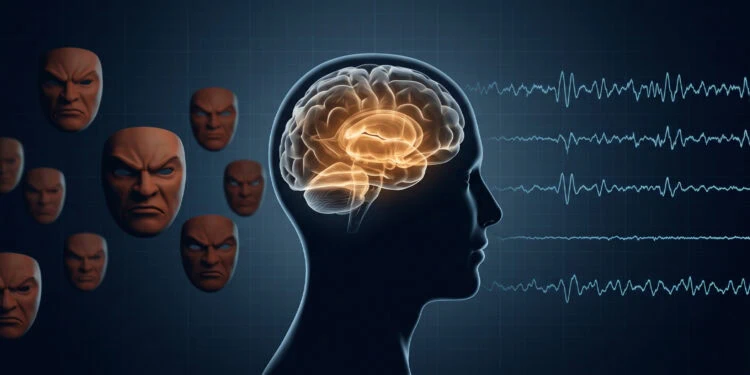

People who exhibit elevated levels of borderline personality traits often struggle to think flexibly and maintain their focus when confronted with negative emotions. A recent study published in Psychiatry Research: Neuroimaging reveals that these individuals experience distinct disruptions in brain activity that make it hard for them to ignore angry faces during difficult mental tasks. The research provides a biological window into why negative feelings can unexpectedly derail unrelated mental efforts for those at risk of borderline personality disorder.
Borderline personality disorder involves intense emotional instability, impulsive behaviors, and trouble managing interpersonal relationships. A core element of this psychiatric condition is a deficit in cognitive control. This mental ability acts like a traffic director in the brain, allowing people to allocate their resources and adapt to new challenges seamlessly.
These emotional regulation issues are not restricted to diagnosed clinical patients. Many people in the general public possess some borderline personality traits. This means they share similar emotional and mental tendencies but fall below the threshold for a formal medical diagnosis.
Researchers want to understand how these nonclinical populations respond to emotional interference. Exploring these overlapping traits helps mental health professionals chart how the full disorder develops over time. Studying undiagnosed groups also avoids the complications of severe psychiatric medications that clinical patients might be taking, which can alter brain scans.
Si Yang, a researcher at Anhui Normal University in China, led a team to investigate the brain dynamics underlying these personality traits. Yang and colleagues designed an experiment to test how negative emotions interfere with active problem solving. They rooted their approach in information theory, treating the brain as an engine that constantly works to reduce uncertainty in a chaotic environment.
Most previous psychological research only tested individuals on simple, binary mental conflicts. The researchers instead wanted to quantify exactly how increasing the difficulty of a task changes a person’s ability to process distracting emotional information. Finding the exact point where the brain gets overwhelmed by uncertainty could help isolate the root of this sensitivity.
To explore this, the research team recruited a large group of college students and used a standard questionnaire to measure their personality traits. They selected about fifty participants with high scores for borderline traits to serve as their main study group. They also selected another fifty participants with very low scores to serve as a baseline comparison group.
The participants then completed a specialized computer test designed to challenge their concentration and visual processing. The test displayed a cluster of five faces on a screen. Every face in a particular cluster featured either a happy expression or an angry expression to simulate emotional interference.
Among the five faces, some pointed to the left while others pointed to the right. Participants simply had to press a button indicating which direction the majority of the faces were looking. They had to make this choice as quickly and accurately as possible within a brief time limit.
The researchers varied the difficulty of the puzzle by changing the ratio of the faces. A trial where all five faces looked the same way was incredibly easy. A trial where three faces looked one way and two looked the other way was highly difficult, forcing the brain to work harder to verify the majority amid high uncertainty.
While the participants clicked through these visual puzzles, the scientists recorded their brain activity using a specialized cap covered in sensors. This recording method measures small electrical changes in the brain that occur in response to a visual stimulus. Scientists can isolate specific electrical peaks that occur mere milliseconds after a person sees an image.
The behavioral results revealed that the differences between the two groups on the easy and medium puzzles were not statistically significant. Both sets of students answered at roughly the same speed with the same level of accuracy. The mental demands of these simpler puzzles were evidently not high enough to cause any disruption.
Differences only emerged during the most challenging puzzles that featured angry facial expressions. Under those difficult negative conditions, people with high borderline traits took much longer to answer. They also made more mistakes than the individuals with low borderline traits.
The electrical brain recordings provided a deeper biological explanation for why this drop in performance occurred. The researchers analyzed three distinct electrical patterns associated with attention and emotional processing. Each wave corresponds to a different phase of human thought, from early detection to late stage appraisal.
Early in the brain’s response to the faces, a specific electrical signal emerges around 200 milliseconds after seeing an image. This peak helps the brain detect conflicting information and direct attention appropriately. The participants with high borderline traits displayed a much weaker electrical signal during this initial monitoring phase.
Because their brains were less responsive to the initial conflict, these individuals struggled with early attention. The researchers suspect that the heavy emotional weight of an angry face quickly dampened their basic ability to identify confusing visual details. The negative emotion essentially hijacked their earliest cognitive defenses.
A second brain wave generally peaks nearly 300 milliseconds after the image appears. This signal represents the investment of mental effort and the updating of a person’s working memory. This specific wave was much larger in the group with borderline traits.
The exaggerated size of this second wave suggests these individuals had to work much harder to process the emotional faces and complete the puzzle at the same time. They poured excessive mental energy into the task but still came up short on speed and accuracy. Their brains allocated resources highly inefficiently under pressure.
Finally, the researchers evaluated a third electrical signal that tracks sustained attention and the late stages of emotional appraisal. This wave occurs roughly half a second after the image appears. In the group with low borderline traits, the size of this wave adjusted smoothly based on how hard the puzzle was.
For the individuals with high borderline traits, this late electrical wave completely failed to adjust during puzzles featuring angry faces. The negative emotional information seemingly overloaded their final cognitive reserves. This prevented their brains from flexibly handling the varied task difficulties, causing a breakdown in their sustained attention.
These findings illuminate some of the mechanical reasons behind emotional instability. Still, the researchers noted a few limitations in their approach. The study relied exclusively on young college students. The psychological responses found in this group might not hold true for older adults or individuals from different educational backgrounds.
The participants also self-reported their personality traits using a standard questionnaire. While this is a common practice in psychology, self-assessment has inherent biases. Future studies might integrate professional clinical interviews to verify trait levels with stronger objectivity.
The research team also acknowledged that other mental health states like chronic anxiety or depression could influence these electrical patterns. Additional testing will need to isolate these variables. Removing these overlapping factors will confirm that borderline traits are the primary cause of the observed brain wave changes.
Acknowledging these nuances will help researchers build better treatments for emotional dysregulation. Psychologists could eventually track these specific electrical signals over extended periods to see if they predict the onset of a full personality disorder. Identifying these biological markers early could help clinicians develop therapeutic strategies, like mindfulness training, that strengthen cognitive control before symptoms worsen.
The study, “Neural evidence for the influence of cognitive control by facial emotion under varying task difficulty in individuals with borderline personality disorder traits,” was authored by Si Yang, Lijun Wang, Man Zheng, and Suhao Peng.