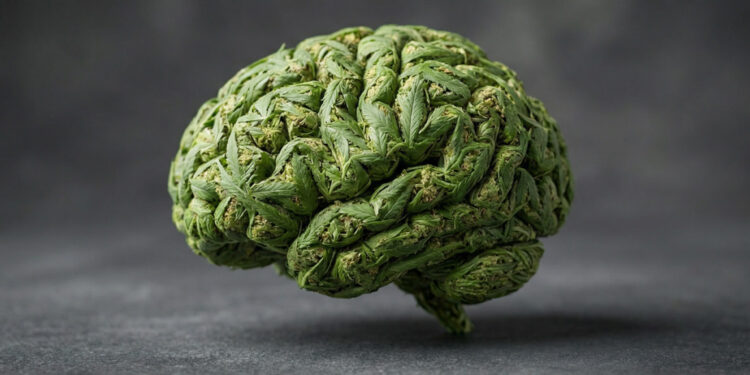

A new study published in Translational Psychiatry suggests that chronic cannabis use may not be associated with cognitive impairment in people with bipolar disorder, contrasting with its effects on healthy individuals. The findings indicate that people with bipolar disorder who use cannabis moderately may possess better decision-making skills than those with the disorder who do not use the drug. This research offers a potential explanation for why many individuals with this condition turn to cannabis for symptom management.
Bipolar disorder is a chronic mental health condition characterized by extreme shifts in mood, energy, and activity levels. These shifts typically range from periods of extremely energized behavior, known as manic episodes, to very sad or hopeless periods, known as depressive episodes. Beyond these emotional symptoms, the disorder is frequently accompanied by cognitive deficits.
Individuals with bipolar disorder often struggle with goal-directed behaviors. This includes difficulties with decision-making and inhibitory control. These cognitive impairments can lead to impulsive actions and engagement in risky behaviors. These deficits can severely impact social relationships, occupational stability, and overall quality of life.
A significant number of people with bipolar disorder report using cannabis. Statistics suggest that over 70 percent of individuals with this diagnosis have a lifetime history of regular use. Patients frequently report using the drug to self-medicate. They claim it helps alleviate specific symptoms such as racing thoughts or hyperactivity.
Medical professionals have historically viewed this high rate of use with concern. In the general population, chronic cannabis use is typically linked to cognitive decline. Regular use is often associated with worse memory, reduced attention, and poorer decision-making. The researchers wanted to investigate whether these negative effects hold true for the unique neurobiology of bipolar disorder.
“People with bipolar disorder face a difficult life-long illness that sees them shift from mania to depressive episodes with regularity, massively disrupting lives and likely contributing to 1/3rd attempting suicide, reducing life expectancy up to 20 years, in addition to the toll on their and friends and families lives,” said study author Jared W. Young of the University of California San Diego and VA San Diego Healthcare System.
“Current treatments are obviously insufficient so novel treatments are needed. We observed that people with bipolar disorder use cannabis at a rate three times higher than the general population. When queried, many with bipolar disorder described using cannabis to alleviate their symptoms, slowing them down when they feel too energetic, and help them manage their thinking. We sought to determine whether cannabis may have unique or even beneficial effects on thinking and behavior in such people, despite evidence for negative effects in healthy people.”
To explore this, the scientists recruited 87 participants between the ages of 18 and 50. They divided the participants into four specific groups to allow for detailed comparisons. The first two groups consisted of healthy individuals: those who did not use cannabis and those who did.
The remaining two groups consisted of participants diagnosed with bipolar disorder. One group was comprised of non-users, while the other was comprised of chronic cannabis users. The researchers defined “chronic” use as using cannabis at least four times per week for the past 90 days. Non-users were those with minimal lifetime exposure and no recent use.
The study employed the Iowa Gambling Task to measure decision-making abilities. This is a computerized psychological test designed to simulate real-life decision-making. Participants are presented with four decks of cards and asked to draw from them to win play money.
Two of the decks are considered “risky.” They offer high immediate rewards but also come with large penalties that result in a long-term loss. The other two decks are “safe.” They offer smaller immediate rewards but also smaller penalties, leading to a long-term gain. The test measures how well a person learns to avoid the risky decks in favor of the safe ones.
The researchers also assessed functional capacity using the UCSD Performance-Based Skills Assessment. This test involves role-playing scenarios to evaluate everyday life skills. The study focused specifically on medication management. Participants had to plan a complex medication routine involving multiple prescriptions to demonstrate their ability to adhere to a treatment plan.
The results showed a clear divergence between the healthy participants and those with bipolar disorder. Healthy participants who used cannabis performed worse on the gambling task than healthy non-users. This confirms previous research showing that cannabis tends to impair decision-making in the general population.
However, the pattern was reversed for the participants with bipolar disorder. Those who did not use cannabis exhibited deficits in decision-making. They frequently chose from the risky decks and failed to adjust their strategy after losing money.
In contrast, the participants with bipolar disorder who used cannabis performed better. Their scores were not only higher than the non-using bipolar group, but they were also comparable to the healthy non-users. This suggests that cannabis use was associated with a normalization of decision-making abilities in this specific clinical population.
The researchers also analyzed the frequency of use. They found that these cognitive benefits were primarily associated with moderate use. Moderate use was defined as using cannabis between four and twenty-four times per week. Heavy use, defined as twenty-five times or more per week, was associated with worse performance.
“It is important to note that only moderate cannabis use was associated with improved function, whereas heavy use worsened functioning in people with bipolar disorder,” Young told PsyPost. “This finding supports the need to identify what component of cannabis and what dose is likely driving the beneficial effects.”
The functional assessment yielded similar results. Participants with bipolar disorder who did not use cannabis struggled with the medication management task. Those who used cannabis demonstrated better functional skills. Their ability to manage a complex medication schedule was statistically similar to that of the healthy participants.
The scientists propose a biological mechanism involving dopamine to explain these findings. Bipolar disorder is often linked to an excess of dopamine transmission in certain brain areas, which can drive impulsive behavior. Chronic cannabis use is known to reduce dopamine transmission over time. The researchers suggest that cannabis might be correcting the dopamine imbalance in people with bipolar disorder, thereby improving their decision-making.
“In short, cannabis use may improve cognition in people with bipolar disorder, though there are caveats,” Young said.
The research was cross-sectional, meaning it looked at a single point in time. It shows an association but cannot prove that cannabis caused the improvement. It is possible that individuals with better cognitive functioning are simply more likely to use cannabis.
The sample size was also relatively small. There were roughly twenty participants in each of the four subgroups. This limits the statistical power of the analysis. Larger studies are needed to confirm these results.
“Care must be taken in simplistic interpretations, given that this work is associative – those choosing to use cannabis perform better, they may simply have better performance than those that do not,” Young explained. “Hence, more research is needed to test if potential cannabinoid-based treatments improve cognition in non-cannabis users with bipolar disorder.”
The researchers caution against interpreting these results as a clinical recommendation. While decision-making seemed improved, cannabis can still have detrimental effects on other aspects of bipolar disorder. It has been linked to increased risks of mania and psychosis in some patients.
“Even though we observed potential beneficial effects here, cannabis use can still have harmful effects on other aspects of bipolar disorder and free use of cannabis should not be encouraged as yet,” Young told PsyPost. “Finally, it cannot be emphasized enough that this study was only associative as mentioned – in other words we cannot say that cannabis caused this as we only compared people who used cannabis vs. those that did not, we need studies where we assign people to doses in a randomized blinded manner.”
“Our long-term goal for this line of research is to investigate the biological mechanisms that underlie the potentially beneficial cannabis effects in people with bipolar disorder using parallel human and animal experiments (translational studies). We also hope to investigate the effects of specific cannabis use patterns (e.g., use frequency and cannabinoid types) on other bipolar disorder symptoms to better understand the potential risks and benefits of cannabis use in bipolar disorder.”
“What we also hope to understand and are currently studying is whether similar things happen in other conditions where cannabis is also used to manage symptoms, like in people with HIV,” Young continued. “We believe that this kind of research will help us do better at making more specific recommendations for people who use cannabis, in terms of how much might help them but how much is too much.”
“It is vital that future studies should test the actual cannabis products used by people with bipolar disorder versus administering cannabis in a controlled laboratory setting in both single and multiple dosing treatment studies. We conduct this research because we want to help people with bipolar disorder manage their disease and hopefully better interact with their friends, families, and society at large. More studies are needed to determine whether this approach will be beneficial long-term, and we hope to continue these studies.”
The study, “Chronic cannabis use in people with bipolar disorder is associated with comparable decision-making and functional outcome to healthy participants,” was authored by Alannah Miranda, Benjamin Z. Roberts, Breanna M. Holloway, Elizabeth Peek, Holden Rosberg, Samantha M. Ayoub, Daniele Piomelli, Kwang-Mook Jung, Samuel A. Barnes, Steven Rossi, Mark A. Geyer, William Perry, Arpi Minassian, and Jared W. Young.