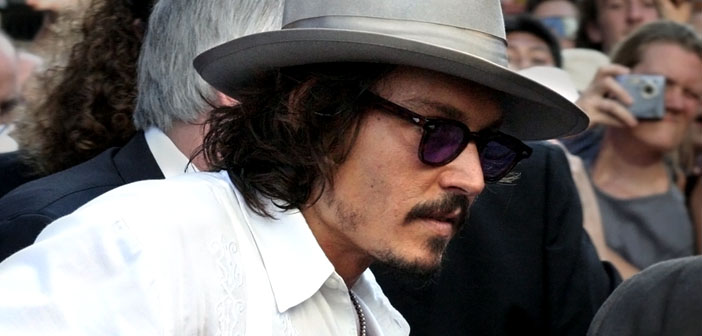

Johnny Depp has an unforgettable face. Tony Angelotti, his stunt double in “Pirates of the Caribbean,” does not. So why is it that when they’re swashbuckling on screen, audiences worldwide see them both as the same person? UC Berkeley scientists have cracked that mystery.
Researchers have pinpointed the brain mechanism by which we latch on to a particular face even when it changes. While it may seem as though our brain is tricking us into morphing, say, an actor with his stunt double, this “perceptual pull” is actually a survival mechanism, giving us a sense of stability, familiarity and continuity in what would otherwise be a visually chaotic world, researchers point out.
“If we didn’t have this bias of seeing a face as the same from one moment to the next, our perception of people would be very confusing. For example, a friend or relative would look like a completely different person with each turn of the head or change in light and shade,” said Alina Liberman, a doctoral student in neuroscience at UC Berkeley and lead author of the study published Thursday, Oct. 2 in the online edition of the journal, Current Biology.
In searching for an exact match to a “target” face on a computer screen, study participants consistently identified a face that was not the target face, but a composite of the faces they had seen over the past few seconds. Moreover, participants judged the match to be more similar to the target face than it really was. The results help explain how humans process visual information from moment to moment to stabilize their environment.
“Our visual system loses sensitivity to stunt doubles in movies, but that’s a small price to pay for perceiving our spouse’s identity as stable,” said David Whitney, a professor of psychology at UC Berkeley and senior author of the study.
Previous research in Whitney’s lab established the existence of a “Continuity Field” in which we visually meld similar objects seen within a 15-second time frame. For example, that study helped explain why we miss movie-mistake jump cuts, such as Harry Potter’s T-shirt abruptly changing from a crewneck into a henley shirt in the “Order of the Phoenix.”
This latest study builds on that by testing how a Continuity Field applies to our observation and recognition of faces, arguably one of the most important human social and perceptual functions, researchers said.
“Without the extraordinary ability to recognize faces, many social functions would be lost.Imagine picking up your child at school and not being able to recognize which kid is yours,” Whitney said. “Fortunately, this type of face blindness is rare. What is common, however, are changes in viewpoint, noise, blur, and lighting changes that could cause faces to appear very different from moment to moment. Our results suggest that the visual system is biased against such wavering perception in favor of continuity.”
To test this phenomenon, study participants viewed dozens of faces that varied in similarity. Each six seconds, a “target face” flashed on the computer screen for less than a second, followed by a series of faces that morphed with each click of an arrow key from one to the next. Participants clicked through the faces until they found the one that most closely matched the “target face.” Time and again, the face they picked was a combination of the two most recently seen target faces.
“Regardless of whether study participants cycled through many faces until they found a match or quickly named which face they saw, perception of a face was always pulled towards face identities they saw within the last 10 seconds,” Liberman said. “Importantly, if the faces that participants recently saw all looked very distinct, the visual system did not merge these identities together, indicating that this perceptual pull does depend on the similarity of recently seen faces.”
In a follow up experiment, the faces were viewed from different angles instead of frontal views to ensure that study participants were not latching on to a particular feature, say, bushy eyebrows or a distinct shadow across a cheekbone, but actually recognizing the entire visage.
“Sequential faces that are somewhat similar will display a much more striking family resemblance than is actually present, simply because of this Continuity Field for faces,” Liberman said.