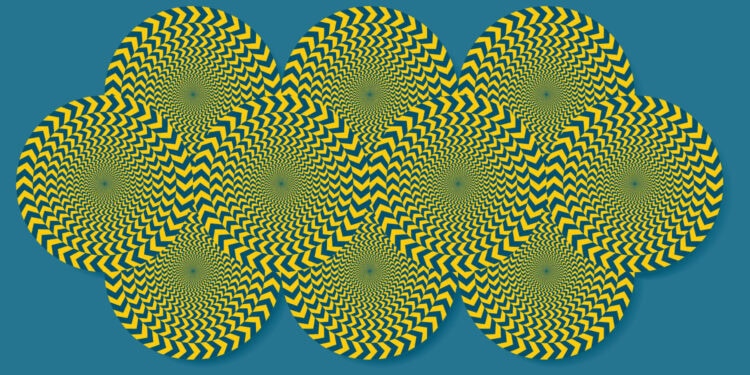

Children diagnosed with attention-deficit/hyperactivity disorder may see the world in subtly different ways compared to their peers, according to a new study published in the Journal of Attention Disorders. Researchers found that children with this diagnosis were more likely to be influenced by certain visual illusions and less influenced by others, suggesting that their visual perception processes may develop along a different trajectory.
Visual illusions offer a unique way to study how the brain processes what it sees. Even though the eyes may capture a scene accurately, the brain interprets that information in ways that can be influenced by experience, attention, and developmental factors. Illusions highlight the gap between what we see and what is actually there. Because they rely on how the brain interprets visual information, illusions can serve as a window into deeper cognitive processes.
Previous research has suggested that individuals with psychiatric or developmental conditions, including schizophrenia and autism, may perceive visual illusions differently. This has led scientists to ask whether similar effects might be seen in children with attention-deficit/hyperactivity disorder. Although ADHD is typically associated with difficulties in attention, focus, and impulse control, studies have also noted changes in how visual information is processed in people with this diagnosis.
The current study builds on this idea. The researchers wanted to understand whether children and teens with ADHD differ from typically developing peers in how they perceive various types of illusions. They were particularly interested in whether those differences might reflect changes in how global or top-down visual processing works in this group.
“Visual illusions happen when what we perceive does not correspond to the actual physical world. It has long been known that susceptibility to visual illusions changes throughout development,” said study author Oxána Bánszegi of the Institute of Biomedical Research at the National Autonomous University of Mexico.
“Research has also shown that several neurodevelopmental disorders are associated with perceptual differences, including how visual illusions are experienced. Autism, for example, has been studied extensively from this perspective. In contrast, there are very few studies examining ADHD, even though it is one of the most common neurodevelopmental disorders, affecting roughly one in every ten children.”
The research team tested 224 participants in total, including 112 children and teenagers diagnosed with attention-deficit/hyperactivity disorder and a matched control group of typically developing peers. The children ranged in age from about six to thirteen years, and the teenagers from thirteen to almost seventeen. Participants were recruited from both a psychiatric hospital in Mexico City and nearby public and private schools. All had normal or corrected-to-normal vision, and those with ADHD had a confirmed diagnosis and were not taking medication for at least three months prior to testing.
The participants were shown 103 pairs of images that contained five types of visual illusions. These included the Ebbinghaus illusion, the Müller-Lyer illusion, the Kanizsa Subjective Contour illusion, the Simultaneous Contrast illusion, and the Moving Snake illusion. Each illusion presents a mismatch between how objects actually appear and how they are perceived. For example, in the Ebbinghaus illusion, a central circle appears larger or smaller depending on the size of surrounding circles. The researchers included both “illusory” and “control” trials to determine how much participants were influenced by the illusion and whether they could still make accurate judgments.
Children with attention-deficit/hyperactivity disorder showed some clear differences in how they responded to the illusions, though not across all types. Specifically, they were more susceptible to the Müller-Lyer illusion, in which lines of equal length appear different because of arrow-like ends. In this case, children with the diagnosis were more likely to misjudge the length of the lines compared to their peers.
In contrast, they were less susceptible to the Ebbinghaus illusion. This suggests that the surrounding context had less influence on their perception of the central circle’s size. Importantly, these differences were found only in the younger age group; teenagers with and without ADHD responded in similar ways. This may suggest that the perceptual differences seen in younger children diminish as they grow older.
“We expected to see differences in how children with ADHD perceive visual illusions compared to other children, but we were surprised to find that the differences went in opposite directions depending on the illusion,” Bánszegi told PsyPost. “Even though both are called geometrical illusions, our results suggest the brain may process them in different ways, which means they should be studied separately.”
Children with ADHD also performed slightly worse on the Kanizsa illusion, which presents incomplete shapes that the brain usually “fills in” to create the perception of a full object. Here, the children were less likely to identify the hidden contour compared to the control group, again suggesting that certain types of visual processing might be affected.
For the Simultaneous Contrast and Moving Snake illusions, however, no meaningful differences were observed. Both groups perceived these illusions similarly, which suggests that the altered perception seen in the other illusions is not simply a general deficit in visual processing, but rather tied to specific cognitive mechanisms.
In addition to measuring responses, the researchers also tracked where and how long participants looked at the images using an eye tracker. This allowed the researchers to rule out the possibility that children with ADHD simply spent less time viewing the images. The eye-tracking data showed no difference between groups in how long they focused on the screen, which strengthens the case that the perceptual differences are not due to a lack of attention during the task.
Reaction times were also analyzed. The findings showed that children responded more quickly during illusory trials than control trials, a pattern that held true across groups. This suggests that participants were indeed experiencing the illusions and not simply guessing. However, reaction time differences between children with and without ADHD were minimal, indicating that the observed effects were not due to slower processing or decision-making.
“The main take home message is that children with ADHD can perceive things differently, and this may affect their everyday life,” Bánszegi explained. “For example, when trying to make sense of a complex visual scene, they might overlook some details, or, on the other hand, focus too much on small details and miss the bigger picture. Being more or less sensitive to illusions is not in itself a bad or a good thing, it may just mean different processing styles, a different way to perceive the world around us.”
As with all research, there are some limitations. One is that they did not include measures of symptom severity or intelligence across both groups, which might help explain individual differences in performance. Also, although the same visual tests were administered to all participants, they were conducted in different settings — a hospital for those with ADHD and schools for the control group — which could introduce subtle differences in testing conditions.
The study also only included a limited set of illusions. While these are widely used in vision research, they do not cover all possible aspects of visual processing. The results may not generalize to other types of illusions or visual tasks.
Still, the findings suggest that children with ADHD may perceive certain visual environments differently. This could have real-world implications, such as how they interpret complex visual scenes or how they respond to visual instructions in a classroom setting.
Looking ahead, the researchers hope to explore how even younger children — including preschoolers — perceive visual illusions. This may help identify early developmental patterns in perception, especially in children who are not yet diagnosed or whose symptoms are not yet clear.
“These findings raise many questions and point to new possibilities for future research,” Bánszegi said. “One area we want to explore is how even younger children with neurodevelopmental disorders perceive the world. This is not easy, though. At this age, it’s harder to make an accurate diagnosis. Also, preschoolers may not be able to name simple geometric shapes, or they may not find them as interesting, so it won’t hold their attention; therefore, we need to use pictures and scenarios that are more engaging and relatable for them.”
“Visual illusions are an interesting methodology, which is non-invasive, easy to test and holds great variability, given the large number of different illusions out there. Despite being around for centuries, it seems they have a lot to say still.”
The study, “Perception of Visual Illusions in Children and Teenagers With ADHD,” was authored by Valeria Montiel, Vania Navarrete, Ana M. González-Pérez, Carolina Vázquez de Alba, Ricardo Díaz-Sánchez, Péter Szenczi, Marcos Rosetti, Rosa E. Ulloa, and Oxána Bánszegi.