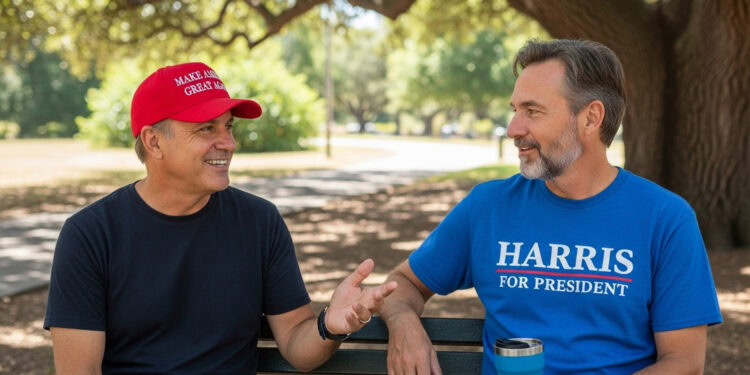

In the United States, friendships between people who hold different political views are surprisingly uncommon. But when they do exist, they may come with a trade-off: slightly lower friendship quality, but also more positive attitudes toward people with opposing political beliefs. That’s according to new research published in the journal Social Psychological and Personality Science.
The new research was conducted by Angela J. Bahns, an associate professor of psychology at Wellesley College and director of the Prejudice Reduction and Friendship Diversity Lab. Bahns set out to explore how common politically diverse friendships are, how they function, and whether they might contribute to more tolerant political attitudes.
Political homophily—the tendency to associate with others who hold similar views—is a well-established phenomenon in social science. It’s common across romantic partnerships, family relationships, and friendships. People often assume their friends share their political views unless told otherwise, and discovering political differences can sometimes damage a relationship. But Bahns wanted to know whether some politically diverse friendships do persist, and what impact they might have.
“Lots of the research in psychology on cross-group friendships looks at race/ethnicity or religion as the dimension of difference,” Bahns told PsyPost. “Given that political groups have become an important part of identity for many people, I was curious to know whether there might be potential benefits of cross-political friendships in the same way that cross-race and cross-religious friendships are associated with more positive outgroup attitudes.”
“Also, in a previous study I found that people with positive diversity attitudes (who tend to be politically liberal) were even more likely to have friends who share their attitudes and values. This finding suggests that people who claim to value diversity may not value viewpoint diversity in the same way they value other forms of sociodemographic diversity.”
To examine this, Bahns conducted two separate studies. In the first, assistants approached 537 pairs of people in public spaces in New York City, Boston, and several colleges in the Northeast. The participants were asked to complete a brief paper survey on their political views, friendship dynamics, and their attitudes toward different political groups.
The second study took place online and recruited 434 adult friendship pairs through CloudResearch Connect, an online research platform. This second sample was politically balanced by design, with a greater share of Republican participants compared to the field study. Participants in both studies ranged in age from 18 to over 80 and completed similar sets of questions.
Across both studies, participants reported their political ideology, party affiliation, and beliefs about specific political issues such as immigration, climate change, gun control, and abortion. They also rated the quality of their friendship using questions about closeness, companionship, and reciprocity. Comfort with political disagreement—a personal trait reflecting how open someone is to discussing political differences—was measured using a validated six-item scale.
The studies also included questions about whether the friends had discussed various controversial political topics, and participants rated how warmly they felt toward members of their own political group and those from the opposite side. These ratings were used to assess prejudice toward political outgroups.
Overall, Bahns found strong evidence of political homophily. In both samples, most friendships were politically aligned. In the first study, only about 3% of pairs included one Democrat and one Republican. In the second study, that number rose to about 8%, still a small share. Even on specific political issues, differences between friends were usually modest. Only a quarter of all pairs had more than a 1.5-point average difference (on a 7-point scale) across their political issue ratings.
“Everyone knows our country is highly polarized when it comes to politics, but I was surprised at just how rare true bipartisan friendships were in these studies,” Bahns said.
Despite this general trend toward political similarity, the studies found that political attitude dissimilarity—when friends disagreed on political issues—was linked to more favorable views of political outgroups. In other words, people who had a friend with different political views tended to rate opposing groups more positively. This finding was consistent across both studies, though the effect was relatively small.
At the same time, greater political dissimilarity between friends was associated with slightly lower friendship quality. In both studies, people who disagreed more with their friends on political issues rated their friendships as a bit less close or satisfying. This suggests that political disagreement may introduce tension or discomfort into a relationship, even if it doesn’t end the friendship entirely.
“Friends that had at least some political attitude dissimilarity tended to have more positive attitudes toward political outgroups,” explained Bahns, but “political attitude dissimilarity was associated with lower friendship quality.”
The studies also looked at the role of “comfort with political disagreement.” People who were more open to discussing political differences tended to rate their friendships more positively, regardless of whether their friends held different views. This trait was modestly related to political orientation in one study but not in the other, and it appeared to play a small but meaningful role in how people managed political differences within their relationships.
Interestingly, the studies found that discussions about political issues were fairly common even among politically similar friends. Most participants reported talking with their friends about at least some controversial issues, such as abortion or LGBTQ+ rights. In these cases, comfort with disagreement predicted a greater likelihood of having such conversations.
The study, like all research, includes some caveats.
“The methods are cross-sectional, so while the study found an association between political attitude dissimilarity and political outgroup attitudes, we cannot say whether people with more positive outgroup attitudes are more open to having politically diverse friends or whether having politically diverse friends makes people’s outgroup attitudes more positive,” Bahns said.
“Another limitation is that the degree of political attitude dissimilarity in the samples is low. Because friendships among people who disagree strongly about politics are quite rare, these types of friendships are not well represented in these studies. Therefore we don’t know what the relationship between political attitude dissimilarity and outgroup attitudes would be at higher levels of attitude dissimilarity.”
Bahns suggests that future research should explore how politically diverse friendships form and whether they are more likely to dissolve over time. It would also be useful to examine other close relationships, such as romantic partners or family members, to see whether similar patterns hold.
“I hope to use experimental methods to test the causal relationship between politically diverse friendship and outgroup attitudes,” Bahns said. “If we learn that having politically diverse friends can reduce prejudice toward political outgroups, I would like to design an intervention to make people more open to having politically diverse friends.”
The study, “Examining the Frequency and Characteristics of Politically Diverse Friendships,” was published July 5, 2025.