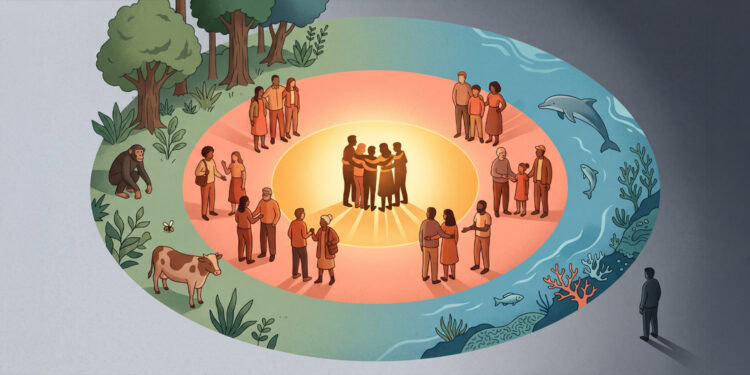

People around the world tend to rank their moral obligations toward others in a remarkably similar order, placing family and friends at the top and violent criminals at the bottom, according to a new study published in European Journal of Social Psychology. An analysis of university students across 41 cultural groups indicates that this general moral pecking order holds up across a wide range of societies, especially in nations culturally similar to the United States. At the same time, cultures and individuals frequently diverge when deciding whether distant humans deserve more moral consideration than animals and the natural environment.
Moral concern refers to the personal obligation people feel to care for the welfare and interests of another being or object. Psychologists and philosophers often picture this concept as a “moral circle” made up of concentric rings, where entities placed in the innermost ring receive the highest level of protection and personal responsibility, while those left outside the boundary receive none at all. Where those entities sit inside a person’s moral circle shapes everyday choices, from donating to an animal sanctuary to supporting aid for foreign refugees or favoring laws that protect old-growth forests.
To map these priorities systematically, psychologists created the Moral Expansiveness Scale, which asks people to sort 30 human and non-human entities into four rings of moral standing. When several of the same researchers first tested this tool in a 2016 study of American adults, they observed a consistent hierarchy: family and friends came first, followed by community members, then revered figures like charity workers and marginalized people at nearly identical levels, then foreign citizens and political opponents, animals and ecosystems, plants, and finally violent criminals.
Later research linked the overall size of a person’s moral circle to real-world generosity, with a 2024 global study of charitable donors showing that people who pledged at least 10 percent of their income to charity had wider moral circles and greater open-mindedness than typical citizens.
Even within Western societies, however, not everyone follows the exact same ordering when weighing human needs against the natural world. For example, a 2021 study of American adults indicated that although most participants prioritized distant or marginalized humans over animals and ecosystems, roughly one-third reversed that pattern and valued nature above people outside their own social groups. Broader social environments also shape moral boundaries, as a 2022 study across 36 countries, drawn from the same dataset by several of the same researchers, found that high perceived economic inequality and low social trust were associated with smaller moral circles overall.
What remained uncertain was whether the specific hierarchy of who matters most was a widespread feature of human psychology or largely a byproduct of Western, educated, industrialized, rich, and democratic societies, since earlier tests of the ranking itself relied almost exclusively on participants from the United States, the United Kingdom, and Australia.
To examine whether this moral ordering holds up across diverse societies and individuals, study co-lead authors Işıl Ayça Akkuş and Bastian Jaeger of the Department of Social Psychology at Tilburg University in the Netherlands, along with their colleagues, analyzed moral rankings across 41 cultural groups.
“There have been quite a lot of studies recently on mapping people’s moral hierarchy, that is, how much concern people show for the welfare and interests of different humans, non-human animals, ecosystems, AI systems, and other entities,” Jaeger told PsyPost. “Most people showed a very similar ranking, and I had the feeling that researchers were starting to treat this pattern as an established fact of how people think about the moral standing of others. But almost all research on this topic was conducted in the US or other Western countries. We wanted to test how often the same, or at least a very similar pattern actually shows up in countries across the world.”
The researchers examined survey responses from 6,561 university students across 41 cultural groups, originally collected in 2018 and 2019, with all but four groups reaching the target of at least 100 students. These groups spanned countries across Asia, Africa, Europe, North and South America, and Oceania, and separated culturally distinct regions within the same nation, such as English-speaking and French-speaking Canada as well as the Northern and Southern United States. The participants had an average age of 21.6 years, and roughly 63 percent were women, 30 percent were men, and less than 1 percent identified as another gender. On average, the student participants leaned slightly toward the political left and rated religion as slightly below moderate importance in their daily lives.
All participants completed the Moral Expansiveness Scale by assigning 30 specific entities into four concentric rings scored from 0 to 3. Placing an entity in the inner circle (3) meant the participant felt a strong moral obligation and personal responsibility to ensure its welfare, whereas the outer circle (2) reflected moderate concern with reduced personal obligation, the fringes (1) indicated minimal moral standing, and the area outside the boundary (0) meant the entity deserved no moral concern at all. The 30 entities were grouped into 10 broader categories of three items each.
Six categories covered humans: family and friends (family member, close friend, partner or spouse); ingroup members from one’s own community (fellow citizen, neighbor, co-worker); revered figures (elected leader, soldier, charity worker); stigmatized individuals (refugee, lesbian, gay, bisexual, or transgender person, mentally challenged person); outgroup members outside one’s national, political, or religious group (foreign citizen, political opponent, person with different religious beliefs); and villains (murderer, terrorist, child molester).
The other four covered non-human nature: high-sentience animals widely seen as having complex minds and feelings (chimpanzee, dolphin, cow); the environment (national park, old-growth forest, coral reef); low-sentience animals viewed as having simpler mental capacities (chicken, bee, fish); and plants (redwood tree, apple tree, rose bush).
To evaluate how closely each cultural group and each individual matched the typical Western hierarchy, the authors focused on 13 pairwise comparisons between categories that had consistently differed in prior Western studies, such as prioritizing family and friends over ingroup members or plants over villains. Category pairs that had historically received nearly identical scores in Western samples, such as revered versus stigmatized humans or high-sentience animals versus the environment, were left out of the 13 core comparisons.
For 26 of the cultural groups with available data, the authors also compared the group rankings against a cultural distance index, which combines nearly 200 survey and institutional indicators to measure how much a society’s broader values, beliefs, and norms differ from those of the United States. The study was not preregistered, and the authors describe their approach as primarily descriptive, intended to map patterns that future work can test directly rather than to confirm specific predictions.
At the cultural group level, the results pointed to substantial cross-cultural similarity in how people organize their moral circles. Across the 41 cultural groups, a median of 11 out of the 13 expected rankings replicated, with an average of 11.32 rankings matching the typical pattern. Twelve cultural groups matched all 13 rankings: the Northern United States, Australia, English-speaking Canada, Northern Ireland, Scotland, Wales, Belgium, Japan, the Netherlands, Portugal, Singapore, and Ukraine. Most of the remaining groups fell close behind, and even the most divergent kept the majority of the hierarchy intact, with Malaysia matching 8 of 13 and French-speaking Canada, Chile, Germany, and Poland each matching 9.
Family and friends occupied the highest position in every single cultural group, receiving an average rating of 2.89 out of 3.00 across all samples. At the bottom of the hierarchy, villains received the lowest moral concern in 38 of the 41 cultural groups, with an overall average score of 0.58 out of 3.00; the only exceptions were Hong Kong, Thailand, and Uganda, where criminals received scores similar to or slightly higher than plants and low-sentience animals. Three specific rankings held true in all 41 cultural groups without exception: family and friends were always ranked above ingroup members, and the natural environment was always ranked above both low-sentience animals and plants.
“Although we found some evidence for cultural differences, what really stood out to me was how similar the results were, even across countries that differ a lot from each other,” Jaeger said. “Participants from Australia, New Zealand, and the Netherlands showed a hierarchy that was very similar to the US hierarchy. These countries are all relatively similar to the US, but we also found similar patterns in Japan, Ukraine, South Africa, and Türkiye.”
Where cultures differed most was in how they weighed distant humans against non-human nature. Prioritizing human outgroup members over the natural environment was the least consistent pattern globally, appearing in only 21 of the 41 cultural groups, while prioritizing human outgroup members over high-sentience animals occurred in 26 of the 41 groups. A multilevel statistical model estimating the sources of variation at the group level indicated that 40.73 percent of the variation in whether a typical ranking held up was explained by which two categories were being compared, whereas only 13.36 percent was explained by which cultural group was being examined.
Comparing the 26 cultural groups with available cultural distance scores showed a moderate negative correlation (-0.46) between a society’s cultural distance from the United States and the number of moral rankings that matched the standard hierarchy. In other words, societies whose general values, beliefs, and social norms were closer to those of the United States tended to display a moral hierarchy more closely aligned with the pattern originally observed in American studies.
Examining individual participants rather than group averages uncovered far greater variation from person to person. Across all 6,561 students, the median individual matched 7 out of the 13 typical rankings, with an average of 6.85 rankings (or 52.75 percent across all comparisons). Only 38.25 percent of individuals placed human outgroup members above the environment, 44.72 percent placed human outgroup members above high-sentience animals, and 31.81 percent rated high-sentience animals higher than low-sentience animals. By contrast, 91.38 percent of individual participants placed family and friends above ingroup members, the most consistent ranking in the entire dataset.
“Researchers usually focus on finding differences, but I think it is also important to recognize that for some issues, people’s views are actually very similar,” Jaeger explained. “This can be an important thing to highlight in very polarized societies like the US, where many people (often mistakenly) think that others’ beliefs and values are completely different from their own. For example, privileging family above all else is usually framed as a conservative value. Our results show that, even though political differences exist, this is a view that is held by a wide majority of people in general no matter their political orientation.”
Identical group-level rankings can also hide disagreement among people within the same country. Both the Netherlands and Ukraine matched all 13 rankings at the group average level, yet 84.25 percent of Dutch students prioritized ingroup members over stigmatized individuals compared to 55.66 percent of Ukrainian students, whereas 44.34 percent of Ukrainian students prioritized high-sentience over low-sentience animals compared to 26.03 percent of Dutch students. In a statistical model analyzing all 85,293 individual comparisons, the pair of categories being compared accounted for 13.82 percent of the variation, differences between individual participants accounted for 1.30 percent, and the participant’s home country accounted for just 0.2 percent.
There are a few things to keep in mind when interpreting these findings. Although the dataset spanned 41 cultural groups, all of the participants were university students, who tend to be younger, more educated, from higher socioeconomic backgrounds, and more politically liberal than the general public in their home countries. Relying on student samples may have made the cultural groups appear more alike than they actually are, and future studies using nationally representative samples could uncover wider cultural differences.
“It is possible that nationally representative samples would lead to more cultural differences, but based on our results, we concluded that there are only modest cultural differences in people’s moral hierarchy,” Jaeger noted.
The high degree of variability among individual participants may also stem in part from how the categories were measured, as each of the 10 groups was represented by just three specific examples: chimpanzees, dolphins, and cows for high-sentience animals, and chickens, bees, and fish for low-sentience animals. The authors suggest that people may downplay the moral standing of cows to justify meat consumption and grant higher moral concern to bees because of their perceived usefulness, which could explain why fewer than a third of individuals rated the high-sentience group above the low-sentience group. Future research using a larger assortment of entities within each category could help separate genuine personal philosophies from measurement noise.
Finally, some of the specific groups on the questionnaire, such as refugees, sexual and gender minorities, and people with intellectual disabilities, were originally selected because they represent stigmatized populations in Western societies, and those social labels may not translate identically across every culture. Statistical checks of measurement invariance, which test whether people in different cultures interpret and use a survey scale in the exact same way, indicated that comparing raw average scores between nations remains challenging, though the researchers avoided this pitfall by comparing relative rankings within each culture rather than raw totals across borders.
Looking ahead, the researchers plan to examine why individuals differ so sharply when weighing human strangers against the natural world. “Although most people show maximum concern for family members, and very little concern for murderers and other deviants, concern for some other entities was more variable,” Jaeger added. “Many people were more concerned about human strangers than the rainforest and other ecosystems, but many also showed the opposite pattern. I’m curious which traits and beliefs can explain these differences in who people prioritize in their moral hierarchy.”
The study, “Exploring Cultural and Individual Differences in the Hierarchy of Moral Concern: Evidence From Student Samples Across 41 Cultural Groups,” was authored by Işıl Ayça Akkuş, Charlie R. Crimston, Kelly Kirkland, Brock Bastian, and Bastian Jaeger.