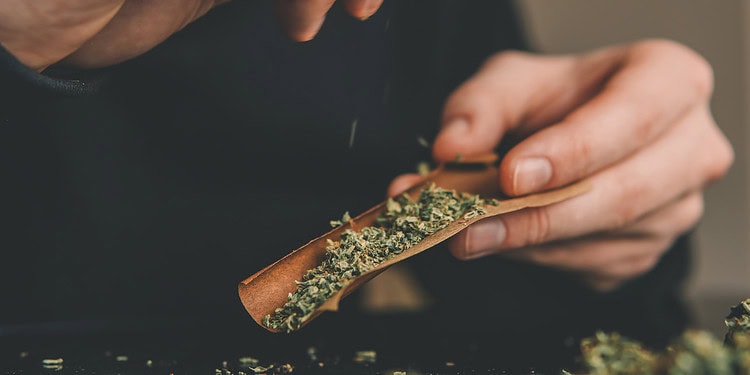

Adults who use cannabis are more likely to report loud snoring and pauses in breathing during the night, according to new research published in Sleep Health: Journal of the National Sleep Foundation. The findings indicate that more frequent cannabis consumption corresponds with higher odds of experiencing these nocturnal breathing issues, even after accounting for factors like body weight and tobacco smoking. This relationship raises important questions for the growing number of people who turn to cannabis as a sleep aid.
Sleep-disordered breathing is an umbrella term for medical conditions characterized by abnormal respiratory patterns or insufficient ventilation during rest. The most common form is obstructive sleep apnea, a disorder in which the muscles in the back of the throat relax too much, causing the upper airway to narrow or collapse entirely. People with this condition require extra physical effort to breathe, often resulting in loud snoring, gasping, or brief, repeated stops in breathing known as apneas. Standard treatments like continuous positive airway pressure machines, oral appliances, and surgery can be effective, yet many patients find the devices uncomfortable or difficult to tolerate over the long term.
At the same time, cannabis has become increasingly accessible across the United States, and difficulty sleeping is one of the most common reasons people cite for using it. While users frequently report that the plant helps them rest, controlled clinical trials examining cannabinoids and sleep have produced mixed outcomes.
For example, a 2023 clinical trial covered by PsyPost found that consuming medicinal cannabis oil improved sleep duration and increased midnight melatonin levels in adults with insomnia, whereas a study covered by PsyPost in 2024 indicated that a cannabis compound called cannabinol reduced nighttime awakenings when taken alone but showed no benefit when combined with cannabidiol, another cannabis compound. Observational tracking also points to potential drawbacks, such as a 2026 longitudinal study of military service members that linked current cannabis use to worse overall sleep quality and longer times needed to fall asleep.
When it comes to breathing disorders specifically, tetrahydrocannabinol, the primary psychoactive compound in cannabis, has shown some potential to stabilize breathing in animal experiments and small human trials using oral pills. However, the broader clinical evidence remains inconsistent, leading the American Academy of Sleep Medicine to formally advise against using cannabis to treat obstructive sleep apnea. Most everyday consumers inhale cannabis rather than taking standardized pills, exposing their airways to smoke and heat that could inflame the tissues of the throat.
The new research, led by Tyler J. Gallagher, a resident physician in the Caruso Department of Otolaryngology-Head and Neck Surgery at the Keck School of Medicine of the University of Southern California, and co-first author Matthew E. Lin of the David Geffen School of Medicine at the University of California, Los Angeles, sought to evaluate how everyday consumption relates to signs of breathing issues at night.
“While some studies have explored cannabinoids as potential treatments for obstructive sleep apnea, there has been relatively little population-level research examining whether real-world cannabis use is associated with common signs of sleep-disordered breathing, such as loud snoring and pauses in breathing during sleep,” Gallagher told PsyPost. “We sought to better understand this relationship using a nationally representative sample of US adults.”
To investigate this connection, the authors analyzed information from the 2017 to 2018 Behavioral Risk Factor Surveillance System, a state-based telephone survey coordinated by the Centers for Disease Control and Prevention. Although nearly 900,000 adults completed the main survey during those two years, only Minnesota and Tennessee included optional survey modules asking about both cannabis habits and sleep breathing symptoms. From the respondents in those two states who had complete data, the researchers selected a stratified random sample of 14,485 adults designed to match the demographic profile of the broader United States population.
Participants were asked how many days they had used marijuana or cannabis during the past 30 days, as well as their primary method of consumption and whether they used it for medical or recreational purposes. The researchers grouped the respondents into three categories: non-users (zero days in the past month), non-regular users (1 to 15 days), and regular users (16 to 30 days). Signs of sleep-disordered breathing were assessed using two yes-or-no questions asking if anyone had ever observed the respondent stop breathing during sleep, and if the respondent had ever been told that they snore loudly.
Of the participants, 13,461 reported no current cannabis use, 438 were classified as non-regular users, and 364 were regular users, meaning about 5.5 percent of the sample currently used cannabis. Smoking was by far the most common consumption method, reported by about 87 percent of both non-regular and regular consumers, followed by vaporizing and eating. Among non-regular users, 61.6 percent used cannabis strictly for recreational reasons, whereas 37.6 percent of regular users reported using it strictly for medical reasons and another 24.7 percent used it for both medical and recreational purposes.
Overall, signs of sleep-disordered breathing were common across the entire cohort, with 44.7 percent reporting either loud snoring or witnessed apneas. In the unadjusted raw numbers, 44.3 percent of non-users reported at least one of the two breathing signs, compared to 48.4 percent of non-regular users and 55.2 percent of regular users. Specifically, witnessed breathing pauses were reported by 15.3 percent of non-users, 17.1 percent of non-regular users, and 19.8 percent of regular users. Loud snoring was reported by 41.3 percent of non-users, 44.5 percent of non-regular users, and 50.0 percent of regular users.
To account for other differences between users and non-users, the researchers ran statistical models that applied national survey weights (statistical adjustments that make a sample better mirror the U.S. adult population) and controlled for a wide range of potentially confounding factors. These adjustments accounted for age, sex, race and ethnicity, education, income, health insurance status, diabetes, body mass index, alcohol consumption, traditional cigarette smoking, and electronic cigarette use. Even after factoring out the influence of tobacco smoking and body weight, cannabis use remained independently associated with higher odds of sleep-disordered breathing symptoms.
Compared to non-users, non-regular cannabis users had 41 percent higher odds of reporting witnessed apneas, 26 percent higher odds of reporting loud snoring, and 33 percent higher odds of experiencing either symptom. The association was more pronounced among regular consumers. Those who used cannabis 16 to 30 days per month had 73 percent higher odds of witnessed apneas, 68 percent higher odds of loud snoring, and 82 percent higher odds of reporting either sign compared to non-users. These figures describe odds rather than probabilities, so the absolute differences are smaller than the percentages might suggest; in the raw numbers, about 55 percent of regular users reported at least one sign, compared with about 44 percent of non-users.
“While the impact of infrequent use is relatively small, the odds of irregular breathing during sleep almost double with more frequent cannabis use, making this a strong association worthy of consideration before frequent cannabis utilization,” Gallagher explained.
The researchers also analyzed cannabis consumption as a continuous spectrum from zero to 30 days. In the weighted models, each additional day of cannabis use per month was associated with an approximate 2 percent increase in the odds of reporting witnessed apneas, loud snoring, or either sign, an estimate the authors note is clinically small and serves as a general summary across use levels rather than a strict per-day effect. When the authors repeated the analysis without the national survey weights, regular cannabis use remained linked to both breathing signs, though the estimates were smaller (for example, 36 percent higher odds of either sign rather than 82 percent). In that analysis, non-regular use was no longer linked to loud snoring or to either sign, and its link with witnessed breathing pauses sat right at the threshold of statistical significance.
“The strength of the association and its greater magnitude among more frequent users were notable, particularly given that some studies have investigated cannabinoids as potential treatments for sleep apnea,” Gallagher said. “These findings may reflect differences between isolated cannabinoids studied in clinical settings and real-world cannabis use, including differences in composition and method of consumption.”
The authors proposed two primary biological mechanisms that might explain why cannabis consumers report more signs of airway obstruction at night. Because roughly 87 percent of the consumers in the sample smoked their cannabis, physical irritation from smoke is one possible contributor. Unlike tobacco, cannabis smoke is typically inhaled through deeper breaths without a filter, and it burns at a higher temperature, which can cause thermal injury and inflammation in the throat tissues that narrow the upper airway.
A second potential mechanism involves the way cannabis interacts with the autonomic nervous system, which regulates involuntary body functions. While small doses of cannabis tend to stimulate the sympathetic nervous system, the body’s “fight or flight” system, higher doses activate the parasympathetic nervous system, which promotes physical relaxation. Frequent users may develop tolerance and consume larger quantities, and the resulting parasympathetic activity may cause the muscles that hold the upper airway open to relax excessively during sleep, making the throat more likely to collapse.
There are a few things to keep in mind when interpreting these findings. Because the survey captured information at a single point in time, the study cannot establish whether cannabis use causes sleep-disordered breathing or if the relationship works in the opposite direction. People who suffer from undiagnosed sleep apnea often experience fragmented, unrefreshing sleep, and it is possible that some of these individuals turn to cannabis in an attempt to self-medicate their exhaustion or insomnia. The researchers also could not account for factors such as sleeping pill or sedative use, heavy drinking, or psychiatric conditions, any of which might influence both cannabis use and nighttime breathing.
The reliance on self-reported telephone survey data also introduces constraints. Asking participants if they have been told they snore or stop breathing is less reliable than conducting an overnight medical sleep study, and people who sleep alone may be unaware of their nighttime breathing habits. Additionally, the survey only tracked how many days a person used cannabis over the past month, without measuring the exact dosage, potency, or ratio of specific compounds like tetrahydrocannabinol and cannabidiol.
The data came from just two states, Minnesota and Tennessee, because they were the only ones to include both sets of questions, and roughly 98 percent of the original survey respondents were excluded for that reason or because of missing information. Survey weights help align the sample with national demographics, but the authors note that applying them to such a small subset is debated among statisticians. In addition, the breathing questions asked whether these symptoms had ever been observed, while the cannabis question covered only the past month, so some symptoms may have predated participants’ current cannabis habits.
Gallagher emphasized that reporting these symptoms is not the same as receiving a formal medical diagnosis. “While obstructive sleep apnea – a clinically defined and hazardous intermittent airway obstruction during sleep – is a type of sleep-disordered breathing, this study cannot make conclusions about the association between cannabis use and sleep apnea or other associated long-term risks,” he noted.
Future research will need to incorporate objective sleep testing, such as polysomnography, an overnight sleep study that monitors breathing, oxygen levels, and brain activity, to verify whether cannabis habits correspond with clinically diagnosed sleep apnea. Scientists also need to compare different delivery methods, such as edibles versus inhalation, to separate the chemical effects of cannabinoids on throat muscles from possible damage from inhaling hot smoke.
“Further research is required to examine the long-term effects of cannabis use on sleep and to determine the effects of cannabis dosage, different cannabis compositions, and different methods of consumption on sleep-disordered breathing,” Gallagher said. “Additionally, the long-term consequences of these impacts must be studied.”
Until those relationships are clarified, the authors suggest that physicians should counsel patients about the potential respiratory risks of using cannabis, particularly for individuals who already show signs of sleep-disordered breathing. “People experiencing persistent snoring, pauses in breathing, or other symptoms of sleep apnea should seek medical evaluation rather than trying to utilize cannabis to manage their sleep,” Gallagher advised.
“This study highlights the importance of evaluating the broader health effects of substances that people increasingly use for self-management,” Gallagher added. “Cannabis may have benefits for certain symptoms or conditions, but those potential benefits should be considered alongside possible risks. Sleep-disordered breathing is particularly important because it can go unrecognized for years while causing significantly worse quality-of-life. We hope these findings encourage further research and help clinicians have more informed conversations with patients who use cannabis for sleep-related concerns.”
The study, “Cannabis use and associated sleep-disordered breathing among US adults,” was authored by Tyler J. Gallagher, Matthew E. Lin, Ian Kim, Ziva D. Cooper, Sebastian M. Jara, and Eric J. Kezirian.