![[Adobe Stock]](https://sp-ao.shortpixel.ai/client/to_webp,q_glossy,ret_img,w_750,h_375/https://www.psypost.org/wp-content/uploads/2024/11/psychedelic-psilocybin-mushrooms-1-750x375.jpg)
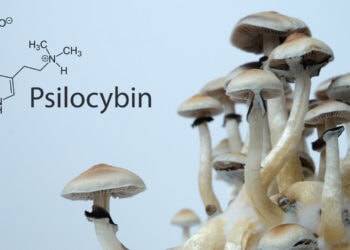
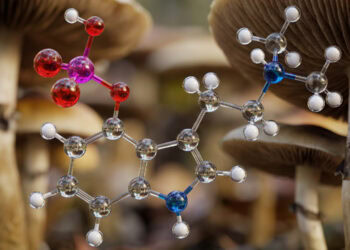
Psilocybin, the psychedelic substance found in magic mushrooms, is a promising new treatment for psychiatric disorders, especially depression. The beneficial effects on mood and anxiety of psilocybin are rapid and pronounced after just a single treatment. A small study even suggested that these benefits remain after a year.
But what is really needed is a comparison of the long-term effect of psilocybin with another treatment (an antidepressant) or a placebo. Ideally, neither participants nor staff should be aware of who was given what – this is known as “double blind” and is used to remove bias in studies. Recently, a first such attempt was summarised in a published report. It is a six-month follow-up of a short psilocybin trial published in 2021.
The original study ran for six weeks and included a group of 59 depressed patients, who were randomly allocated to receive either two doses of psilocybin or daily escitalopram, a commonly prescribed antidepressant. After six weeks, both groups showed reduced depression symptoms, without a difference between the groups.
Now, outcomes at six months have been reported. Depressive symptoms were not found to be different between the psilocybin group and escitalopram at the end of this period. However, some differences were found between the groups, such as greater social functioning and increased meaning in life in the patients receiving psilocybin.
Social functioning was measured using a questionnaire where participants can indicate how much their mental health interfered with their ability to work, manage their home, be sociable and enjoy hobbies. Psilocybin seemed to mainly improve social functioning, but not the ability to work.
Similarly, “meaning in life” was also measured with questionnaires, where the participants indicate how much they agree with statements like: “My life has a clear sense of purpose” and “I have discovered a satisfying life purpose.” Patients who were treated with psilocybin answered these questions more positively than those treated with escitalopram.
Not enough to draw conclusions
It would be tempting to conclude from this study that psilocybin works just as well as commonly described antidepressants in the long term. Unfortunately, the data from this study is insufficient to draw that conclusion. A much larger sample of participants is needed.
Also, many patients (63%) had other treatments in those six months, such as psychotherapy, antidepressants or used psychedelics. Because of the small number of participants and the study design, especially since the need for alternative treatments were not well monitored, the results from this study cannot be used to draw any hard conclusions on the long-term effect of psilocybin.
However, this study is a good example of the tendency of the field to shift away from only looking at short-term antidepressant effects. Many early studies on psilocybin focused on the first few weeks after treatment. More and more studies now follow patients for months or even a year after treatment to see how they fared.
Monitoring the duration of the effect of psilocybin for a minimum of 12 weeks, but ideally up to a year, has also been indicated as an important consideration for clinical investigation into the effectiveness of psychedelic drugs by the US Food and Drug Administration. The European Medicines Agency makes the same point.
Results from the long term will also be vital in determining the safety and cost-effectiveness of psilocybin, given that the treatment needs to be administered in a hospital. This is surely more costly than prescribing antidepressants that can be taken at home.
This article is republished from The Conversation under a Creative Commons license. Read the original article.