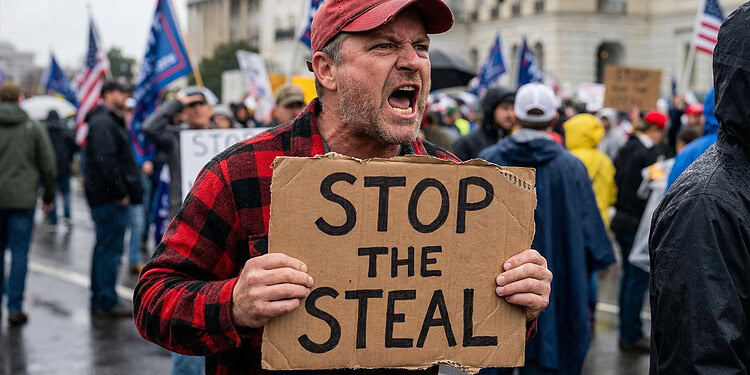

Recent research published in the journal Party Politics suggests that a person’s underlying political beliefs strongly influence whether doubting the integrity of an election will drive them to participate in politics outside of the voting booth. The findings indicate that conservative voters tend to become more politically active when they distrust election systems, whereas liberal voters tend to participate at higher rates regardless of their trust levels.
Political scientists Erin B. Fitz and Kyle L. Saunders from Colorado State University conducted the new research to better understand the relationship between election trust and political behavior. Their work focuses specifically on non-voting political participation. This type of participation includes activities outside of casting a ballot, such as attending protests, signing petitions, donating money to campaigns, or attending political meetings.
The authors sought to explore how ideological differences change the way people react to claims of election fraud. To do this, they relied on a concept known as operational ideology. Operational ideology refers to what people actually believe the government should do when it comes to specific policies, such as taxation or healthcare.
This concept is distinct from symbolic ideology or partisan identity. Symbolic ideology represents the labels people give themselves, such as calling oneself a conservative or a liberal. Because operational ideology captures a person’s concrete policy preferences, it often serves as a foundational anchor for their broader political worldview.
The authors explain that politicians and elites often use specific messaging, or cues, to motivate their base. If conservative voters are naturally less inclined to participate in non-voting political activities, political leaders might need to find alternative ways to engage them. By sowing doubt about the fairness of an election, leaders might successfully incite anger or urgency, which can inspire supporters to donate to campaigns or attend rallies.
Fitz and Saunders previously analyzed survey data from the 2020 election. In that prior work, they found that operational liberals were generally more politically active outside of voting. They also observed that operational conservatives became much more active when they lost trust in the election process.
Between the 2020 and 2024 elections, the American political landscape underwent significant transformations. The coronavirus pandemic, which dramatically altered how people voted in 2020, had largely abated. Several states also revised their laws regarding early voting and mail-in ballots.
Additionally, numerous lawsuits attempting to overturn the 2020 election results were dismissed in court. Federal prosecutors also convicted hundreds of individuals involved in the attack on the United States Capitol that occurred on January 6, 2021. Because of these monumental shifts, Fitz and Saunders wondered if the strong connection between conservative distrust and political participation would fade away or if it had become a permanent fixture of American politics.
To investigate these dynamics during the 2024 election, Fitz and Saunders utilized survey data from the American National Election Study. This large-scale survey captures the political attitudes and behaviors of citizens across the United States. The researchers first analyzed a sample of 4,256 respondents from the 2024 survey.
They measured operational ideology by averaging each respondent’s self-reported preferences across seven different policy issues. This created a scale ranging from operationally liberal to operationally conservative. To measure trust in elections, the authors combined responses to two questions asked before the election.
These specific questions asked respondents how much they trusted election officials and whether they believed votes would be counted accurately. Measuring trust before the election takes place helps prevent the survey from merely capturing voters’ reactions to their preferred candidate winning or losing. Finally, the researchers measured non-voting political participation by counting how many of twelve different political activities each respondent reported engaging in.
The statistical models included adjustments for factors like age, education, income, race, and the strength of a person’s political party identification. The results from the 2024 data replicated the authors’ previous findings from 2020. Operational liberals were associated with higher levels of non-voting political participation overall, and their participation did not significantly change based on their trust in elections.
On the other hand, the relationship between election trust and political participation was entirely different for operational conservatives. Operational conservatives who trusted the election process engaged in the lowest levels of non-voting political participation. However, conservatives who reported low trust in elections engaged in significantly more of these political activities.
This finding suggests that distrust acts as a mobilizing force primarily for conservative voters. To better understand why these patterns persist, Fitz and Saunders took their analysis a step further. They examined a subset of 1,857 individuals who participated in the American National Election Study in both 2020 and 2024.
Following the same group of people over four years allows scientists to track how attitudes and behaviors influence one another across time. The researchers used statistical models to test whether a person’s ideology in 2020 predicted their election trust and participation in 2024, or if the reverse was true. The tracking data provided evidence that operational ideology acts as a stable foundation that shapes future attitudes.
Specifically, holding a more liberal operational ideology in 2020 was associated with greater trust in elections and higher non-voting political participation four years later. Holding a more conservative operational ideology in 2020 predicted lower trust and lower participation in 2024. Importantly, a person’s level of trust or participation in 2020 did not significantly alter their operational ideology in 2024.
This indicates that policy preferences tend to remain stable and guide how individuals interpret political events over time. Trust and participation appear to be downstream effects of these deeply held ideological commitments. The researchers noted that these differences are not just a reflection of party loyalty, as their models accounted for the strength of participants’ partisan identities.
Readers should avoid misinterpreting these findings as absolute proof that election distrust will always mobilize conservatives in every political context. The findings rely on data from two consecutive elections featuring Donald Trump, a candidate who heavily emphasized narratives of voter fraud. The continuous presence of these specific political cues may have uniquely influenced conservative voters during this period.
The authors note that the study relies on self-reported survey data, which can sometimes be influenced by respondents’ desire to provide socially acceptable answers. The statistical models tracking people over time also cannot definitively prove that ideology causes changes in trust, only that the two are reliably linked. There may be other underlying psychological factors connecting policy preferences to election skepticism that these surveys do not capture.
Future research should investigate whether these patterns appear in local or state elections where national political figures are not involved. Scientists might also explore how voters react in election cycles where election integrity is not a dominant theme in media coverage or political speeches. Continuing to track these voters could help determine if a decisive change in political leadership eventually alters these deeply entrenched views on election security.
High levels of political participation and trust are typically viewed as signs of a functioning democracy. This research suggests that participation can sometimes be driven by a fundamental distrust of democratic processes, complicating how we measure the stability of a political system.
The study, “Ideological asymmetries of trust in elections and non-voting political participation,” was authored by Erin B. Fitz and Kyle L. Saunders.