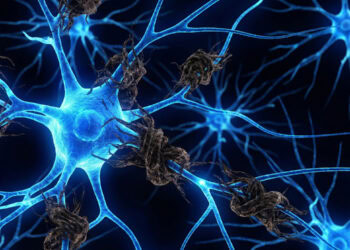
![Abnormal levels of the beta-amyloid protein clump together to form plaques (seen in brown) that collect between neurons and disrupt cell function. Abnormal collections of the tau protein accumulate and form tangles (seen in blue) within neurons, harming synaptic communication between nerve cells. [Photo credit: NIH]](https://sp-ao.shortpixel.ai/client/to_webp,q_glossy,ret_img,w_750,h_375/https://www.psypost.org/wp-content/uploads/2021/10/Beta-Amyloid-Plaques-and-Tau-in-the-Brain-750x375.jpg)
A new study published in the journal Alzheimer’s & Dementia reports that a novel vaccine targeting a toxic form of the tau protein generated a strong and long-lasting immune response in mice and monkeys. The vaccine, which uses a virus-like particle to display a key phosphorylated tau fragment, reduced the buildup of pathological tau in the brain, prevented brain shrinkage, and improved memory performance in mice prone to tau-related neurodegeneration. These results offer a potential path forward for treating Alzheimer’s disease and other tauopathies with an approach that could be longer-lasting and more cost-effective than current antibody-based therapies.
The research was motivated by ongoing failures in developing effective treatments for Alzheimer’s disease, especially therapies targeting tau protein. Tau forms tangles in the brains of patients with Alzheimer’s and related disorders, and one specific version of tau—phosphorylated at threonine 181 (pT181)—is known to appear early in disease progression.
While monoclonal antibody therapies have recently gained approval for targeting amyloid beta, efforts to develop antibodies against tau have often failed in human trials. In addition to limited efficacy, antibody treatments are expensive and require repeated intravenous infusions. The researchers behind this new study aimed to overcome those barriers by designing a vaccine that could train the immune system to produce its own antibodies against pT181.
“I am interested in developing a vaccine for Alzheimer’s disease because, when I was young, my grandfather had late-stage confusion and dementia,” said study author Kiran Bhaskar, a professor at the University of New Mexico School of Medicine, director of the Brain and Behavioral Health Institute, and co-director of the New Mexico Alzheimer’s Disease Research Center. “At that time, we didn’t even know that his state of confusion was due to Alzheimer’s disease or another type of dementia. Since I got my PhD in neuropathology in 2002, I’ve been working on this topic, and ever since, my team has been trying to understand the disease mechanisms and find a cure.”
To create the vaccine, the team attached a synthetic version of the pT181 tau fragment to the surface of a virus-like particle (VLP) derived from the Qß bacteriophage. These VLPs mimic the structure of real viruses without carrying infectious material, making them a powerful tool for presenting antigens to the immune system. The resulting vaccine, called pT181-Qß, was tested in several animal models of tauopathy, including two different strains of genetically modified mice and a small group of rhesus macaques.
In one set of experiments, mice engineered to develop severe tau pathology (PS19 model) received two intramuscular doses of either the pT181-Qß vaccine or a control treatment. The researchers measured antibody levels, brain pathology, and behavior over several months. Mice that received the pT181-Qß vaccine produced high levels of antibodies targeting pT181, and these levels remained elevated months after the final injection. These mice showed less tau buildup in the hippocampus and cortex, areas of the brain important for memory and learning. They also had fewer tau tangles, reduced brain inflammation, and less brain atrophy, as measured by MRI scans.
“We all age and continue to live longer than our parents and grandparents,” Bhaskar told PsyPost. “Age is the main risk factor for dementia. Without a cure, many of us will end up having either Alzheimer’s disease or another type of dementia. In fact, 1 in 2 people over the age of 80 is diagnosed with Alzheimer’s disease or another type of cognitive disability.”
“Lately, there are reliable blood markers that can detect the disease 10–20 years before the onset of clinical symptoms. When we have this window of opportunity to treat and prevent the disease—or delay its onset—with a vaccine approach, we may have a better quality of life later on as we age.”
Bhaskar and his colleagues observed similar benefits in another mouse model (hTau mice), which expresses non-mutated human tau and mimics features of late-onset Alzheimer’s disease. In these animals, the vaccine again led to strong anti-pT181 antibody responses and reduced tau pathology, including a decline in a key inflammation-related protein (ASC). Mice that received the vaccine also performed better in a Y-maze memory test, suggesting that targeting pT181 helped preserve cognitive function.
To assess the safety and effectiveness of the vaccine in a species more closely related to humans, the scientists also vaccinated six adult rhesus macaques. Three received the experimental vaccine and three received a control. The vaccinated monkeys developed high levels of antibodies against pT181, which were also detected in their cerebrospinal fluid—suggesting the antibodies crossed into the brain. No adverse effects were reported, and extensive blood tests and tissue analysis after death showed no signs of toxicity or immune-related damage.
“Because our approach is built on a dummy virus as a means to attach tau protein—which forms tangles in the brains of people with Alzheimer’s—and then inject it as a vaccine to trick the immune system into thinking that there is a viral attack, which then leads to the production of antibodies against tau, we thought it might cause some unwanted side effects,” Bhaskar explained. “Surprisingly, in three mouse models of Alzheimer’s disease we tested, and also in the rhesus macaques, we did not see any major changes in blood biochemistry or blood cell counts. But the vaccine did the job it was supposed to do—reducing tangles in the brain and improving memory.”
Importantly, the researchers also showed that the antibodies generated by the vaccine were able to bind to tau found in the brains of human Alzheimer’s patients. Using tissue samples from deceased donors and blood from patients with mild cognitive impairment, they found that the vaccine-induced antibodies could detect pT181 and immunoprecipitate tau from human brain lysates. This suggests that the vaccine’s antibodies could recognize the same pathological targets in humans as they did in the animal models.
Although the results in animal models are promising, mouse and monkey brains differ from those of humans, especially in the context of age-related neurodegeneration.
“Humans are not mice,” Bhaskar said. “Although the vaccine worked great even in monkeys in terms of safety and making the antibodies against ‘bad’ tau, until we test it in humans, we always face uncertainties about whether it will work because of the high degree of variability due to various factors.”
One of the main challenges is funding the production of clinical-grade vaccine batches, which can cost millions of dollars. The researchers hope to pursue a combination vaccine strategy similar to existing multivalent vaccines, like Gardasil-9 for human papillomavirus (HPV). Their vision includes targeting multiple forms of tau, amyloid beta, and neuroinflammatory molecules in a single shot to better address the complex biology of Alzheimer’s disease.
“We have an array of ‘bad’ tau-targeting vaccines that we’d like to test as a combination vaccine,” Bhaskar explained. “For example, the FDA-approved vaccine Gardasil-9, which is typically given to teenagers, is also built on this ‘dummy’ virus-like particle platform. It has a cocktail of nine different vaccines targeting different strains of HPV. We want to develop a similar cocktail vaccine approach for Alzheimer’s disease by combining vaccines that target different types of ‘bad’ tau, amyloid beta, and brain inflammation—all of which we are also developing in my lab. That way, the major drivers of dementia—at least in Alzheimer’s disease, which is likely caused by amyloid beta, tau, and inflammation—can be removed from the brain.”
“It costs about $4–5 million just to make a small amount of clinical-grade vaccine for clinical trials. We are trying to find funding to get this off the ground. Until we do human testing, no big pharmaceutical company is likely to risk joining our team. We are now in a ‘gap’ period and really bootstrapping in terms of funding.”
The study, “Targeting of phosphorylated tau at threonine 181 by a Qβ virus-like particle vaccine is safe, highly immunogenic, and reduces disease severity in mice and rhesus macaques,” was authored by Nicole M. Maphis, Jonathan Hulse, Julianne Peabody, Somayeh Dadras, Madelin J Whelpley, Manas Kandath, Colin Wilson, Sasha Hobson, Jeff Thompson, Suttinee Poolsup, Danielle Beckman, Sean P Ott, Jennifer W. Watanabe, Jodie L. Usachenko, Koen K Van Rompay, John Morrison, Reed Selwyn, Gary Rosenberg, Janice Knoefel, Bryce Chackerian, and Kiran Bhaskar.