
When first-time fathers watch videos of their own infants, specific brain regions activate in ways that differ from how they respond to unfamiliar babies—or even their pregnant partners. A new study published in Human Brain Mapping offers evidence that fatherhood reshapes the brain in ways that may support sensitive caregiving. The research provides insight into how regions involved in social understanding, emotion regulation, and reward processing are tuned to the unique salience of one’s own child.
While previous research has shown that parents tend to respond more strongly to their own children than to unfamiliar infants, most of this work has focused on mothers. Far less is known about how fathers’ brains adapt to the demands of caregiving. The new study — led by Philip Newsome, an incoming third-year PhD student at the University of Southern California, and Anthony Vaccaro, a research professor at the University of North Carolina at Chapel Hill — aimed to fill that gap.
“For a little over 20 years, scientists have been studying how mothers’ brains respond to viewing their own infant as a way to understand how biology supports the social and emotional demands of parenting. But compared to mothers, far fewer studies have looked at fathers,” said Newsome, who works in the Neuroendocrinology of Social Ties Lab, directed by Darby Saxbe, the senior author of the paper.
“In addition, prior studies have often looked at how parents respond to their own infant versus an unfamiliar infant, but it remained unclear if those responses were specific to their baby or if they simply reflected brain responses to a person they know and love. So, we designed a task that included own-infant, unfamiliar-infant, and romantic partner videos to try and tease apart these often-overlapping dimensions.”
The study included 32 first-time fathers from the Los Angeles area. All were scanned using functional MRI approximately eight months after the birth of their child. During the scan, the fathers watched short video clips showing either their own baby, an unfamiliar baby, their pregnant partner, or an unfamiliar pregnant woman. The videos were naturalistic and silent, displaying faces and upper bodies with a range of emotional expressions. Fathers were asked to rate the emotional valence of each video to ensure they were paying attention.
These same fathers had previously filled out questionnaires measuring prenatal bonding with their unborn child, postpartum bonding, parenting stress, and bonding difficulties. The researchers examined whether neural responses to the videos were related to these self-reported parenting experiences.
The research team used two types of brain imaging analyses. First, they applied traditional univariate analysis to identify regions with higher average activation during specific conditions (e.g., own infant versus unfamiliar infant). Then they employed multivariate pattern analysis (MVPA), which examines spatial patterns of activation across brain regions rather than just the overall intensity, to determine whether the brain could distinguish between different types of stimuli.
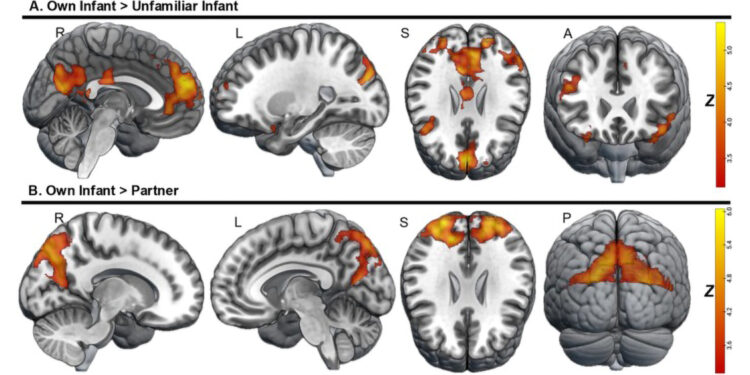
The researchers found that fathers showed stronger activation to videos of their own baby compared to unfamiliar babies in several brain regions. These included the precuneus and posterior cingulate cortex—areas associated with social cognition and self-referential processing—as well as the orbitofrontal cortex and inferior frontal gyrus, which are linked to emotion and reward.
When the researchers compared fathers’ responses to their own baby versus their own partner, they again saw heightened activation in the precuneus. This region appears to play a central role in processing information that is both socially relevant and personally significant, supporting the idea that the paternal brain is especially attuned to cues from one’s own child.
Notably, brain responses in these regions varied depending on the father’s reported parenting experience. Fathers who reported stronger prenatal and postpartum bonding, and less parenting stress, tended to show greater activation in the precuneus and posterior cingulate cortex when viewing their own infant. This suggests that these neural responses may reflect not just general social or emotional processing, but also the depth of the father’s psychological connection to their child.
Unexpectedly, however, brain activation was unrelated to the amount of time fathers spent as the infant’s primary caregiver or the infant’s age at the time of the scan.
“We were somewhat surprised that fathers’ brain responses weren’t linked to their caregiving experience, like time spent as the primary caregiver,” Newsome told PsyPost. “Notably, it’s possible that our relatively small sample limited our ability to detect such associations.”
Multivariate pattern analysis revealed additional findings. Brain regions involved in visual processing, social cognition, and reward—including the parahippocampus, orbitofrontal cortex, and anterior prefrontal cortex—could distinguish between viewing one’s own infant and other conditions. When the researchers trained a classifier to differentiate between infant and adult stimuli, or between familiar and unfamiliar stimuli, they found above-chance accuracy in several areas, including the superior temporal gyrus, middle temporal gyrus, and occipital cortex.
Although these areas overlap with those identified in studies on mothers, the results suggest that fathers’ neural responses may be especially centered in cortical areas associated with mentalizing—interpreting the thoughts, feelings, and intentions of others. This may reflect the need for fathers to infer their infants’ needs, given that babies are preverbal and rely on caregivers to interpret their signals.
The findings indicate that “fathers’ brains responded uniquely to their own infant (compared to seeing an unfamiliar infant or their partner), particularly in regions supporting the ability to regulate emotions, process rewards, and interpret others’ thoughts and feelings,” Newsome explained. “In addition, these ‘own-infant brain responses’ were linked to how bonded the father felt to their infant and how stressed they were in the initial months of parenthood.”
While the study offers evidence of distinct neural tuning to one’s own child in first-time fathers, it does come with limitations. The sample size, though larger than in some previous parenting studies, remains modest and includes primarily highly educated families from Southern California, which may limit generalizability.
Additionally, while comparing infant and partner stimuli helped tease apart self-relevance and social affiliation, videos of the partners were recorded during pregnancy, introducing a possible confound due to differences in timing and context. The study also lacked a control group of non-fathers, making it difficult to determine whether the observed effects are specific to parenthood.
“Our sample size of 32 is comparable to other parenting fMRI studies out there, but it is still relatively small, so smaller effects may have gone unnoticed,” Newsome said. “It will be important for future work to replicate our findings in larger samples to ensure generalizability.”
“Future analyses with these data will focus on participants’ brain responses to their partner and how these responses relate to relationship characteristics, such as relationship quality. We are also working on analyses that assess how participants’ responses change from the prenatal period to after their baby is born.”
The study, “My Baby Versus the World: Fathers’ Neural Processing of Own‐Infant, Unfamiliar‐Infant, and Romantic Partner Stimuli,” was authored by Philip Newsome, Anthony G. Vaccaro, Sofia I. Cárdenas, Narcis A. Valen, Yael H. Waizman, Elizabeth C. Aviv, Gabriel A. León, Jonas T. Kaplan, and Darby E. Saxbe.