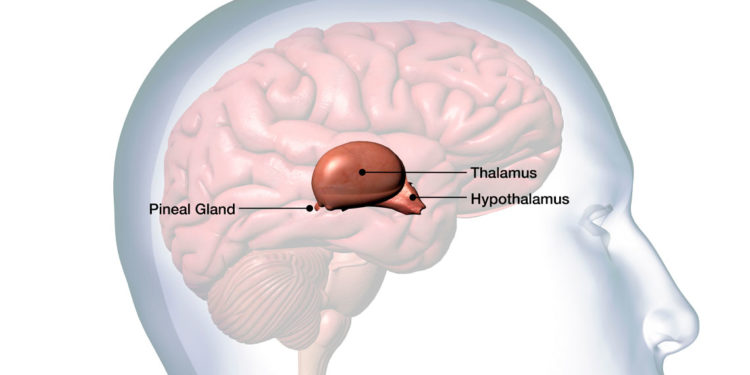

A neuroimaging study in Germany found that people with a higher body mass index (BMI) — people who are overweight or obese — tend to show activity patterns in the hypothalamus region of the brain that indicate alterations to the microstructure of this brain region compared to people with lower body mass index values. The findings show that there are changes in the area of the brain that is responsible for the balance between food intake and energy expenditure by the body in people with excessive weight. The study was published in Scientific Reports.
Body mass index (BMI) is a measure that combines a person’s height and weight to determine whether a person is underweight, normal weight or overweight. It is one of the most common ways to diagnose obesity. Obesity, abnormal or excessive fat accumulation, presents a serious risk to one’s health. Persons whose body mass index is above 25 are considered overweight, while those with BMI over 30 are considered obese.
In the past decades, the world has seen an epidemic of obesity. World Health Organization estimates that 13% of the world’s adult population was obese in 2016. There are large differences in the occurrence of obesity between countries that are due to differences in lifestyles and diets. In countries like the island nations of Cook Islands and Nauru, more than 50% of adult population is considered obese, while the percentage of obese people is less than 5% in countries like Vietnam, Bangladesh or India. In the US, 41.9% of adults are considered obese.
Obesity is associated with dysfunctions in regulating energy homeostasis i.e. the balance between food intake and energy expenditure by the body. Studies in animals have shown that eating high-fat food triggers an inflammation-like response in the hypothalamus area of the brain. This impairs the sensing of body signals that tell the person that he/she should stop eating, making the person continue to eat, which leads to weight gain. It is however, not clear whether these changes are permanent or temporary.
To study whether there are permanent changes to brain regions that regulate energy homeostasis, the authors of the new research conducted a study using a sample of 338 participants selected out of a sample of 2,637 adults who went through magnetic resonance imaging of their brains for a wider scientific study. They additionally analyzed data of another 236 participants who had magnetic resonance images of their abdomens done.
The researchers measured body weight and height of participants and they used it to calculate their body mass indexes (weight in kilograms divided by the square of their height in meters). Participants also had their blood pressure measured and obesity-related biomarkers were estimated from blood samples (glucose and insulin levels). All participants underwent magnetic resonance imaging of their brains and their abdomens.
“On average, men showed 4.4% larger, head-size adjusted, whole hypothalamic volumes than women,” authors report. When considering the relationship between body mass index of participants and the microstructure of the hypothalamus, authors report that higher body mass index was related to higher mean diffusivity of the hypothalamus, a finding that is typically interpreted as “less intact cellular microstructure.”
The researchers examined another sample of 236 participants to validate this finding and results again showed that higher body mass index was linked to higher hypothalamus mean diffusivity. The changes were of similar size as on the first sample and were unrelated to age and sex of the participant. Hypothalamus mean diffusivity was also linked to the volume of the visceral adipose tissue i.e., fat stored deep inside the belly of the person, wrapped around the organs, such as liver and intestines.
“This finding thus points to persisting microstructural alterations in a key regulatory area of energy homeostasis occurring with excessive weight. The underlying mechanisms might include inflammatory activity, neuronal degeneration or angiopathy in the hypothalamus due to obesity-related overnutrition and metabolic alterations,” study authors conclude.
The study provides novel insights into neural mechanisms underpinning obesity. However, it should be noted that the study design does not allow for cause-and-effect conclusions and that it still remains unknown how the observed changes to the brain structure develop.
The study, “Higher body mass index is linked to altered hypothalamic microstructure”, was authored by K. Thomas, F. Beyer, G. Lewe, R. Zhang, S. Schindler, P. Schönknecht, M. Stumvoll, A.Villringer, and A.V.Witte.